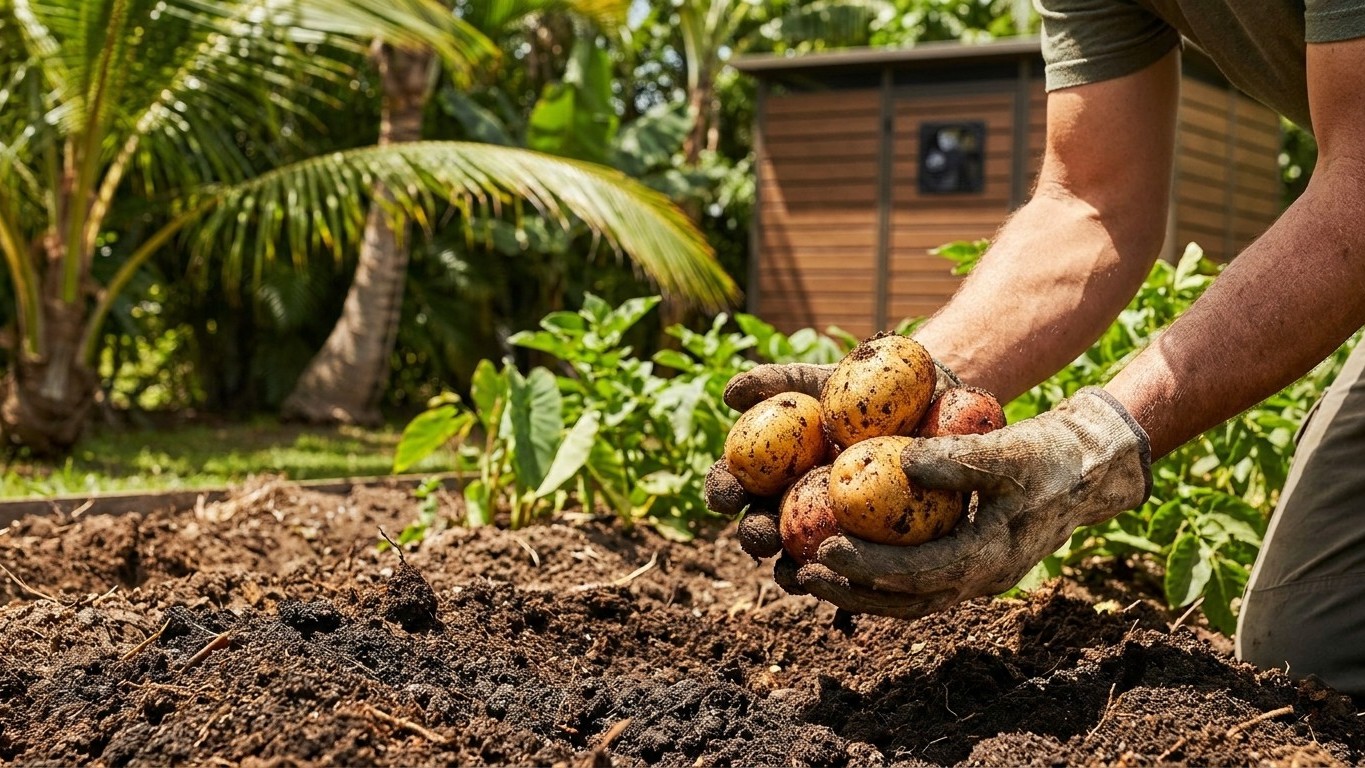

Hawaii’s potato answer isn’t about frost, it’s about heat. There’s no freeze season here to schedule around, and the state’s coldest month still averages a 66.8°F low. That single number rules out both curing and cold storage in an unheated space, so the practical answer is: harvest by soil dryness and vine dieback, then move the crop straight into a refrigerated or air-conditioned space, because nothing outdoors gets cold enough on its own.
The short answer
Start with what NOAA’s climate normals actually say for Hawaii. At station USW00022521, the 1991-2020 record shows zero days per year at or below 32°F, and every freeze percentile at both 32°F and 36°F comes back not-computable. That’s NOAA NCEI’s way of saying the math doesn’t apply, because a freeze essentially never happens in the places people garden. Frost exists in this state, but only on the summits of Mauna Kea, Mauna Loa, and Haleakala, thousands of feet above any potato patch.
That changes the whole planning question. On the mainland, gardeners work backward from a first fall frost date to time their harvest. In Hawaii, there’s no frost date to work from. Harvest timing instead follows the plant itself: vines yellowing and dying back, soil drying enough that tubers aren’t sitting in mud, and the calendar slot chosen around the dry season for a given elevation and coastal exposure, since windward sides run wetter than leeward sides year-round.
The second figure matters more once the crop is out of the ground. A mean minimum of 66.8°F in the coldest month means an unheated porch, shed, or garage in lowland Hawaii doesn’t drift down into the 40-45°F range that Utah State University Extension recommends for storage. It just doesn’t get there. Nights stay mild, days stay warm, and a dark closet or garden shed will track close to room temperature straight through what passes for winter here.
So the short answer has two parts. Harvest is not frost-driven at all, it’s driven by vine condition and rainfall timing. And storage is not a freezing risk the way it is in cold-winter states, it’s the opposite problem: a space that stays too warm to hold potatoes properly, which pushes early sprouting and shortens how long the crop keeps. Anyone growing potatoes in Hawaii is managing heat, not cold, from the moment the tubers come up.
Curing, and where
Utah State University Extension’s curing target is 55-60°F with high humidity, held for two to three weeks. That range sits noticeably below Hawaii’s coldest-month mean minimum of 66.8°F, which means ambient air at low elevation is already running warmer than the top end of the curing window even in the cooler part of the year. A shaded lanai, an open garage, or a covered porch won’t cool down into that band on their own.
- Dig the crop once vines have died back and the soil has dried out, handling tubers gently since curing is meant to heal, not create, skin damage.
- Brush off loose soil without washing the tubers, and set them somewhere out of direct sun to avoid heat buildup on the skin.
- Look for the coolest, most humid space available: an air-conditioned room set toward the low 60s, an interior closet away from appliance heat, or an insulated space that can be actively cooled, since ambient outdoor air will not supply the 55-60°F range described by Utah State University Extension.
- Hold that temperature and high humidity for the full two to three weeks the source specifies, checking periodically that the space hasn’t warmed above the target range.
- After curing, move tubers directly into cold storage rather than leaving them at room temperature, since Hawaii’s ambient warmth will start sprouting them quickly once the curing period ends.
Elevation changes the math somewhat, since upcountry areas run cooler than sea-level towns. But no published temperature normal for those higher-elevation sites is available here, so the safest approach for a home grower anywhere in the state is to treat curing as something that requires a controlled indoor space, not a passive outdoor one, and to plan for that space before harvest day arrives rather than scrambling afterward.
Storing through this winter
Once cured, potatoes want darkness and 40-45°F according to Utah State University Extension, or 38°F at 95 percent humidity according to the University of Maine Cooperative Extension. Set that against a coldest-month mean minimum of 66.8°F and the gap is stark: even the coolest nights of the year in lowland Hawaii run more than 20 degrees warmer than the top of that storage range.
That gap means the failure mode here is the reverse of what a cold-climate grower deals with. In a place with real winters, the risk is a storage space dropping below freezing and turning tubers to mush. In Hawaii, freezing simply isn’t on the table outside the volcanic summits. The risk instead is a storage space that never gets cold enough, so potatoes sit at ambient warmth, break dormancy early, and start sprouting weeks or months sooner than they would at 40-45°F.
Practically, that pushes most growers here toward a refrigerator, a dedicated wine cooler or beverage fridge set to the low 40s, or an air-conditioned room held consistently cool and dark, sometimes with a humidity source added since air conditioning tends to dry air out rather than hold the near-saturation humidity the University of Maine’s figure calls for. A cardboard box or paper bag inside a fridge, kept dark, is a workable small-scale setup. What doesn’t work is the classic mainland approach of an unheated basement or root cellar, because Hawaii’s climate simply never delivers the ambient cold that method depends on.
Checking stored tubers periodically still matters, regardless of how they’re being cooled. Sprouted, soft, or off-smelling potatoes should come out before they affect the rest of the batch, and that inspection matters more in a marginal, actively-cooled storage setup than in a naturally cold cellar where the environment is doing most of the work automatically.
What goes wrong here
- Early sprouting from warm storage: without mechanical cooling to reach 40-45°F, tubers held at Hawaii’s ambient temperatures sprout well ahead of schedule. The remedy is refrigeration or a consistently air-conditioned space, not a garage or pantry.
- Rot from high humidity paired with insufficient airflow: Hawaii’s tropical humidity, if trapped in a sealed container without ventilation, encourages soft rot even at otherwise reasonable temperatures. Ventilated crates or perforated bags help, along with checking stored potatoes on a regular schedule.
- Skipping curing altogether: because ambient air never naturally sits in the 55-60°F curing band, it’s tempting to skip the step and go straight to storage. That shortens shelf life and increases bruising damage, so the fix is building a small controlled space, even a cooler with ice packs monitored for temperature, rather than skipping the step.
- Harvesting into wet soil: because harvest timing here follows rainfall and vine dieback rather than a frost date, digging during a wet spell leaves tubers coated in mud and more prone to rot in storage. Waiting for a drier stretch, or improving drainage in the bed beforehand, reduces that risk.
- Disease and pest pressure in warm, humid conditions: Hawaii’s steady warmth supports fungal and insect activity year-round with no winter die-off to slow it down. Where problems appear, an appropriate fungicide or an appropriate insecticide, applied according to label directions, addresses the specific issue rather than a blanket treatment.
Common questions
Does Hawaii have a frost date I should plan around?
No. NOAA NCEI’s 1991-2020 climate normals for station USW00022521 show zero days per year at or below 32°F, with freeze percentiles marked not-computable. Frost occurs only on the highest volcanic summits, never where gardens are planted, so harvest timing here follows vine condition and rainfall rather than a frost calendar.
Can I cure potatoes outdoors in Hawaii the way mainland guides describe?
Generally not reliably. Utah State University Extension’s curing target is 55-60°F, and Hawaii’s coldest-month mean minimum runs at 66.8°F, meaning ambient outdoor air stays above the recommended range even during the cooler part of the year. A cooled indoor space works better than a porch or shed.
Will an unheated garage keep potatoes cold enough over winter?
No. Storage wants 40-45°F per Utah State University Extension, or 38°F at 95 percent humidity per the University of Maine Cooperative Extension. With a coldest-month mean minimum of 66.8°F, an unheated garage in Hawaii stays far too warm for either target, so refrigeration or a dedicated cooled space is needed instead.
Is freezing ever a risk for stored potatoes in Hawaii?
Not in inhabited areas. NOAA NCEI’s data for this state shows no computable freeze occurrence at the reference station. The storage challenge in Hawaii runs the opposite direction from cold-climate states: the risk is a space staying too warm and letting tubers sprout early, not a space dropping below freezing.