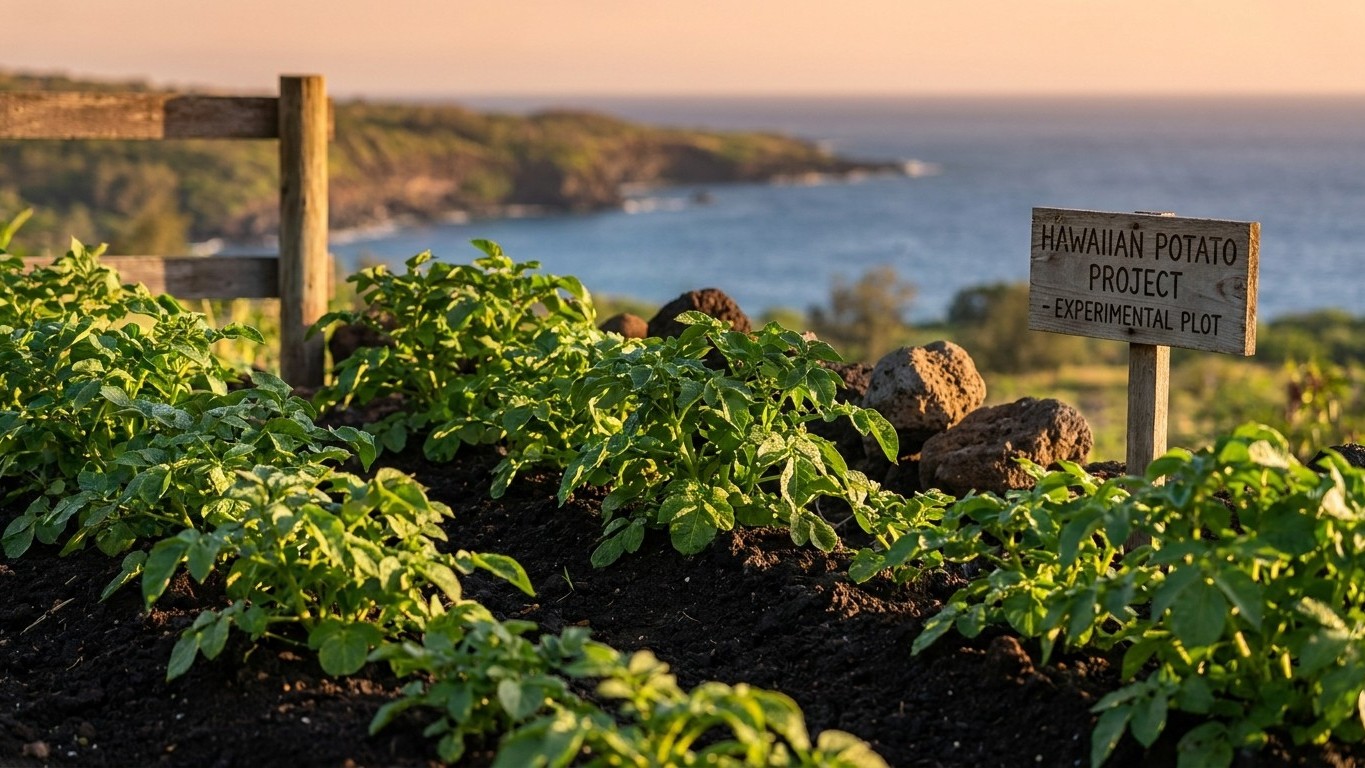

Hawaii’s coastline sees no frost. None. NOAA’s 1991-2020 climate normals return a “not computable” flag for every freeze percentile at the reference station, because inhabited land here simply never drops to 32°F. Meanwhile Honolulu averages 18.7 days a year at 90°F or hotter, a heat load lighter than most Mainland hot states. That combination rewrites the whole planting calendar: no frost date to count from, but still a soil-heat ceiling that shuts tubers down.
The short answer

Start with the two numbers that actually run this state’s potato calendar. Honolulu averages 18.7 days a year at 90°F or above, according to NOAA NCEI Climate Normals covering 1991-2020. That’s the measure of summer heat load, and by that yardstick alone, lowland Hawaii isn’t nearly as punishing as inland desert states that rack up two or three months of 90-degree afternoons. The second number is the one that changes everything else: at station USW00022521, every freeze percentile comes back not computable, and the average number of days at or below 32°F is zero. There is no last spring frost date in the places people actually garden. Frost exists only on the high volcanic summits, Mauna Kea, Mauna Loa, Haleakala, ground no one is planting potatoes on.
So does summer heat stop tubers from sizing here? Partly, and the answer depends on where in the state you’re standing. Utah State University Extension and the University of Maine Cooperative Extension both describe the same mechanism: tuber set and fill are inhibited once soil temperatures climb above 90°F. That’s a soil reading, not an air reading, and it’s the ceiling that decides When to Plant Potatoes in Hawaii. At the Honolulu reference station, a relatively modest 18.7 days a year cross the 90°F air-temperature line, which suggests the coastal lowlands aren’t locked into brutal, months-long heat the way a true desert climate is. But Hawaii’s tropical setting also means there’s no winter cold snap to reset soil temperature the way a frost-belt state gets every year. Soil at low elevation stays warm on a much steadier basis, even on days when the air itself never spikes past 90°F.
That’s the real shift a Hawaii gardener has to make. In a frost-belt state, the season is bracketed by two dates, the last spring frost and the first fall frost, and the potato crop lives in between. Here, there is no bracket. The season is instead bounded by elevation and by how consistently warm the soil runs through the year. A garden at higher elevation, where temperatures run cooler and closer to Mainland spring conditions, has far more room to work with than a beachfront lot, and choosing among Potato Varieties That Suit Hawaii can help close that gap. Without a frost date to anchor a calendar against, the soil thermometer becomes the only honest instrument in the shed, and that same instrument will later guide Harvesting and Storing Potatoes in Hawaii once the tubers have sized up.
When to plant here
The standard extension arithmetic, published by Utah State University Extension and the University of Maine Cooperative Extension, works like this almost everywhere else in the country: soil needs to reach 50°F, and that point typically falls 14 to 21 days before the local last spring frost date. A gardener in a frost-belt state can look up that date, count backward roughly two to three weeks, and land on a planting window. In lowland Hawaii, that math has nothing to count backward from, because NOAA’s own climate normals record no computable frost date for the islands’ inhabited elevations.
What replaces it is a sequence built around soil temperature and elevation instead of a date on a calendar. Here’s how to work it in order:
- Start with the rule itself. Soil needs to be at 50°F before seed potatoes go in, full stop, regardless of what state you’re gardening in.
- Recognize the frost math doesn’t apply here. Since there’s no last spring frost date on record for inhabited Hawaii, the “14 to 21 days before” calculation has no anchor point to work from.
- Check whether 50°F is even the limiting factor. Lowland tropical soil rarely sits near 50°F for long, so that lower threshold is usually already met most of the year, which flips the real question from “is it warm enough yet” to “is it about to get too warm.”
- Pick your window by elevation and season, not by date. A higher-elevation garden runs cooler and gives tubers more breathing room before soil pushes toward the 90°F ceiling; a coastal lowland garden has less margin and needs a tighter window.
- Confirm with a soil thermometer, not a calendar. Push a probe thermometer four inches into the row before planting and again through the season, since that reading, not the date on the wall, is what tells you whether tubers can still size.
The takeaway is straightforward: the mainland’s frost-based countdown simply doesn’t compute in Hawaii, so soil temperature and elevation do the job a frost date does everywhere else.
What the heat does to the crop
The mechanism itself doesn’t change from state to state, only the numbers around it do. Once soil temperature climbs above 90°F, tuber set and fill stop, according to Utah State University Extension and the University of Maine Cooperative Extension. That’s not a slowdown that a little extra irrigation can talk the plant out of. Watering harder doesn’t lower soil temperature enough to matter once that ceiling is crossed, and it doesn’t restart the biological process that stalls out above it. The plant can look green and healthy above ground while doing nothing useful below ground.
Cross that mechanism against Honolulu’s 18.7 days a year at 90°F or hotter, and a mixed picture emerges. That air-temperature count, on its own, is lighter than what many Mainland hot-summer states log, which means the coastal lowlands aren’t guaranteed months of soil sitting above the ceiling. But air temperature and soil temperature aren’t the same measurement, and Hawaii’s lack of a cold season means soil doesn’t get the same seasonal cooldown that resets things in a frost-belt state. A garden at low elevation can run warm through stretches of the year even without registering extreme air-temperature days, simply because there’s no cold snap breaking up the pattern.
For a gardener working at higher elevation, where temperatures run consistently cooler, the practical answer looks close to what a frost-belt gardener does in reverse: plant so tuber bulking happens during the coolest stretch available, rather than trying to push a crop through peak heat. For a gardener at low elevation, the safer strategy is treating the window as tighter and shorter, watching the soil thermometer directly rather than assuming the state’s overall 90°F day count applies evenly to a specific backyard. Either way, the ceiling itself doesn’t move. What moves is how much runway a given site has before soil crosses it.
What goes wrong here
- Uncertified seed potatoes. Seed pulled from a grocery bag or an unverified source can carry viruses that stunt the whole planting before it has a chance to size a single tuber. Buy certified seed potatoes from a known supplier, every time.
- Planting into soil that hasn’t warmed enough. Even in a climate without a frost calendar, tubers set into cold, wet soil rot before they sprout. Confirm the 50°F soil reading with a thermometer before planting, especially at higher elevation where soil takes longer to warm.
- Skipping the hilling. Tubers that push up near the surface and catch direct sunlight turn green and develop solanine, making them unsafe to eat. Mound soil over the row as the plants grow so developing tubers stay covered.
- Digging too early. Pulling the crop before vines have yellowed and died back gives thin-skinned, immature tubers that don’t store and often peel before they even leave the garden. Let the vines finish their natural die-back before the fork goes in the ground.
Checking this against your own county
A state-wide figure describes a reference station, not a specific backyard. Honolulu’s 18.7 days-a-year at 90°F comes from one coastal measuring point, and elevation moves that number substantially as you gain altitude inland or upslope. A windward garden catching regular rain and cloud cover behaves differently than a leeward garden baking in sun and lower rainfall, even a few miles apart. Neither the heat-day count nor the soil-warming pattern is uniform across an island, let alone across the state.
That’s exactly why a state-wide planting window is a starting point, never an instruction to follow blindly. The University of Hawaii’s Cooperative Extension Service, part of the College of Tropical Agriculture and Human Resources, tracks these local variations by island and by district. Before committing seed potatoes to the ground, check current guidance through CTAHR’s extension service, which can speak to elevation and windward-versus-leeward conditions in ways a single Honolulu reference station simply can’t.
Common questions
Does Hawaii ever get frost?
Not in the areas people garden. NOAA’s climate normals flag every freeze percentile as not computable for the reference station, with zero days a year at or below 32°F. Frost occurs only on the high volcanic summits, ground with no potato gardens on it.
If there’s no frost date, how do I know when to plant?
Skip the calendar and use a soil thermometer instead. Push it four inches into the row and plant once the reading holds at 50°F, then watch it through the season since the same soil will eventually climb toward the 90°F ceiling that stalls tuber fill.
Can I grow potatoes through a full Hawaii summer?
It depends heavily on elevation. Honolulu’s 18.7 days a year at 90°F suggest the lowlands aren’t locked into extreme heat the way a desert state is, but soil there stays warmer more consistently without a cold season to reset it. Higher-elevation gardens have more room to run a longer season than coastal lowland plots do.
Does more watering fix heat-stressed potatoes?
No. Once soil crosses 90°F, tuber set and fill stall as a heat response, not a moisture shortage, according to Utah State University Extension and the University of Maine Cooperative Extension. Extra irrigation doesn’t lower soil temperature enough to restart that process.