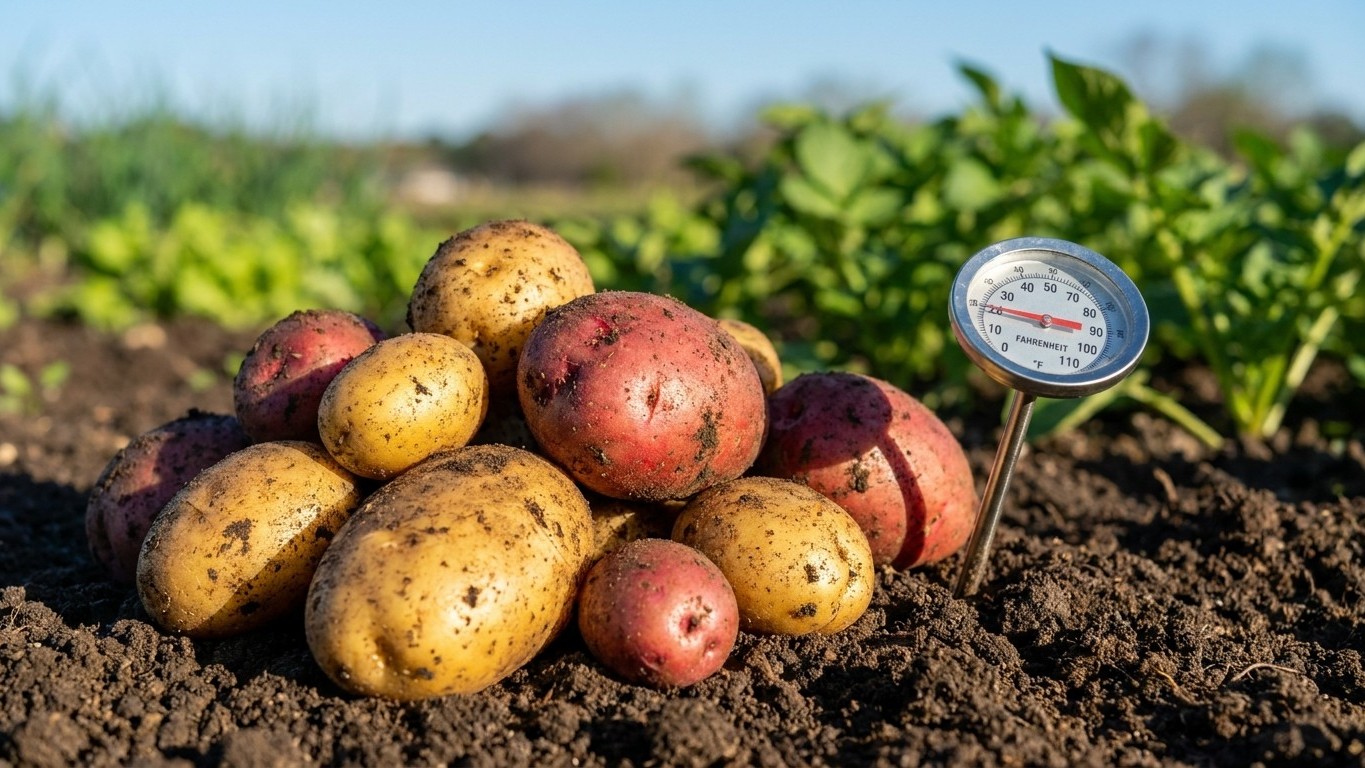

South Louisiana potato growers are working against a different clock than gardeners almost anywhere else in the country: the state’s mild winters mean frost barely limits the calendar, so the real deadline is a soil thermometer, not a frost date. That single fact reshapes which potato varieties actually make sense here, and it favors early and mid-season types planted for a quick spring harvest over anything meant to bulk up through a long summer.
The short answer
Early-season and mid-season potatoes grown for baking or boiling are the ones that suit Louisiana, and the reason comes down to a single number from NOAA NCEI’s 1991-2020 Climate Normals for the New Orleans station (USW00012916): the last spring freeze there falls somewhere between January 18 and February 8. That is not a typo. In much of the country, gardeners wait until March or April to think about potatoes. In south Louisiana, the frost window has often already closed before other states have started counting down to spring.
But that early date is not really a gift, it is a warning label. Louisiana’s growing challenge was never really the cold. According to Utah State University Extension’s Potatoes in the Garden fact sheet, tuber set and fill shut down once soil temperatures climb above 90 degrees Fahrenheit, and no amount of extra watering reverses that. Louisiana soil crosses 90 degrees early and stays there for months, which means the growing window for a potato crop here is short and front-loaded, bookended by heat rather than frost.
That is also why the NOAA data comes with a caveat worth repeating: a 32-degree freeze happens in only 86.8 percent of years at that New Orleans station. Roughly one year in seven, south Louisiana gets no freeze at all, and the fall freeze window itself straddles the New Year rather than landing cleanly in autumn like it does farther north. North Louisiana freezes far more reliably than the coastal parishes, which matters for anyone reading this from Shreveport rather than New Orleans, but the heat ceiling applies statewide.
Put those two facts together and the short answer holds up: choose early or mid-season potatoes suited to baking or boiling, get them in the ground as soon as the soil is workable, and plan to dig before summer heat, not after it.
What actually decides it
Two mechanisms run this whole decision, and once a gardener understands them, the question of “which variety” becomes secondary to “when and how fast.”
Soil temperature triggers planting, not the calendar date
Both Utah State University Extension and the University of Maine Cooperative Extension (Bulletin #2077) anchor planting to soil temperature rather than a fixed date: potatoes go in once the soil reaches 50 degrees Fahrenheit, which typically lands 14 to 21 days before the last frost date. In most of the country that rule is a shortcut. In Louisiana it is close to the whole strategy, because the region’s mild, erratic winters make the frost date itself a soft target. A gardener who waits for a calendar date instead of checking soil temperature with a thermometer risks planting either too early into cold, rot-prone ground or too late into soil that is already warming past ideal.
The heat ceiling, not frost, ends the season
The 90-degree soil threshold is the mechanism that actually decides whether a Louisiana potato crop succeeds, because it defines how much time exists between “soil is workable” and “soil is too hot to size tubers.” In a northern state, a gardener might worry about an early fall frost cutting the season short. In Louisiana, the season is cut short from the other direction: heat arrives and shuts tuber growth down regardless of how much rain or fertilizer follows. This is why the smart move statewide is treating the potato crop as a spring dash rather than a season-long project. A gardener anywhere in the state, north or south, can apply this same logic to a case this page never covers, like a raised bed in a hot parking-lot-adjacent yard: check the soil thermometer, count backward from when 90-degree soil typically arrives locally, and plant early enough that the crop matures before that window closes.
Season class determines how much runway a variety needs
Neither Utah State nor Maine publishes a days-to-maturity figure for specific potatoes, but both sources classify varieties by season length: early, mid-season, and late. That classification is the practical tool here. An early-season type needs the least runway before the 90-degree ceiling arrives, which makes it the safer default almost everywhere in Louisiana. A late-season type needs more time in the ground filling out tubers, which works fine in regions with a long, gradual spring but runs headlong into Louisiana’s compressed window.
How to do it
- Buy certified seed potatoes. Uncertified seed carries virus that spreads through a planting and through a garden’s soil for seasons afterward, and no amount of good timing fixes that problem later.
- Choose an early-season or mid-season variety suited for baking or boiling, based on the season classes published by Utah State University Extension and the University of Maine Cooperative Extension.
- Check soil temperature directly with a soil thermometer rather than relying on a calendar date, since Louisiana’s frost timing is inconsistent enough that a fixed date is unreliable.
- Plant once soil reaches 50 degrees Fahrenheit, which falls 14 to 21 days ahead of the last frost date for the area.
- In south Louisiana, plant with the awareness that the last spring freeze at the New Orleans station falls between January 18 and February 8, and that some years bring no freeze at all.
- In north Louisiana, expect a more reliable, later freeze pattern than the coastal parishes, and adjust the planting window accordingly rather than copying a south Louisiana timeline.
- Track soil temperature through the growing weeks and plan the harvest before soil climbs above 90 degrees Fahrenheit, since tuber set and fill stop at that point regardless of watering.
- Dig the crop promptly once tubers have sized, rather than leaving them in the ground to “finish,” since extra time in hot soil does not add size once the ceiling is crossed.
What goes wrong
- Planting by the calendar instead of the soil. A gardener who waits for a specific date rather than checking soil temperature can miss the 50-degree window entirely in a warm year, or plant into cold, wet soil in a slow one. The fix is a $10 soil thermometer checked at planting depth, not a date circled on a calendar.
- Using saved or uncertified seed. Seed held over from a grocery-store potato or a neighbor’s uncertified stock often carries virus that stunts the whole crop and lingers in garden soil. Certified seed potatoes are the one input in this whole process that has no workaround once skipped.
- Choosing a late-season type by habit. A late-season variety needs more time filling tubers than Louisiana’s compressed spring window generally allows before soil crosses 90 degrees. Switching to an early or mid-season class, per the season groupings published by Utah State and Maine Extension, gives the crop a realistic runway.
- Assuming watering fixes heat stress. Once soil passes 90 degrees, tuber set and fill are inhibited regardless of irrigation, according to Utah State University Extension. The remedy is timing the harvest earlier, not increasing water later in the season.
- Treating south Louisiana’s frost date like a firm boundary. Because a 32-degree freeze occurs in only 86.8 percent of years at the New Orleans station, a gardener who plans strictly around “the” frost date can be caught off guard in either direction. Using soil temperature as the real trigger sidesteps that unpredictability.
- Copying a north Louisiana planting timeline in the south, or vice versa. The coastal parishes freeze far less reliably than north Louisiana, so a single statewide planting date does not hold up. Anchoring the decision to local soil temperature rather than a shared regional date avoids this mismatch.
Common questions
Can Louisiana gardeners grow a fall potato crop instead of a spring one?
The published frost data for south Louisiana shows the freeze window straddling the New Year rather than sitting neatly in autumn, which makes fall timing trickier to plan around than a straightforward spring planting keyed to the 50-degree soil rule.
Does north Louisiana follow the same planting rules as south Louisiana?
The underlying mechanism, plant at 50-degree soil and harvest before 90-degree soil, applies statewide, but north Louisiana’s more reliable, later freeze pattern shifts the practical timing later than a south Louisiana garden near New Orleans.
Is a late-season potato ever a reasonable choice in Louisiana?
It is a harder fit statewide because the extra time a late-season type needs to fill tubers runs against the state’s early arrival of 90-degree soil, which is why early and mid-season classes are the more dependable defaults.
Why does certified seed matter so much for a home garden?
Uncertified seed potatoes carry virus that reduces yield and can persist in garden soil, and unlike timing or variety choice, there is no adjustment later in the season that fixes a compromised seed source.