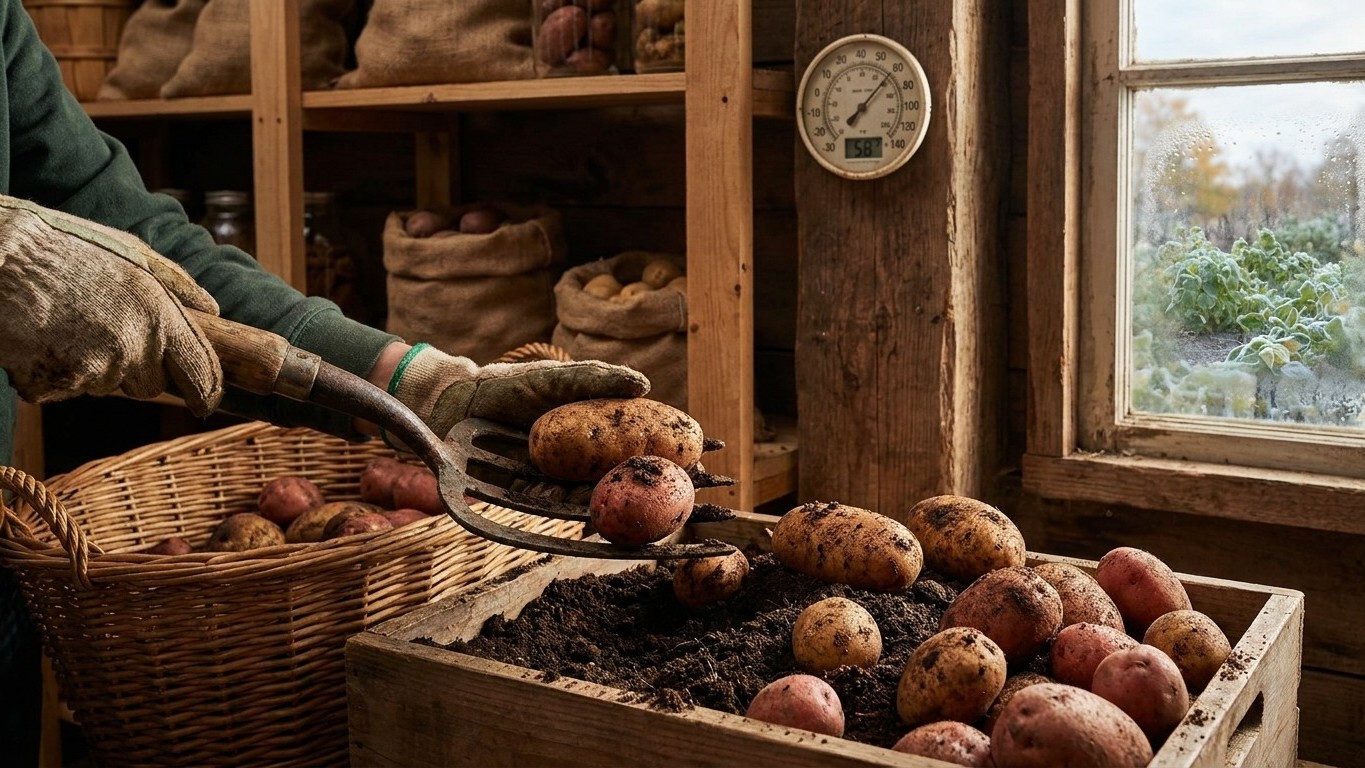

Dig your potatoes before Manitoba’s average first fall frost of September 22, cure them for 2 to 3 weeks at 55-60 F in a humid spot such as a basement, then move them into dark storage at 40-45 F. The catch: this province’s coldest month averages a nightly low of -6.6 F, so an unheated shed or garage won’t hold that storage range past October. You need an insulated or heated space to get through winter.
The short answer
Two numbers decide almost everything about growing and keeping potatoes in Manitoba. The first is September 22, the average date of the first fall frost recorded at Winnipeg Richardson International Airport over the 1981-2010 period. The second is -6.6 F, the mean nightly minimum of the coldest month at that same reference station. Neither number is a guarantee. The frost date is a midpoint, not a safe cutoff, which means in roughly half the years frost arrives later than September 22, and in the other half it arrives earlier. Treat it as a planning marker, not a promise, especially if your garden sits north of Winnipeg or at higher elevation, where cold settles in sooner.
What that frost date tells you is simple: potato tops usually get cut down by cold well before October, and the tubers underground need to come out shortly after, before the soil itself starts to chill and before a hard freeze reaches root depth. Once the vines are dead, whether from frost or from natural dieback, there’s little reason to leave tubers in the ground longer than a week or two in this climate. Waiting risks a cold snap that drops soil temperatures fast, since Manitoba’s transition from mild fall days to serious cold can happen in a matter of weeks rather than months.
The second number, that -6.6 F average low, is the one that changes how you think about winter storage. A garage, a shed, or an unheated porch might hold up fine in October and even into November, but by the depth of winter those same spaces will sit far below the 40-45 F that stored potatoes need. There’s no unheated outbuilding in this climate that reliably holds a mid-40s temperature all winter without help. That reality shapes every storage decision that follows: you’re not just picking “a cool dark place,” you’re picking a space you can keep from freezing for months at a stretch, through a season where outdoor lows regularly run well below zero.
So the short answer has two parts. Harvest with September 22 as your rough deadline, understanding it’s a mean and not a hard line. Then plan storage assuming that anything short of an insulated cellar, a heated basement corner, or a monitored root cellar will eventually freeze solid during Manitoba’s coldest stretch.
Curing, and where
Utah State University Extension recommends curing freshly dug potatoes at 55-60 F with high humidity for 2 to 3 weeks before storage. That window lets the skins toughen and minor wounds seal over, which matters directly for how long the crop keeps. The trouble in Manitoba is timing: harvest typically falls in September, right as outdoor temperatures are sliding toward that first frost. A shaded porch might hit 55-60 F on a mild September afternoon, but overnight lows in that same period can already be dipping toward freezing, which is too cold and too dry for proper curing. A basement, by contrast, tends to sit in a steadier range year-round and is the more dependable option once the outdoor swings begin.
- Dig potatoes on a dry day and let them sit on the soil surface for an hour or two, no longer, to shed surface moisture without exposing them to direct sun for extended periods.
- Brush off loose soil by hand rather than washing the tubers, since added moisture works against the curing process.
- Move them indoors immediately to a basement, root cellar, or similarly insulated space where temperatures run close to 55-60 F with high humidity, since an open porch or garage in a Manitoba September rarely holds that range consistently.
- Spread the tubers in a single layer, or in shallow crates, so air can move around each one instead of trapping moisture against the skin.
- Leave them undisturbed for 2 to 3 weeks, checking periodically for soft spots or rot and pulling out any damaged tubers before they affect the rest.
- After curing, sort once more and move the sound tubers into the colder, darker conditions needed for long-term storage.
Storing through this winter
Once cured, potatoes need dark conditions and a steady 40-45 F, according to Utah State University Extension. The University of Maine Cooperative Extension gives a related figure for longer-term keeping: 38 F at 95 percent humidity. Both numbers describe a narrow band, and Manitoba’s climate makes hitting that band year-round genuinely difficult without some kind of insulation or heat source. At -6.6 F average for the coldest month’s nightly lows, an unconditioned space will drop well below 38 F and stay there for stretches at a time, which freezes the tubers and turns them soft and unusable once thawed. On the other end, a space that’s too well heated, like a heated basement living area, will sit above 45 F and encourage sprouting, which drains the starch and shortens the potatoes’ usable life.
A dug-in root cellar, or a basement corner near an exterior wall but away from any furnace or heating duct, tends to be the more workable middle ground in this climate. Some growers rely on an insulated cold room built into a basement, with a small vent or fan to manage humidity, since the University of Maine figure of 95 percent humidity is high enough that a bone-dry basement will shrivel tubers over the winter even if the temperature is right. A thermometer left in the storage space, checked periodically through the coldest months, is the simplest way to know whether you’re holding that 38-45 F range or drifting outside it in either direction.
Darkness matters as much as temperature. Light exposure, even indirect light through a window, triggers greening and the buildup of solanine near the skin, which is a separate problem from cold damage but shows up just as often in home storage. A cardboard box, a burlap sack, or simply a windowless closet handles that part of the equation without much effort, as long as the temperature and humidity underneath are also being managed for the winter ahead.
What goes wrong here
- Leaving tubers in the ground past the frost window. Since September 22 is only a mean date, a grower who waits for a “safe” later date can get caught by an early cold snap that chills the soil hard. The remedy is to dig as soon as the vines die back naturally or at first frost, whichever comes first, rather than waiting for a calendar date.
- Curing on a porch or in a garage that’s already too cold. By the time potatoes are dug in a Manitoba September, outdoor evening temperatures often sit below the 55-60 F curing range Utah State University Extension recommends. Move curing indoors to a basement or similarly insulated room instead of relying on an outbuilding.
- Storing in an unheated shed through winter. With the coldest month averaging -6.6 F at night, any uninsulated outbuilding will freeze stored potatoes solid for weeks at a stretch. An insulated cellar, a monitored basement space, or a heated area kept near 40-45 F is the only reliable option once real winter sets in.
- Storage that’s too warm instead of too cold. A heated basement or utility room that stays above 45 F causes sprouting and softening well before spring, even though the space never freezes. Keep stored potatoes in the coolest available room away from furnaces, water heaters, or heating ducts.
- Low humidity shriveling the crop. A dry basement can pull moisture out of tubers over a Manitoba winter, especially with a furnace running for months. A loosely covered container, an occasional light misting of the storage area, or a humidity tray helps hold conditions closer to the 95 percent the University of Maine Cooperative Extension recommends.
- Skipping the sort before storage. A single soft or damaged tuber left among cured potatoes can spread rot through a whole bin over a long winter. Check the crop again after curing and remove anything questionable before it goes into long-term storage.
Common questions
How early should I dig potatoes if frost is coming sooner than usual?
Since September 22 is a mean date and not a guarantee, watch your own garden’s conditions rather than the calendar. Once the vines have died back from cold or disease, or a frost warning is issued for your area, dig within the following few days rather than waiting.
Can I cure potatoes outside in Manitoba if the weather is still mild?
A shaded, sheltered spot can work for a short stretch if daytime and nighttime temperatures both sit close to the 55-60 F range Utah State University Extension recommends. Given how quickly Manitoba evenings cool in September, checking a thermometer in that space, rather than assuming it’s warm enough, is the safer approach.
Is a heated garage a good place for winter potato storage?
Only if you can keep it consistently within the 40-45 F range, or as low as 38 F at high humidity per the University of Maine Cooperative Extension. A garage heated just enough to prevent freezing but not monitored closely can swing wide in either direction during a Manitoba cold snap, so regular temperature checks matter more than the heat source itself.
What happens if stored potatoes freeze partway through winter?
Freezing breaks down the cell structure inside the tuber, and once thawed, potatoes that have frozen turn soft, discolored, and unusable. There’s no way to recover them once that happens, which is why matching your storage space to the 40-45 F, or 38 F at 95 percent humidity, ranges described here matters more in Manitoba than in milder climates.