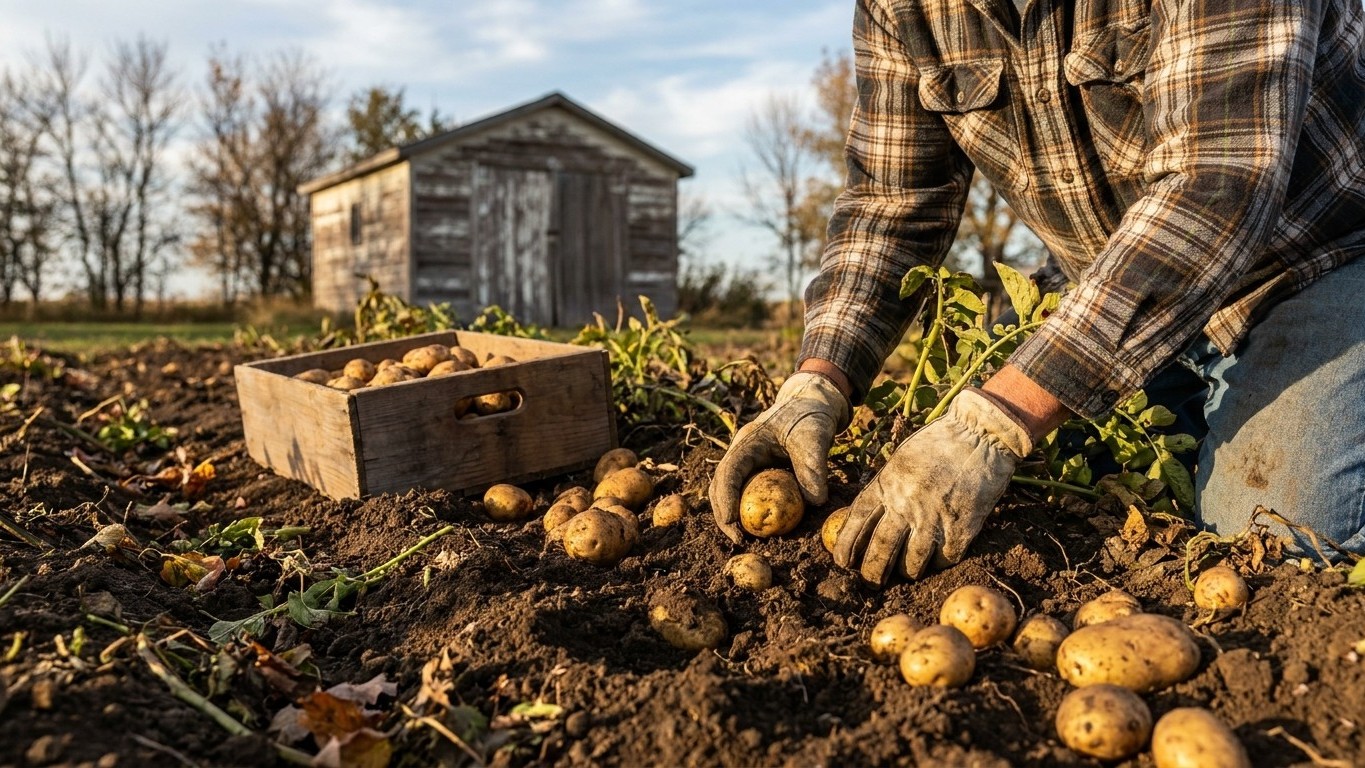

In South Dakota, potatoes generally come out of the ground before the first fall frost hits, in the window of September 24 to October 4 at the Sioux Falls reference station. After that, the challenge shifts from digging to keeping the crop from freezing: an unheated garage or shed here will not hold 40-45 F through winter, because the coldest month averages a minimum of 8.5 F. That gap is the whole story of storing potatoes in this state.
The short answer
Two numbers frame everything a South Dakota grower needs to know. The first is the fall frost window at the Sioux Falls reference station: September 24 to October 4, based on NOAA NCEI’s 1991-2020 climate normals. The second is the coldest month’s mean minimum temperature, which sits at 8.5 F. Those two figures pull in opposite directions, and understanding why matters more than memorizing either one.
The frost date tells you when to dig. Potato tops die back with the first hard freeze, and once that happens the tubers underground are exposed to a cooling soil that will eventually catch up to air temperatures. Most growers in this state pull their crop in the days leading up to that late-September to early-October window, sometimes a bit earlier if the foliage has already yellowed and died naturally. Waiting past the frost date risks tubers sitting in ground that’s dropping toward freezing, which invites chilling injury and rot once they’re bagged.
What the cold month figure changes
The 8.5 F figure is the one that reshapes the storage plan. Utah State University Extension recommends holding stored potatoes at 40-45 F in a dark space. An unheated structure in South Dakota, a detached garage, a garden shed, an uninsulated porch, will not stay in that range once the coldest month arrives. With a mean minimum of 8.5 F, any space without insulation or a heat source is going to drop well below freezing on a routine basis, not just during a cold snap.
That single fact rules out the casual approach that works in milder states, where a garage might coast through winter in the 40s without help. Here, storage has to be planned around a space that’s either underground (a basement or true root cellar), insulated and monitored, or supplemented with a small heat source and a thermometer. Digging on schedule solves half the problem. The other half is finding, or building, a space that can actually hold the temperature the tubers need for months at a stretch. Skip that step and the frost date becomes irrelevant, because the crop won’t survive the storage season regardless of when it came out of the ground.
Curing, and where
Before storage even starts, cured tubers need 55-60 F and high humidity for two to three weeks, according to Utah State University Extension. This step toughens the skin and heals small wounds from digging, and skipping it leads directly to storage rot later. The tricky part in South Dakota is timing: harvest lands right at the edge of the frost window, when outdoor daytime highs can still work in your favor but nights are already dropping fast toward that 8.5 F coldest-month reality later in the season.
- Dig on a dry day and let the tubers sit on the soil surface for an hour or two to dry off, no longer, since direct sun and wind exposure work against the humidity curing needs.
- Move them indoors immediately to a space that isn’t exposed to the falling nighttime temperatures typical of late September and early October here. A shaded porch can work only if it stays reliably in the 55-60 F range during the day and doesn’t dip sharply overnight, which becomes less reliable the closer harvest gets to the frost date.
- Choose a basement or interior garage space instead where the temperature is more stable. These spots hold heat better than anything exposed to outside air once the season turns, and they’re the more dependable choice for anyone harvesting near the later end of the frost window.
- Add humidity with damp burlap, cardboard, or a tray of water nearby, since basements and garages both tend to run drier than the high humidity curing calls for.
- Hold for two to three weeks before sorting and moving the cured tubers into long-term storage, checking periodically that the space hasn’t drifted outside the target range.
Storing through this winter
Once cured, potatoes need a dark space at 40-45 F according to Utah State University Extension, or 38 F at 95 percent humidity per the University of Maine Cooperative Extension. Both ranges sit comfortably above freezing but well below room temperature, which is exactly the band that’s hard to hold in a South Dakota winter without a dedicated space.
The coldest month’s mean minimum of 8.5 F is the number that decides whether a given storage spot will actually work. A basement corner away from heating ducts often lands close to the target range naturally, especially below-grade areas where the surrounding soil buffers temperature swings. A true root cellar, dug into a hillside or built with earth contact on multiple sides, does even better, since soil temperature at depth stays far more stable than air temperature above ground. An attached garage might work in early winter but is a gamble once the coldest month arrives, because a run of nights near that 8.5 F average will pull an uninsulated garage down with it.
Reading the two thresholds together
A space that freezes ruins stored potatoes just as surely as one that stays too warm sprouts them. Freezing turns the starches to sugar and breaks down cell walls, leaving a mushy, sweet-tasting tuber once thawed. Too warm, meanwhile, wakes the tubers into active growth, and sprouted potatoes lose eating quality and shelf life fast. The sweet spot between 38 and 45 F is narrow, and in a climate where the coldest month averages a minimum of 8.5 F, hitting it requires either a naturally insulated space like a basement or cellar, or an unheated space fitted with a thermostat-controlled heater and monitored with an actual thermometer rather than a guess.
What goes wrong here
At harvest
- Digging too close to a hard freeze. Waiting until frost has already blackened the vines risks soil temperatures dropping enough to chill the tubers underground. Watch the foliage and dig as soon as tops die back naturally, rather than waiting for the calendar frost date to arrive.
- Skin left too tender for storage. Tubers dug in a hurry ahead of an early cold snap sometimes don’t get the full curing period they need. Extend curing to the full two to three weeks even if it means storing slightly later than planned, since Utah State University Extension notes that period is what heals wounds and toughens skin against rot.
In storage
- Unheated garages freezing solid. Given the 8.5 F coldest-month minimum, a detached or uninsulated garage is likely to freeze stored potatoes at some point in a typical winter. Move stock to a basement, insulated cellar, or add a monitored heat source before deep winter arrives.
- Storage near a furnace or heat duct. The opposite problem shows up in basements, where a spot too close to a heat source pushes temperatures well above the 40-45 F target and triggers sprouting. Relocate storage bins to the coolest corner of the basement, away from mechanical rooms.
- Low humidity causing shriveling. Basements and garages both tend to run drier than the high humidity potatoes need, especially once furnaces kick on for the season. A damp burlap cover or a shallow pan of water nearby helps maintain moisture around the storage bin.
- Disease carried in from the field. Tubers with soft spots or blemishes should be sorted out before storage, since a single rotting potato can spread through a bin. Where fungal or insect pressure was a problem in the garden, an appropriate fungicide or appropriate insecticide applied during the growing season reduces what makes it into storage in the first place.
Common questions
When should potatoes be dug in South Dakota?
Most growers dig ahead of the first fall frost window, which runs September 24 to October 4 at the Sioux Falls reference station, though local conditions vary by county and elevation, so it’s worth tracking your own garden’s frost history rather than relying on a single reference point.
Can potatoes be stored in an unheated garage over winter?
Generally no in this state. With a coldest-month mean minimum of 8.5 F, an unheated garage is likely to freeze the crop at some point during winter unless it’s insulated or fitted with a monitored heat source that keeps it in the 40-45 F range recommended by Utah State University Extension.
How long does curing take before storage?
Utah State University Extension recommends two to three weeks at 55-60 F with high humidity, done in a stable indoor space like a basement or garage rather than outdoors, where South Dakota’s dropping fall temperatures make it hard to hold that range consistently.
What temperature and humidity should a storage space hold?
Utah State University Extension recommends 40-45 F in a dark space, while the University of Maine Cooperative Extension specifies 38 F at 95 percent humidity. Either target requires a basement, root cellar, or a monitored, insulated space, since a plain unheated shed or garage won’t hold those numbers through a South Dakota winter.