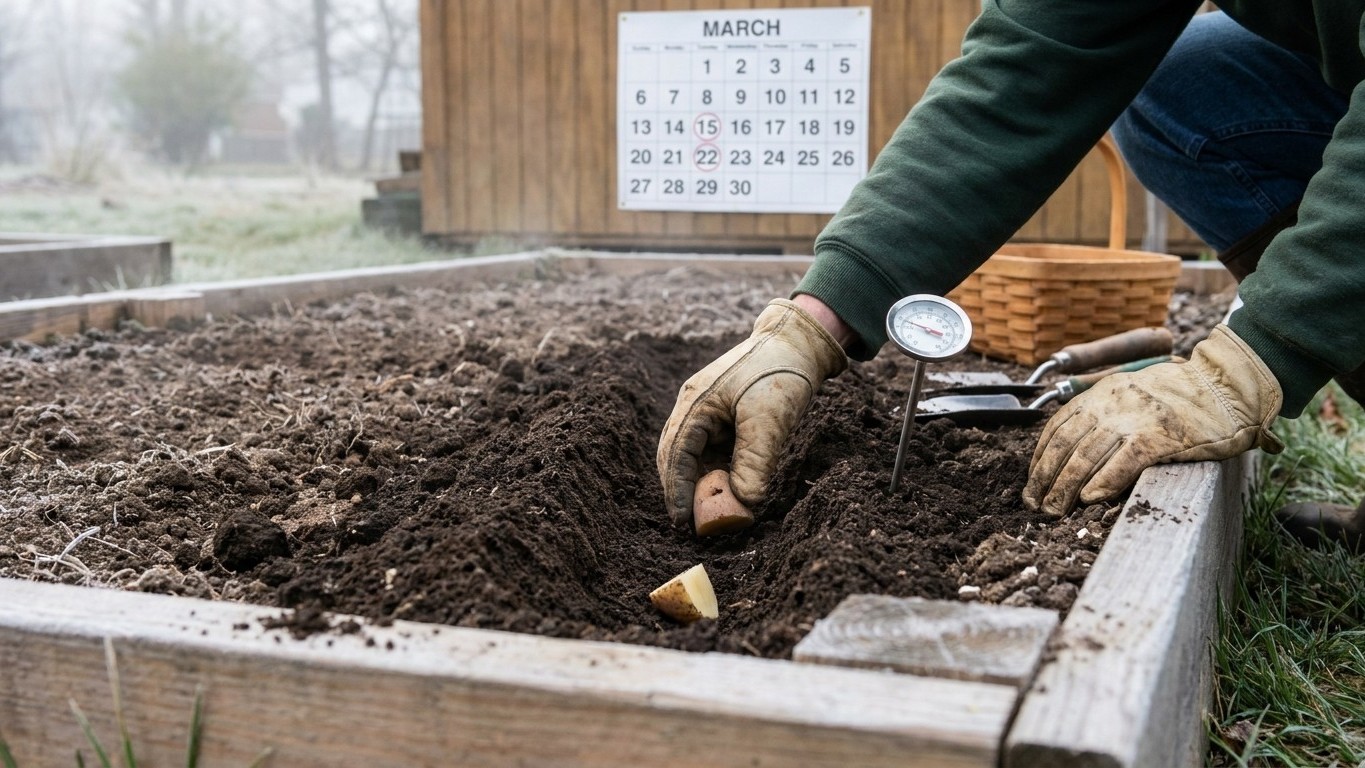

Plant potatoes in Maryland 14 to 21 days before your last spring frost, once soil hits 50°F, according to Utah State University Extension. For the Baltimore-Washington reference station, NOAA NCEI puts that last frost between April 3 and April 16, which pushes soil prep and planting into mid-to-late March for most of the central corridor.
The short answer
NOAA NCEI’s 1991-2020 Climate Normals, drawn from the BWI Marshall Airport station, place the 32°F freeze probability window (the band where a last spring frost falls 30% to 70% of the time) between April 3 and April 16. That’s the anchor date. Everything else in a Maryland potato calendar is built by counting backward from it, not forward from some fixed calendar square.
Count back 14 to 21 days from that window and you land somewhere in the third or fourth week of March for gardens near the BWI reference point. That’s not a guess dressed up as science, it’s the University of Maine Cooperative Extension’s standard planting rule for potatoes: get seed pieces into the ground as soon as soil temperature reaches 50°F, which typically happens two to three weeks ahead of the last frost date because soil warms faster under bare, worked ground than air does overnight.
The catch is that BWI’s window doesn’t travel well across a state this varied. Garrett County and the Allegany highlands sit at elevation, and mountain air drains cold long after the Piedmont has warmed, so a gardener in Oakland or Cumberland is working from a frost date that lands weeks later than the reference station’s numbers suggest. The Eastern Shore runs the other direction: the Chesapeake’s open water moderates spring nights, so growers in Salisbury or Cambridge often see soil cross 50°F before their central Maryland neighbors do.
None of this means checking a calendar and calling it done. Soil temperature, not air temperature and not a date on a seed packet, is what triggers sprouting and root development in a seed potato. A thermometer pushed 4 inches into the bed on three consecutive mornings tells you more than any regional average ever will. Cold, wet soil sitting at 45°F will hold seed pieces in place for weeks doing nothing but rotting, while the same seed dropped into 52°F soil breaks dormancy within days.
So the short answer has two layers. The regional layer says: mid-to-late March near BWI, later in the western counties, earlier on the Shore. The mechanical layer, the one that actually governs the outcome, says: whenever your own soil reads 50°F, that’s your day, regardless of what the calendar claims.
What actually decides it
The 50°F soil threshold
Potatoes don’t read calendars. A seed piece sitting in soil colder than 50°F simply waits, and while it waits it’s exposed to fungal and bacterial rot that thrives in cold, saturated ground. Utah State Extension frames the 50°F mark as the trigger point where root and sprout growth actually begins, which is why the planting rule is built around soil temperature rather than frost risk alone. A light frost on emerged foliage is rarely fatal; potato plants can push new growth back up from below the soil line. Cold, wet soil sitting on dormant seed pieces for three or four extra weeks is a far bigger threat than a frost the plant hasn’t even broken ground to meet yet.
The 90°F ceiling that ends the season
The other end of the calendar matters just as much, and it’s the mechanism most home gardeners never hear explained. Once soil temperatures climb above 90°F, tuber set and tuber fill both shut down. This isn’t a matter of the plant wilting or looking stressed; the below-ground process that turns a flowering plant into a harvestable crop simply stalls, and no amount of extra watering restarts it. That’s why the University of Maine’s planting guidance and Utah State’s fact sheet both push toward early planting rather than a summer-long grow cycle: the goal is to get tubers sized before soil temperatures cross that ceiling, not to fight the heat once it arrives.
Season class matters here too. Early-season potatoes finish their bulking before summer heat peaks, which makes them the safer bet in any Maryland county that racks up a long run of 90°F soil days. Mid-season and late varieties need a longer stretch of cool root-zone temperature to fill out, so they depend more heavily on getting into the ground at the earliest safe date rather than a date in the middle of the recommended window. Neither Utah State nor Maine publishes a maturity date in days for named varieties, so the useful distinction to carry into variety selection is the season class itself, and what the crop is grown for, whether that’s a potato suited to baking or one suited to boiling, not a waxy-or-floury label that doesn’t come from either source.
Why Maryland’s regions don’t share a calendar
Elevation and water proximity are the two forces splitting Maryland’s planting map. Garrett and Allegany counties sit high enough that spring cold air pools in valleys well after the Piedmont has warmed, delaying the safe planting window by real weeks, not days. The Eastern Shore’s low elevation and surrounding water do the opposite, moderating nighttime lows and letting soil cross 50°F earlier than the BWI reference date implies. A single statewide answer was never going to hold for both.
How to do it
- Find your local last-frost estimate and count backward. Working from the BWI reference window (April 3 to April 16), that puts the safe planting stretch roughly two to three weeks earlier for most central Maryland gardens, adjusted later for Western Maryland and earlier for the Eastern Shore.
- Check soil temperature directly instead of trusting the calendar alone. Push a soil thermometer 4 inches deep on three consecutive mornings; don’t plant until readings consistently hit 50°F.
- Buy certified seed potatoes, not grocery-store tubers or last season’s leftovers. Uncertified seed carries viral disease that spreads silently through a planting and through a garden bed for years afterward; certified seed is the one input in this whole process that isn’t optional.
- Cut larger seed potatoes into pieces with at least one or two eyes each, then let the cut surfaces cure for a day or two in a cool, dry spot so they scab over before going into the ground. Small seed potatoes can be planted whole.
- Choose a season class that matches your county’s heat pattern. Where long stretches of 90°F soil days are common, favor early-season varieties that size up before that ceiling arrives.
- Dig trenches 4 to 6 inches deep and space seed pieces roughly 12 inches apart within the row, cut side down and eyes facing up.
- Cover with soil and wait for emergence, then hill soil up around the base of the plants as they grow to keep developing tubers shaded from sunlight and protected from a late, light frost on new foliage.
- Track soil temperature through the growing season, especially heading into summer, so you know roughly when the 90°F ceiling is approaching and can plan harvest of early varieties before tuber fill stalls out.
What goes wrong
- Planting into cold, saturated soil before it hits 50°F. Seed pieces sit dormant and rot instead of sprouting. Fix: wait for three consecutive mornings of 50°F soil readings rather than planting by a fixed calendar date.
- Using uncertified seed potatoes, including grocery-store tubers. These frequently carry viral disease invisible at planting time that reduces yield and can persist in garden soil across seasons. Fix: buy certified seed potatoes every time, with no exceptions for convenience.
- Ignoring the western counties’ later frost window. A gardener in Garrett or Allegany County planting on the same date as a central Maryland grower risks losing an early crop to a frost that arrives weeks later there than the BWI reference date suggests. Fix: push the planting window later for mountainous counties and confirm with a local soil thermometer reading rather than the regional average alone.
- Growing a mid-season or late variety in a county with a long run of 90°F soil days. Tuber set and fill stall out once that ceiling is crossed, and extra irrigation doesn’t reverse it. Fix: shift toward early-season varieties in hotter counties so bulking finishes before the heat arrives.
- Skipping hilling. Tubers that push up near the soil surface turn green from light exposure and become unusable, and shallow tubers are also more exposed to a late frost reaching the root zone. Fix: hill soil around the base of the plants progressively as they grow, not as a single late-season pass.
Common questions
Can I plant potatoes before the last frost date in Maryland?
Yes, and the standard guidance from Utah State University Extension is built around doing exactly that. Potatoes go in the ground 14 to 21 days before the last frost, once soil reaches 50°F, because the plant tolerates cold soil and light frost on emerging foliage far better than it tolerates a delayed start that pushes tuber fill into hotter summer soil.
Does the BWI frost date apply to all of Maryland?
No. NOAA NCEI’s April 3 to April 16 window comes from the BWI Marshall Airport station and applies most directly to the central Maryland corridor around it. Western Maryland’s mountainous counties run weeks later because of elevation and cold-air drainage, and the Eastern Shore tends to warm earlier due to the moderating effect of surrounding water.
What happens if potatoes are planted too late in the season?
Soil temperatures rising above 90°F inhibit tuber set and tuber fill, according to Utah State University Extension and University of Maine Cooperative Extension guidance. A late planting risks having the crop still bulking when that ceiling is reached, at which point additional watering or care doesn’t restart the process. Early-season varieties planted at the earliest safe date are the more reliable path in counties with long hot stretches.
Why does certified seed matter so much for potatoes?
Uncertified seed potatoes, including ones bought for eating at a grocery store, commonly carry viral disease that isn’t visible when you plant them. That virus reduces yield in the current crop and can linger as a source of infection in the garden for seasons afterward. Certified seed is inspected specifically to avoid that risk, which makes it the one input in this process worth never substituting.
If you follow the almanac, here is when to plant potatoes by the moon. It is a tradition, not a proven method.