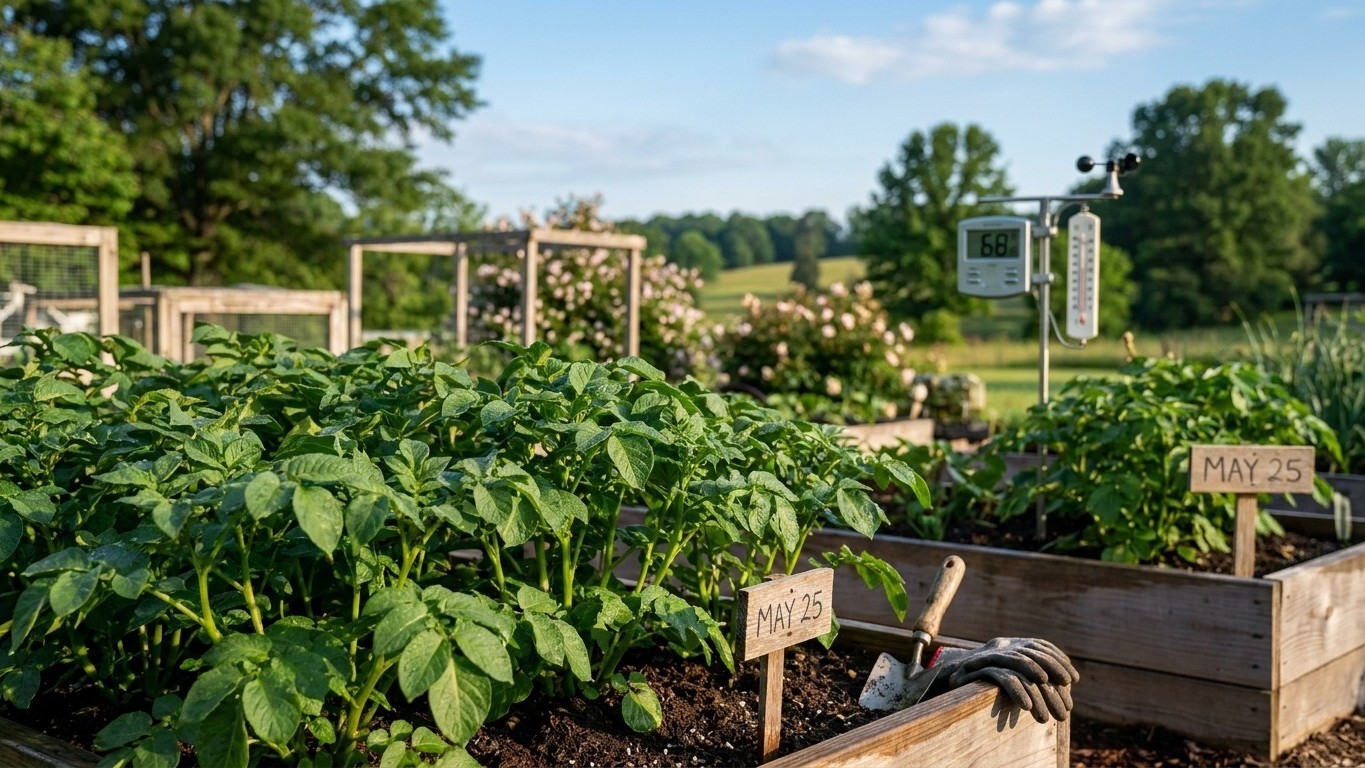

Maryland’s summer heat load is moderate, not extreme: Baltimore averages 24.6 days a year at 90 F or hotter (NOAA NCEI, 1991-2020 Climate Normals). Combined with a last spring frost window of April 3 to April 16, that means potatoes planted early can size their tubers before the hottest stretch of summer arrives. This is a spring-into-early-summer crop here, not a season-long fight against heat.
The short answer

Two numbers decide whether a Maryland garden can grow potatoes without a heat problem. The first is 24.6, the average number of days per year Baltimore’s reference weather station records a high of 90 F or more (NOAA NCEI Climate Normals, 1991-2020). The second is the last spring frost window for that same station: April 3 to April 16. Neither number alone tells the story. Together they set the calendar, which is why knowing When to Plant Potatoes in Maryland matters as much as which variety you choose.
Utah State University Extension identifies the mechanism that actually limits a potato crop: tuber set and fill slow down and can stop once soil temperatures climb above 90 F. Baltimore’s 24.6 days of 90 F air temperature a year is not extreme compared to states further south or west, but it is enough heat, arriving in July and August, to shut down a potato crop that is still trying to bulk up tubers at that point in the season. The fix is not to fight the heat. It is to time planting so the crop has already done its tuber-growing work before the hottest weeks land.
What this means for variety choice
Neither Utah State University Extension nor the University of Maine Cooperative Extension publishes a days-to-maturity figure for named potato varieties, so this page won’t invent one. What both sources do publish is season class: early, mid-season, or late. In a state with Maryland’s frost timing and heat load, an early or mid-season variety is the safer bet, since it reaches harvest size closer to the cooler part of the growing window rather than pushing into the hottest stretch of summer. For a closer look at Potato Varieties That Suit Maryland, choose varieties by what they’re published to be good for rather than by texture labels: some are described as good for baking, others as good for boiling. That’s the information the extension fact sheets actually give.
The practical read for Maryland gardeners: this state sits in a workable middle ground. It’s not Arizona, where triple-digit soil temperatures make a spring-only crop mandatory. But 24.6 days above 90 F is real heat pressure, concentrated in the exact weeks when tubers are sizing up, which makes timing your dig dates just as important as your planting dates. See Harvesting and Storing Potatoes in Maryland for guidance on when a late-planted crop would still be trying to size tubers. Plant early, and Maryland’s climate does not stop a potato harvest. Plant late, and it will.
When to plant here
The planting date isn’t picked from a calendar page. It’s counted backward from the last frost window, using soil temperature as the real trigger. Here’s the arithmetic, in order.
- Start with the last spring frost window. For the Baltimore reference station, NOAA’s 1991-2020 Climate Normals put that window at April 3 to April 16.
- Identify the soil temperature target. Utah State University Extension and the University of Maine Cooperative Extension both point to 50 F soil as the trigger for planting seed potatoes.
- Count back 14 to 21 days from the last frost date. That’s how long before the frost window soil generally reaches 50 F in spring, according to those same sources. Applied to Baltimore’s window, that puts the planting target somewhere in the second half of March to the very start of April, depending on how quickly soil warms that particular spring.
- Confirm with a soil thermometer rather than the calendar alone. A cold, wet spring can push the 50 F mark later than the date math suggests; a warm, dry one can pull it earlier.
A reader in a different Maryland county can run this same math with their own last-frost date. The logic doesn’t change: find the local frost window, subtract 14 to 21 days, and plant when the soil itself hits 50 F, not before.
What the heat does to the crop
This is the mechanism that decides the whole outcome, and it has nothing to do with how green the leaves look. Above 90 F in the soil, tuber set and fill are inhibited, according to Utah State University Extension. The plant can keep producing foliage. It can look perfectly healthy above ground. But the underground process that actually builds a harvest, tubers swelling and multiplying off the root system, slows and can stop.
Baltimore’s 24.6 days a year above 90 F land almost entirely in July and August. A potato crop planted on the recommended schedule, soil at 50 F roughly 14 to 21 days before the April 3 to April 16 frost window, spends its tuber-bulking weeks in May and June, before that heat load arrives. That’s the difference between a crop that finishes strong and one that stalls just as it should be gaining size.
Watering more does not solve this. Soil temperature, not soil moisture, is the constraint once it crosses that 90 F line. A well-irrigated potato bed sitting in soil above that threshold still sees tuber development stall, because the limiting factor is heat, not water availability. For Maryland gardeners, that makes irrigation a tool for a healthy spring crop, not a workaround for a summer one pushed too late. The lesson from the numbers is straightforward: get the crop planted on schedule and dug before the heat concentrates, rather than trying to nurse tubers through Maryland’s hottest weeks.
What goes wrong here
- Uncertified seed potatoes. Seed saved from a grocery-store potato or an uncertified source can carry viruses that stunt the whole plant before heat is even a factor. Buying certified seed potatoes removes that risk from the start.
- Planting into cold, wet soil. Going in before soil reaches 50 F invites seed piece rot rather than sprouting. Waiting for that 50 F mark, even if it means planting a few days later than the calendar target, protects the crop better than an early date does.
- Skipping the hilling. Tubers that develop too close to the surface turn green and produce solanine, making them unsafe to eat. Hilling soil up around the stems as the plant grows keeps developing tubers covered and out of direct light.
- Digging too early. Harvesting before the plant has finished its bulking phase leaves tubers undersized. Since no source here publishes a days-to-maturity figure, the better signal is the plant itself: foliage yellowing and dying back naturally is the cue that tubers have finished sizing.
Checking this against your own county
A statewide frost window is a starting point, not a fixed instruction. Western Maryland, particularly Garrett and Allegany counties, sits at higher elevation and runs weeks later than the Baltimore reference date; the Eastern Shore tends to run milder and earlier. Anyone gardening outside the immediate Baltimore area should treat April 3 to April 16 as a reference point to adjust from, not a date to circle on the calendar.
The most reliable way to pin down a local frost date and planting window is to check with University of Maryland Extension (extension.umd.edu), which tracks conditions at the county level across the state. Pairing that local guidance with a soil thermometer, rather than relying on a single statewide number, is what actually gets the planting date right for a specific yard.
Common questions
Can potatoes handle a Maryland summer without irrigation?
Irrigation supports a spring-planted crop through its growth phase, but it does not offset the tuber-set slowdown that happens once soil crosses 90 F, according to Utah State University Extension. The better strategy is timing the crop to finish before that heat arrives rather than relying on water to push through it.
Is Maryland too hot to grow potatoes at all?
No. Baltimore’s 24.6 days a year above 90 F is a moderate heat load compared to hotter states, and it’s concentrated in mid to late summer. A potato crop planted on the standard 50 F soil schedule finishes its critical tuber-bulking period before most of that heat lands.
What soil temperature should trigger planting in Maryland?
50 F, measured directly in the soil rather than estimated from air temperature, per Utah State University Extension and the University of Maine Cooperative Extension. That typically falls 14 to 21 days before the local last frost date.
Should I pick an early, mid-season, or late variety here?
Given Maryland’s frost timing and summer heat load, an early or mid-season variety generally fits better, since it completes tuber development closer to the cooler part of the season. Neither Utah State University Extension nor the University of Maine Cooperative Extension publishes exact maturity days, only these season classes, so use that classification rather than a specific date count when choosing seed.