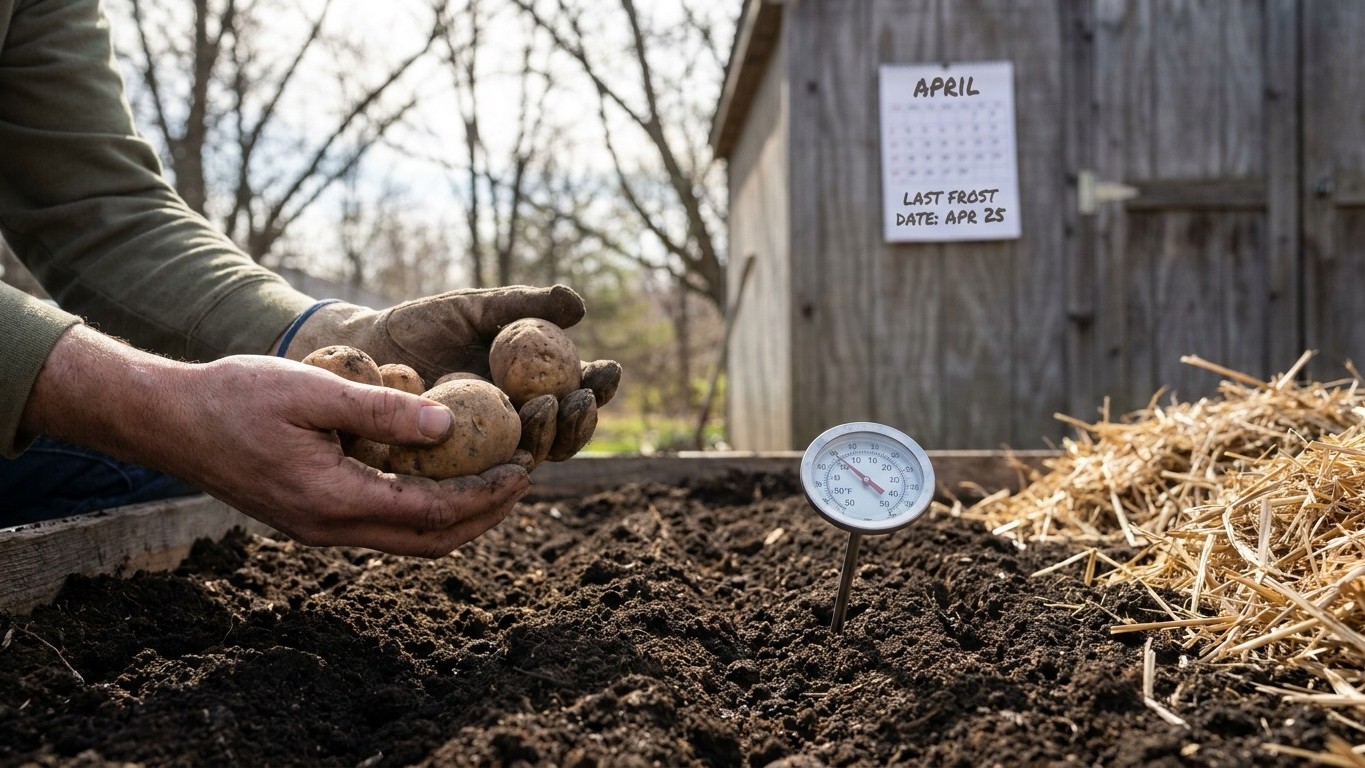

Potatoes go into Michigan soil 14 to 21 days before your last spring frost, timed to when soil temperature reaches 50 F, according to Utah State University Extension and the University of Maine Cooperative Extension. In the Detroit area, MSU Extension’s frost-free date data puts last frost around April 30, which puts potato planting in early-to-mid April. Across the rest of Michigan’s Lower Peninsula, where last frost lands early to mid May, that same math pushes planting back by two to three weeks.
The short answer
Counting back from frost sounds like a calendar exercise, but it’s really a soil-temperature exercise wearing a calendar’s clothes. Utah State University Extension and the University of Maine Cooperative Extension both anchor potato planting to a 50 F soil temperature, not to a date on a seed packet. The 14-to-21-day window before last frost is simply how long it usually takes soil to warm to that point once the freeze risk is easing. That’s why the same rule produces different planting weeks depending on where in Michigan a garden sits.
In the Detroit area, where MSU Extension’s frost-free date data lands around April 30, backing off 14 to 21 days lands most gardens in the first half of April. Move north or inland across the rest of the Lower Peninsula, where the last frost typically arrives in early-to-mid May, and the same counting method shifts the planting window into late April or the first half of May. Neither date is “correct” for the whole state. Michigan spans enough latitude and enough microclimate variation, lakeside versus inland, that a single statewide planting day was never going to hold up.
| Reference area | Typical last spring frost | Potato planting window (14–21 days before frost) |
|---|---|---|
| Detroit area | Around April 30 (MSU Extension) | Roughly early to mid April |
| Rest of Lower Peninsula | Early to mid May (MSU Extension) | Roughly late April to early May |
What this table doesn’t do is tell a gardener exactly when their own plot crosses 50 F. Soil warms unevenly. A raised bed against a south-facing wall can hit 50 F a week or more ahead of an open, low-lying garden a mile away. The frost date sets the outer boundary of the calculation; the soil thermometer sets the actual planting day.
What actually decides it
Soil temperature, not calendar date
The reason the 14-to-21-day window exists at all is that seed potatoes don’t respond to frost dates directly. They respond to the temperature of the ground they’re sitting in. Below 50 F, seed pieces sit largely dormant and are more vulnerable to rot before they can sprout. Once soil reaches and holds near 50 F, sprouting and early root development proceed reliably. A frost date is just a proxy, a rough marker of when soil in a given region tends to cross that threshold. That’s why the same 14-to-21-day count produces an early-April answer in the Detroit area and a late-April-to-early-May answer farther north or inland: the frost date moved, so the proxy moved with it, but the underlying rule, wait for 50 F soil, never changed.
The 90 F ceiling that ends tuber sizing
The other end of the season carries its own hard limit. Utah State University Extension and the University of Maine Cooperative Extension both document that once soil temperature climbs above 90 F, tuber set and tuber fill are inhibited. This isn’t a growth slowdown that irrigation can undo. Watering a potato patch through a heat wave keeps the foliage alive, but it doesn’t override what’s happening below ground once the soil itself has crossed that ceiling. This is the mechanism that should drive the whole planning conversation, more than any single planting date. A gardener who plants late, then watches July and August push soil temperatures up toward or past 90 F, isn’t dealing with a watering problem. They’re dealing with a timing problem that started weeks earlier. The practical takeaway carries beyond potatoes alone: any Michigan garden with a lot of full-sun, poorly-shaded, sandy soil should treat the early end of the 14-to-21-day window as the safer bet, because that soil heats up faster once summer arrives.
How to do it
- Track soil temperature starting a few weeks before your local frost-free date, using a soil thermometer placed at planting depth, and hold off until it reads near 50 F on multiple checks, not just one warm afternoon.
- Order certified seed potatoes rather than using tubers from a grocery store. Uncertified seed can carry virus that a certified lot has already been inspected against, and that single choice affects the whole season’s yield more than most other decisions made at planting time.
- Cut larger seed potatoes into pieces, each with at least one eye, a couple of days before planting, and let the cut surfaces callus over in open air before they go into the ground.
- Plant the seed pieces once soil has held at 50 F, spacing them in a trench with the cut side down and the eyes facing up.
- Hill soil up around the stems as the plants grow, which shields developing tubers from light exposure and helps moderate soil temperature near the root zone as the season warms.
- Watch soil temperature through the summer. Once it approaches the 90 F range documented by Utah State University Extension and the University of Maine Cooperative Extension, treat tuber sizing as effectively finished for that stretch, rather than expecting continued growth with more water.
What goes wrong
- Planting by calendar date instead of soil temperature. A gardener who plants on a fixed date every season, regardless of how cold or slow the spring has been, risks putting seed pieces into soil still well below 50 F, where rot is more likely than sprouting. The remedy is simple: check the soil with a thermometer before the day arrives, and let the reading, not the date, make the call.
- Using uncertified seed potatoes. Tubers pulled from a grocery bag or held over from a prior season without inspection can carry virus that spreads through the crop and reduces yield for reasons that have nothing to do with timing. Buying certified seed potatoes is the direct fix, and it’s a one-time decision made before any soil temperature question even comes up.
- Planting late and running into the 90 F ceiling. In warmer, sunnier, sandy-soil gardens, waiting toward the far end of the 14-to-21-day window, or past it, means tuber bulking can land right when midsummer soil temperature climbs toward the range that stalls tuber set. The remedy is to lean toward the earlier edge of that window and to favor an early season class of potato where a garden reliably runs hot in midsummer.
- Skipping hilling. Tubers that push up near the soil surface without enough hilled soil over them are exposed to more light and more heat swings. Building up soil around the stems as plants grow keeps developing tubers better insulated and out of direct light.
- Treating one Michigan frost date as statewide. A last-frost date pulled from a source describing the Detroit area doesn’t describe conditions in the rest of the Lower Peninsula, where frost typically lingers into early-to-mid May. The fix is to identify the frost-free date for the reference area closest to the actual garden, not the state as a whole, before doing the 14-to-21-day count.
Common questions
Can I plant potatoes before the last frost in Michigan?
Yes, and that’s the point of counting back from frost in the first place. Seed pieces planted 14 to 21 days before the last frost date sit underground while the soil is still cool, not exposed as foliage during an actual frost event. The timing is built around soil temperature reaching 50 F, which typically happens before the final frost has passed.
What if my soil doesn’t reach 50 F on the schedule I expected?
Wait. The 14-to-21-day window is a general guide tied to typical frost-free dates, but actual soil warming varies by garden. A soil thermometer reading below 50 F is the signal to hold off, regardless of what the calendar or a neighbor’s planting date suggests.
Does the 90 F soil ceiling actually matter in Michigan gardens?
Utah State University Extension and the University of Maine Cooperative Extension document that soil above 90 F inhibits tuber set and fill, and that mechanism applies wherever soil crosses that threshold, including sunny, sandy-soil gardens in warmer parts of Michigan during a hot stretch. The safest hedge is planting at the early edge of the recommended window rather than waiting.
Should I choose an early or late season class of potato in Michigan?
That depends on how much heat a given garden runs in midsummer. Neither Utah State University Extension nor the University of Maine Cooperative Extension publishes days-to-maturity figures for potato varieties, but both describe season class, early, mid-season, or late, along with intended use such as baking or boiling. A garden that reliably gets hot and sunny through summer benefits from an early season class planted at the front of the window.