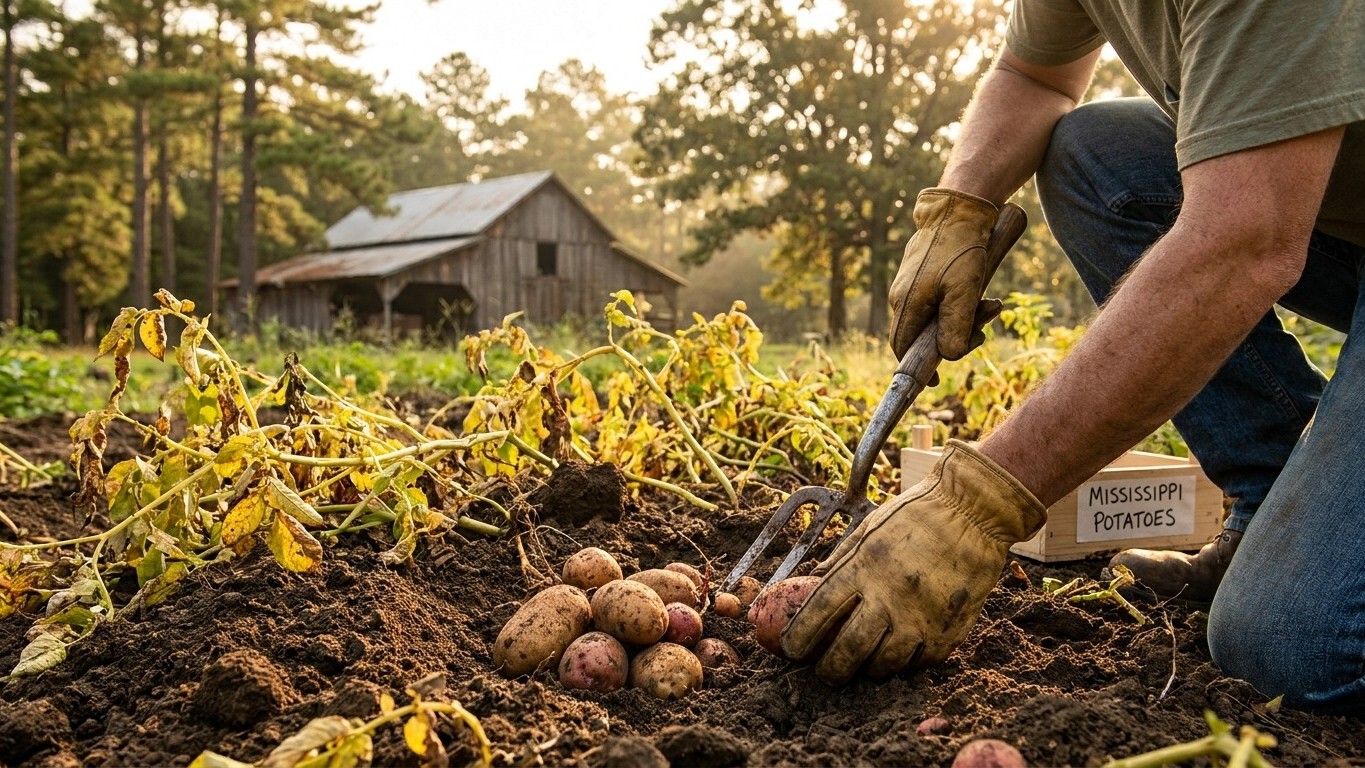

Mississippi potatoes come out of the ground on the calendar, not the thermometer, because vine die-back happens long before any real frost risk shows up. The bigger issue is storage: state winters rarely turn cold enough to threaten the crop, but they also don’t stay reliably in the 40-45°F range potatoes want, so an unheated space here behaves differently than it would farther north.
The short answer
Two figures set the frame for this state. The first fall frost typically arrives between November 7 and November 22 in the Jackson area (NOAA NCEI, 1991-2020 Climate Normals), and the mean minimum temperature during the coldest month sits at 36.6°F, also from the Jackson reference station. Those numbers come from an airport weather station, and gardens in the suburbs or out in the county often run a week or two cooler in fall than the airport does, so treat this window as a starting point and check local conditions before you commit to a digging date.
For most home growers here, potatoes go in the ground in late winter or early spring and come out well before that November frost window even becomes relevant. The crop matures and the foliage yellows and dies back during the warm months, and that die-back, not any frost threat, is what tells you it’s time to dig. If you’ve planted a fall crop instead, the frost dates above matter more directly, since a hard freeze reaching the soil can damage tubers left too long in the ground.
Storage is where the state’s mild winters actually work against you. A mean minimum of 36.6°F in the coldest month sounds close to freezing, and on the coldest individual nights an uninsulated, unheated space can dip below that average. But 36.6°F is also below the 40-45°F storage target that Utah State University Extension recommends, which means a garage or shed here won’t reliably hold potatoes at the ideal range all winter. Some nights it’ll be too cold; on milder stretches, which are common in Mississippi, it’ll run too warm and encourage sprouting. The state doesn’t hand you a natural potato cellar the way a colder climate might, so you’ll need to manage the space rather than trust it.
Curing, and where
Before storage even starts, freshly dug potatoes need to cure. Utah State University Extension recommends 55-60°F with high humidity for 2 to 3 weeks, a step that toughens the skin and helps small wounds from digging heal over so the tubers don’t rot in storage. In Mississippi, the challenge at harvest time usually isn’t finding somewhere warm enough, it’s finding somewhere that isn’t too warm, since a spring-dug crop often comes out of the ground when outdoor temperatures already sit well above 60°F.
- Dig on a dry day and let the potatoes sit on the soil surface for an hour or two out of direct sun, just long enough for loose dirt to dry and fall off without scrubbing the skin.
- Move them immediately out of full sun and heat. A shaded porch with airflow, an interior hallway, or a basement (where one exists) will run closer to the 55-60°F target than a closed garage baking in summer sun.
- Spread the tubers in a single layer, or in shallow crates, rather than piling them, so air reaches all sides and humidity stays even without pooling moisture against the skin.
- Check the space with a thermometer over the first few days. If it’s consistently running above 60°F, add a fan for airflow and move the crates to the coolest interior room you have, since a hot, still space invites rot rather than proper curing.
- Hold them there for 2 to 3 weeks, checking every few days and pulling out any tuber that shows soft spots or breaks down, before moving the batch into longer-term storage.
Basements are less common in this state than in colder regions, largely because of clay soils and high water tables, so plenty of Mississippi growers cure potatoes in a back room, a closet off a mudroom, or a shaded, screened porch instead. Any of those work as long as the temperature stays out of the summer heat and out of direct sun.
Storing through this winter
Long-term storage asks for something different than curing: dark conditions and 40-45°F according to Utah State University Extension, or 38°F at 95% humidity according to the University of Maine Cooperative Extension. Both ranges sit above freezing but below what most Mississippi homes run at room temperature, and that gap is the whole problem. The state’s coldest month averages a minimum of 36.6°F, close enough to the low end of these targets that an outbuilding without insulation can swing either direction depending on the night.
A detached garage or a garden shed will often drop near or below that 36.6°F average on the coldest nights of the season, and on those nights a fully uninsulated space risks dipping to freezing or below, especially if a cold snap pushes well past the average. That kind of exposure turns starchy tissue soft and eventually ruins the tuber from the inside. On the other end, the same space during a mild January week, which happens regularly in Mississippi, can climb into the 55-60°F range, which is warm enough to trigger sprouting and shorten how long the potatoes will keep.
The practical fix is an interior space that isn’t heated for daily living but also isn’t fully exposed to outdoor swings: an insulated closet on an exterior wall, a mudroom, or a lidded storage container with some insulating material inside, kept somewhere shaded and out of direct sun. Wrapping the storage container in an old blanket or packing straw around it on the coldest forecast nights can buy several degrees of protection without any equipment. Whatever the location, darkness matters as much as temperature, since light exposure turns skins green and encourages sprouting even when the temperature sits right in range.
What goes wrong here
- Curing space too hot. A closed garage or shed in late spring or summer easily exceeds 60°F by a wide margin, which speeds decay instead of healing wounds. Move the crop to the coolest shaded interior room available and add a fan for airflow.
- No basement to fall back on. Mississippi’s clay soils and high water tables mean many homes here don’t have a cellar at all. Use an interior closet or insulated container instead, and monitor it with a thermometer rather than assuming it behaves like a cellar would.
- Mild winter stretches sprouting the crop. Outbuildings can climb well above 45°F during warm January spells, common in this state, and sprouting shortens storage life fast. Check stored potatoes every couple of weeks and move them to a cooler spot if the space is running warm.
- A hard freeze reaching an uninsulated container. Even with a mild average, a single cold night can push an exposed space below freezing and ruin the batch. Insulate the container or bring it indoors briefly whenever a hard freeze is forecast.
- Fungal issues from humid digging conditions. Mississippi’s humidity at harvest time can encourage disease pressure in the field before the crop is even out of the ground. Where fungal problems appear during the growing season, an appropriate fungicide applied per label directions, along with good field drainage, reduces losses before storage begins.
- Bruised skins from summer heat handling. Digging in full midday sun softens skins and makes bruising more likely, which then rots in storage. Dig in the cooler morning hours and handle tubers gently rather than dumping them into buckets.
Common questions
When should I dig potatoes in Mississippi?
Timing follows the plant, not the calendar: dig once the foliage has yellowed and died back. For a fall-planted crop, keep the November 7 to November 22 frost window for the Jackson area in mind and finish digging before a hard freeze reaches the soil, checking your own county’s typical timing since it can run earlier than the airport station shows.
Can I store potatoes in a garage in Mississippi winter?
Sometimes, but not reliably on its own. An uninsulated garage can swing from near-freezing on the coldest nights to well above 45°F during mild stretches, both of which shorten storage life. Insulating the storage container and monitoring temperature works better than trusting the garage air alone.
Do I need a root cellar to store potatoes in this state?
No, and most Mississippi homes don’t have one because of soil and water table conditions. An interior closet, insulated container, or shaded mudroom kept dark and checked regularly can substitute for a cellar as long as it avoids both freezing and warm swings.
What’s the difference between curing and storage temperatures?
Curing happens first and briefly, at 55-60°F with high humidity for 2 to 3 weeks per Utah State University Extension, to heal skin and toughen tubers. Storage follows and runs cooler and longer, at 40-45°F per Utah State University Extension or 38°F at 95% humidity per the University of Maine Cooperative Extension, to slow sprouting and decay over the winter.