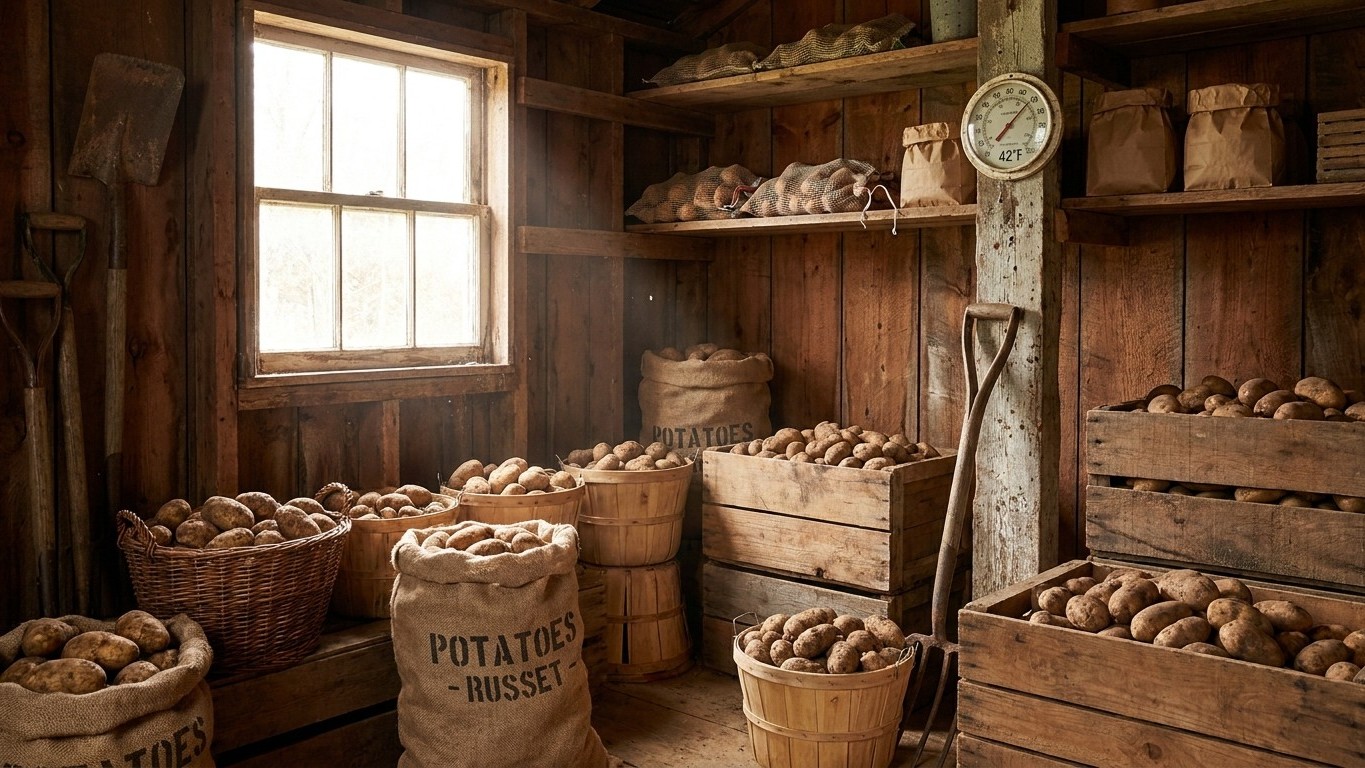

In South Carolina, potatoes come out of the ground in early summer, months before the first fall frost even shows up on the calendar. That timing matters more for storage than for harvest: curing needs 55-60°F and high humidity for two to three weeks, and long-term storage wants 40-45°F in the dark. An unheated garage or shed here won’t hold that range all winter. The coldest month averages a 38.9°F low, so storage tends to run cold rather than warm once winter actually settles in.
The short answer
Two numbers do the real work here. The first is the fall frost window: November 20 to December 5, drawn from NOAA’s 1991-2020 Climate Normals for a reference station near Charleston. That’s the 30 to 70 percent probability band for a 32°F freeze, not a hard cutoff. The second is the mean minimum of the coldest month: 38.9°F. That’s not a record low and not a monthly average temperature; it’s the average of the daily low readings across the coldest stretch of the year, and it’s the figure that decides whether a stored crop freezes.
Neither number governs when a South Carolina gardener actually digs potatoes. This is a spring-planted, early-summer crop here, and harvest is triggered by the vines dying back, not by any approach of fall frost. By the time that November-to-December frost window opens, most home-grown potatoes have already been out of the ground for months. Where the frost date and the coldest-month figure actually matter is storage: how a space that holds the crop through autumn and into winter behaves as outdoor temperatures drop.
That’s where the answer gets less comfortable. A mean minimum of 38.9°F sits right at the bottom edge of the 40-45°F storage target, and it’s an average. Roughly half the nights in the coldest month run colder than that, which means an unheated garage or shed on the coast will dip below 40°F regularly and occasionally flirt with freezing. Move inland or upstate and the picture tightens further: the caution attached to the frost data is explicit that peninsular Charleston runs milder than the airport station used for these normals, and the Upstate runs its frost dates several weeks earlier in fall and later in spring. An unheated space in Greenville or Spartanburg will see harder, more frequent freezes than one in Charleston or along the coast. So: mostly holds, on the coast, most winters, with real freeze risk on individual cold nights, and considerably less margin the farther inland you go.
Curing, and where
Curing wants 55-60°F with high humidity for two to three weeks, according to Utah State University Extension. The trouble in South Carolina isn’t winter cold, it’s summer heat, because curing happens right at harvest, in June or July, when outdoor temperatures routinely sit 25 to 35 degrees above that target. A shaded porch or an open garage does nothing useful here; both run into the 80s or 90s at exactly the time freshly dug potatoes need to be cool. Finding 55-60°F in a South Carolina summer usually means going indoors, not outdoors.
- Dig once the vines have yellowed and died back, working in dry soil and handling the tubers gently to avoid bruising or skinning the skin, which is thinner and more easily damaged at harvest.
- Skip washing. Brush off loose soil by hand and leave the rest for after curing; wet tubers going into a warm, humid space invite rot instead of a proper cure.
- Locate the coolest interior space available. A basement is ideal if the home has one, though basements are uncommon in much of South Carolina because of high water tables; a climate-controlled interior room, an unused closet, or a cool spare room is a realistic substitute where no basement exists.
- Spread the tubers in a single layer rather than piling them, so air can move around each one and humidity stays even across the batch.
- Hold that space at 55-60°F for two to three weeks before moving the cured potatoes into longer-term storage.
Storing through this winter
Storage wants dark conditions at 40-45°F, per Utah State University Extension, or a more specific 38°F at 95 percent humidity, per the University of Maine Cooperative Extension. Set against South Carolina’s coldest-month mean minimum of 38.9°F, those targets sit close together, closer than in most Southern states. That’s a useful coincidence: an insulated, unheated space on the coast can land right in the workable range through the heart of winter, without any added heat.
The catch is that “coldest month average” smooths over a lot of variation. On any given cold snap, that unheated space can slip well below 38°F, and in the Upstate, where the frost window opens weeks earlier and closes weeks later, the same structure runs colder for longer stretches. A detached, uninsulated shed offers almost no buffering; it tracks outdoor swings closely and can freeze on the sharpest nights even in a season with a mild average. A garage attached to a heated house, or an interior closet, buffers better and is a safer bet once night temperatures start dropping into the 30s.
Humidity is the other half of the equation, and it’s the part South Carolina storage setups usually get wrong in the opposite direction from cold-climate states. The University of Maine’s 95 percent figure assumes a controlled root cellar; a South Carolina garage or crawlspace in winter can actually run humid enough from ambient outdoor moisture, but that same humidity combined with any warm spell accelerates rot rather than helping the tubers hold. Checking stored potatoes every couple of weeks through winter, pulling any that have gone soft, and keeping the space dark are the practical, low-effort ways to manage that balance without special equipment.
What goes wrong here
- Curing in a hot garage instead of a cool room. Summer garage temperatures in South Carolina run far above the 55-60°F target, which softens skins and encourages rot rather than curing them. Move the batch to the coolest interior space in the house instead.
- Storing too warm in early fall. October and even parts of November stay mild across most of the state, well above the 40-45°F storage target, so a shed or garage that feels “cool enough” by hand often isn’t. Sprouting shows up early in years when the crop goes into storage before real cold arrives.
- Assuming the coastal average applies statewide. A storage setup that works fine near Charleston, where the frost window opens later and stays milder, can freeze solid in the Upstate on the same calendar date. Adjust storage location, or add insulation, based on local frost timing rather than a statewide rule of thumb.
- Disease pressure from warmth and humidity together. South Carolina’s combination of humid air and a long mild season favors storage rot and fungal issues more than in drier, colder climates. Utah State University Extension recommends an appropriate fungicide where disease pressure is a known issue in the field before harvest, which reduces what makes it into storage in the first place.
- Freezing on the coldest individual nights. Even with a coldest-month average near 39°F, single nights can drop well below that, especially inland. An unheated, uninsulated space has no buffer against those spikes, and a hard freeze ruins stored tubers as completely as a summer of neglect ruins a garden.
Common questions
When should potatoes be dug in South Carolina?
Harvest is tied to the vines dying back in early to mid summer, not to any fall frost date. By the time the region’s fall frost window opens between November 20 and December 5, home-grown potatoes are typically long out of the ground.
Does an unheated garage work for winter storage?
On the coast, often yes, since the coldest month’s mean minimum of 38.9°F sits close to the recommended range. Inland and upstate, where cold arrives earlier and lingers longer, an unheated, uninsulated garage carries a real freeze risk on the coldest nights.
Why does curing matter if potatoes are going into storage anyway?
Curing at 55-60°F for two to three weeks, per Utah State University Extension, toughens the skin and heals small nicks from digging. Skipping it in favor of straight-to-storage handling leaves tubers more prone to rot once they’re sitting in a dark, cool space for months.
What’s the biggest difference between coastal and Upstate storage?
Timing and margin. The Upstate’s frost dates run several weeks tighter at both ends than the coastal reference station, meaning cold arrives sooner and stays longer, which shrinks the window where an unheated space naturally sits in the 40-45°F range without help.