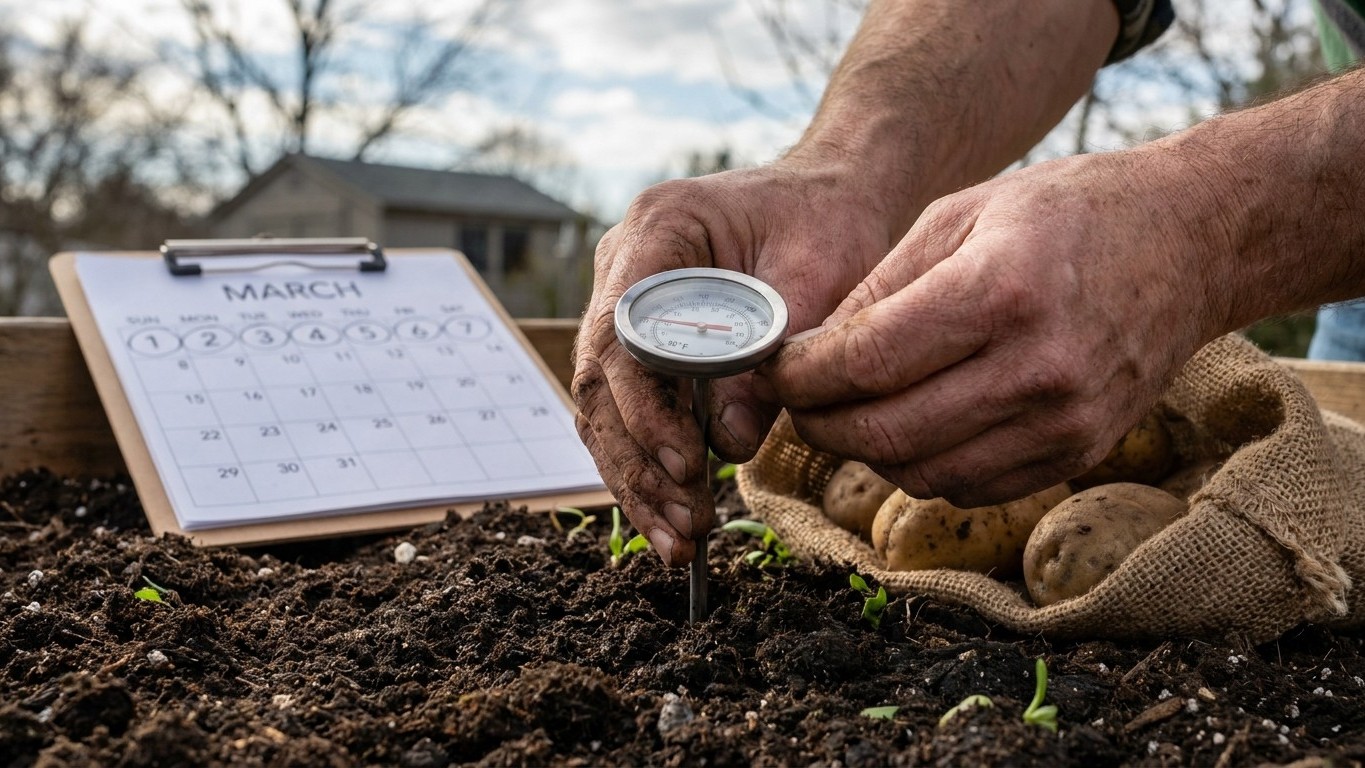

Mississippi gardeners plant potatoes 14 to 21 days before the last spring frost, once soil temperature hits 50 F, not on a fixed calendar date. Near Jackson, that frost window runs March 6 to March 22, per NOAA NCEI’s 1991-2020 climate normals. Count backward from your own county’s date, not Jackson’s, and let a soil thermometer make the final call.
The short answer
The window NOAA NCEI publishes for the Jackson airport station puts the last spring freeze somewhere between March 6 and March 22, based on the 30 to 70 percent probability band for 32 F in the 1991-2020 Climate Normals. That’s the number to start from, and it’s the only frost figure this page uses, because it’s the only one with a named source behind it.
Working backward from that window, and applying the planting guidance from Utah State University Extension and the University of Maine Cooperative Extension, seed potatoes go into Mississippi soil 14 to 21 days before whichever date applies to your spot. Run the math against the early end of the window (March 6) and you land in mid-February. Run it against the late end (March 22) and you’re pushing into early March. Either way, the planting decision isn’t really about the calendar square. It’s about whether the ground itself has warmed to 50 F, which is the threshold both extension sources use as the actual green light.
Here’s the catch with airport-based frost data: it comes from a paved, open, heat-retaining site, which almost always runs warmer than a shaded backyard or a low-lying rural garden. Suburban and rural properties in Mississippi typically see their last frost land later, sometimes by one to two weeks, and gardens at higher elevation lag further behind. So treat March 6 to March 22 as the Jackson-area reference point, not a promise for Tupelo, Hattiesburg, or a hollow outside Oxford. Pull your own county’s frost data before you commit seed to ground.
The other piece of the short answer, and the one gardeners in this state overlook most, is the ceiling on the other end of the season. Mississippi’s summer heat arrives fast, and potatoes stop sizing tubers once soil runs above 90 F. That single fact does more to set the Mississippi planting calendar than the frost date does. It’s the reason the smart move here is planting as early as soil allows and digging a spring crop, rather than trying to nurse plants through a Mississippi August.
What actually decides it
Soil temperature, not the date on the calendar
Frost dates get all the attention because they’re easy to look up, but potatoes don’t read calendars. Utah State University Extension’s guidance is specific: seed potatoes go in the ground once soil reaches 50 F, and that moment typically falls 14 to 21 days ahead of the last frost date for a given area. Soil warms slower than air, so a warm afternoon in late winter doesn’t mean the ground underneath is ready. A basic soil thermometer, pushed a few inches down at planting depth, tells you more than any date circled on a wall calendar. If your soil hits 50 F three weeks before your county’s typical last frost, that’s your signal, whether the calendar agrees or not.
The heat ceiling that ends the season early
The mechanism that decides more of the Mississippi potato calendar than anything else is the upper limit, not the lower one. Both Utah State University Extension and University of Maine Cooperative Extension identify soil temperatures above 90 F as the point where tuber set and tuber fill are inhibited. Once soil crosses that line, the plant’s underground growth effectively stalls, and no amount of extra watering reverses it. In a state where soil temperatures routinely climb into that range by early to mid summer, this isn’t a minor footnote. It’s the reason the entire planting strategy in Mississippi points toward getting potatoes in early and harvesting before peak heat, rather than planting late and hoping the plants push through summer. A gardener working from a cooler-climate frost chart alone, without accounting for this ceiling, will plant on schedule and still lose the crop to heat before harvest.
Local geography moves both ends of the window
Elevation, tree cover, and how close a garden sits to open water all shift frost timing away from what an airport station records. Low spots collect cold air and frost later into spring. A garden tucked against a wooded slope may warm slower in the mornings even after air temperatures elsewhere have climbed past 50. None of this shows up in a station-wide average, which is exactly why the Jackson figures are a starting reference, not a rule to apply unmodified across every county in the state.
How to do it
- Find your own county’s last spring frost date rather than relying solely on the Jackson-area window, since low-lying or rural gardens often run later than an airport station.
- Buy certified seed potatoes instead of grocery-store tubers. Certified seed is grown and inspected to be free of the viruses that build up in uncertified stock, and that single choice affects the whole season more than almost any other decision.
- Choose a season class suited to a short, heat-limited spring window: an early or mid-season type gives the plant more time to bulk tubers before soil crosses the 90 F ceiling.
- Cut larger seed potatoes into pieces with at least one or two eyes each, then let the cut sides dry and callus for a day or two before planting, which helps prevent rot in cool, damp soil.
- Check soil temperature at planting depth with a soil thermometer, and hold off until it reads at or near 50 F, even if that date falls earlier or later than the general frost-window math suggests.
- Plant seed pieces 14 to 21 days ahead of your local last frost date, once soil temperature confirms the ground is ready, cut-side down, in a trench a few inches deep.
- Hill soil up around the stems as plants grow, covering developing tubers and keeping them shaded from direct heat and light.
- Watch soil temperature as the season progresses, and plan to dig the spring crop before soil consistently climbs above 90 F, rather than leaving plants in ground through the hottest stretch of summer.
What goes wrong
- Planting by a fixed calendar date instead of soil temperature. A gardener who plants on “the usual date” without checking the ground can hit cold, wet soil that rots seed pieces before they sprout. Check soil temperature at planting depth and wait for 50 F, regardless of what the date says.
- Using uncertified seed potatoes from a grocery store or pantry. These often carry viruses that stunt growth and reduce yield, and the problem isn’t visible at planting time. Source certified seed potatoes instead, which are inspected specifically to avoid this.
- Planting late and letting the crop run into peak summer heat. Once soil passes 90 F, tuber set and fill stop, and extra irrigation won’t restart the process. Shift planting earlier in the window and treat the harvest as a spring crop rather than a summer one.
- Skipping hilling as plants grow. Tubers that push up near the soil surface get exposed to light and turn green, and green potatoes aren’t good eating. Hill soil around the base of the plants as they grow to keep developing tubers covered.
- Assuming a station-wide frost date applies exactly to a home garden. Airport-based averages like the Jackson figures skew earlier than many suburban and rural yards actually experience. Check local frost history for your specific county before finalizing a planting date.
Common questions
Can I plant potatoes before the last frost date in Mississippi?
Yes, and that’s actually the standard approach. Extension guidance from Utah State University calls for planting 14 to 21 days before the last frost date, once soil temperature reaches 50 F. Potato plants can tolerate some cold, and a light frost on emerging foliage typically doesn’t kill the plant outright.
How do I know if my soil is warm enough to plant?
Use a soil thermometer at the depth you intend to plant, generally a few inches down, and look for a reading at or near 50 F. This is the threshold both Utah State University Extension and University of Maine Cooperative Extension point to as the actual signal to plant, rather than a specific calendar date.
Why do potatoes struggle in Mississippi summers?
Soil temperatures above 90 F inhibit tuber set and fill, according to both extension sources cited here. Mississippi’s summer heat regularly pushes soil past that threshold, which is why the state’s growing strategy favors an early-planted spring crop harvested before peak heat rather than a crop left in ground through summer.
Should I choose an early or late-season potato variety for Mississippi?
An early or mid-season type generally fits Mississippi’s shortened window better, since it has less time to bulk tubers before soil crosses the 90 F ceiling. Neither Utah State University Extension nor University of Maine Cooperative Extension publishes exact days-to-maturity figures, so plan around the season class rather than a specific day count.