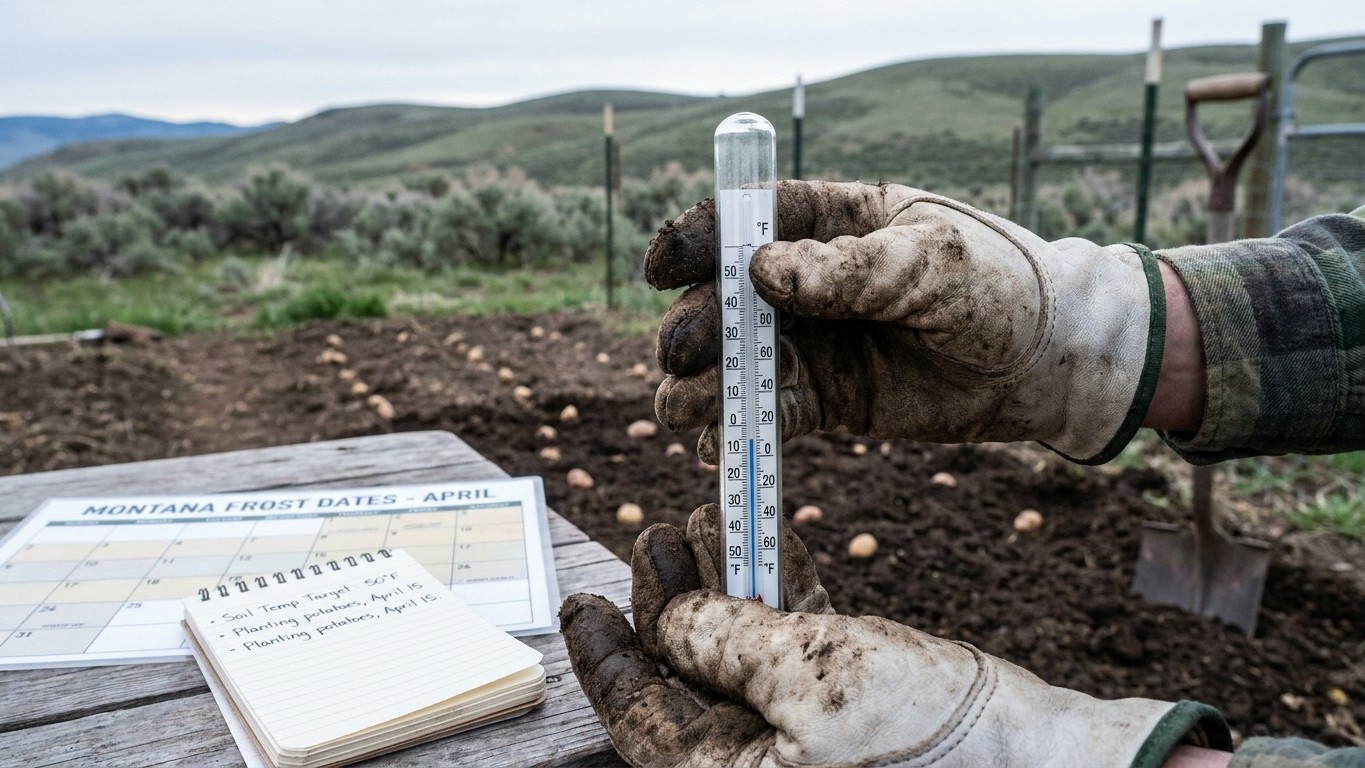

Plant potatoes in Billings between roughly April 8 and April 26, using the region’s last spring frost window of April 29 to May 10 as the anchor (source: NOAA NCEI 1991-2020 Climate Normals). The trick isn’t the frost date itself. It’s counting backward 14 to 21 days from it, because that’s when soil hits the 50°F mark potatoes actually need.
The short answer
For a gardener in Billings, the math is straightforward once you have the right anchor point. NOAA’s 1991-2020 Climate Normals put the 32°F freeze probability window (the 30-70% band) at April 29 to May 10 for that station. Utah State University Extension and the University of Maine Cooperative Extension both peg the actual planting trigger at soil temperature, not air temperature: potatoes go in once soil reaches 50°F, and that point typically arrives 14 to 21 days before the last frost date. Run the subtraction on the Billings range and you land somewhere between April 8 (21 days before April 29) and April 26 (14 days before May 10).
That’s a real window, not a single date, and the spread matters. A cold spring pushes the 50°F soil mark later even if the calendar frost date stays put. A warm early spring can get soil to 50°F well ahead of schedule. Neither Utah State nor Maine publishes a single “plant on this day” figure, because soil warms at different rates depending on how wet it is, whether it’s tilled, and which way a slope faces.
Here’s the part that trips people up: this isn’t really a frost-avoidance question. Potato foliage that gets nipped by a light, late frost usually recovers and regrows from the eyes below ground. Growers plant ahead of the frost date on purpose, accepting some foliage risk, because the alternative (waiting until frost has completely passed) pushes the crop later into the season and closer to the heat ceiling on the other end. That ceiling is 90°F soil temperature, above which tuber set and fill stop cold. Watering doesn’t fix it. Once the soil crosses that line, the plant’s energy goes nowhere useful until temperatures drop again.
So the short answer for Billings works out to a roughly three-week planting window in April. But that number belongs to one station in one valley. Move into the mountains and the entire calculation changes, sometimes drastically.
What actually decides it
The 50°F soil threshold, not the calendar
Seed potatoes don’t read calendars. They respond to soil temperature at planting depth. Below 50°F, seed pieces sit in cold, often wet soil and are far more likely to rot before they sprout than to grow. That’s the entire reason the 14-to-21-day-before-frost rule exists: it’s not a magic number, it’s an observed correlation between when soil typically crosses 50°F and when the last frost typically occurs. In a valley with heavy clay soil that stays cold and wet longer, the 50°F mark can lag well behind what the frost-date math predicts. In sandy, fast-draining soil with southern exposure, it can arrive earlier than the formula suggests.
The 90°F ceiling at the other end
The heat side of the equation is just as mechanical. Tuber set and fill are inhibited once soil temperature climbs above 90°F, according to Utah State University Extension. This isn’t a matter of the plant wilting or looking stressed. The tubers simply stop sizing, and once that window closes for the season, no amount of irrigation reopens it. This is why the planting date matters so much more for potatoes than for many other vegetables: get in too late, and the growing season effectively shortens itself from the far end, not just the near one.
Why elevation changes everything
Billings sits in one of Montana’s milder valley locations. Move to a higher mountain valley and the last frost date can arrive weeks later, or frost can show up in any summer month regardless of the calendar. A gardener in a mountain valley working from a Billings-based planting window would be planting far too early relative to their own soil conditions, risking seed rot in cold, still-frozen ground. The mechanism (count back 14 to 21 days from local last frost, plant once soil hits 50°F) stays the same everywhere. The dates it produces do not. That’s the reasoning tool worth keeping, more than any single date on this page.
How to do it
- Find the last spring frost data for a weather station near your own location, not just a statewide average. A single figure for Montana as a whole hides enormous variation between a low valley like Billings and a high mountain valley elsewhere in the state.
- Starting about three weeks ahead of that local frost date, begin checking soil temperature at planting depth with a soil thermometer rather than guessing from air temperature or the calendar.
- Order certified seed potatoes ahead of time, choosing an early, mid-season, or late season class based on how quickly summer heat typically arrives in your area. Uncertified seed can carry virus that undermines the whole crop, so certified seed is the one step worth never skipping.
- Cut and plant seed pieces once soil reads 50°F, which should fall roughly 14 to 21 days before the local last frost date.
- Hill soil up around the stems as plants grow, both to protect emerging foliage from an occasional late frost and to keep developing tubers covered.
- Track soil temperature again as summer approaches. If daytime soil readings are climbing toward the 90°F range, plan to dig the crop before that threshold arrives rather than letting it sit in ground that’s stopped sizing tubers.
What goes wrong
- Planting by the calendar instead of the soil. A gardener plants on a fixed date because “that’s when it’s always been done,” ignoring that a cold, wet spring hasn’t brought soil to 50°F yet. The remedy is simple: use a soil thermometer at planting depth and let the reading, not the date, decide.
- Planting too late in a hot region. Waiting until all frost risk has passed pushes planting later, which pushes tuber fill later, which runs the crop straight into 90°F soil before it’s finished sizing. The fix is to plant at the early end of the window and choose an early season class where summer heat historically arrives fast.
- Using uncertified seed potatoes. Seed saved from a grocery store potato or an unverified source can carry virus that stunts the plant or reduces yield without any obvious symptoms until harvest. Buy certified seed potatoes every time.
- Assuming one Montana date applies everywhere. A planting window built from Billings data doesn’t transfer to a mountain valley that can see frost in any month. Pull frost data for a station close to the actual planting site, not a statewide figure.
- Ignoring the heat ceiling entirely. Some gardeners watch only for frost and never track summer soil temperature. Once soil crosses 90°F, tuber fill halts regardless of watering, so the harvest date should be planned around that ceiling as carefully as planting is planned around the frost date.
Common questions
Does a light frost after planting kill the potato crop?
Usually not. Foliage that gets nipped by a late, light frost typically regrows from the eyes below ground, which is part of why growers accept some frost risk by planting ahead of the last frost date rather than waiting for it to fully pass.
Can I use air temperature instead of a soil thermometer?
Air temperature is a poor substitute. Soil warms at a different rate than air depending on moisture, drainage, and sun exposure, and both Utah State University Extension and the University of Maine Cooperative Extension tie the planting trigger to soil reaching 50°F specifically, not to an air temperature reading.
Why does the source material avoid giving a days-to-maturity number for varieties?
Neither Utah State University Extension nor the University of Maine Cooperative Extension publishes a specific days-to-maturity figure for potato varieties. Both instead classify varieties by season class (early, mid-season, or late), which is the more reliable way to plan a harvest around a region’s frost and heat windows.
Is the Billings frost window useful for other parts of Montana?
Only as an example of the method, not as a number to copy directly. Billings is one of the milder valley locations in the state. Mountain valleys elsewhere can experience frost in any month, so the same 14-to-21-day-before-frost calculation needs to be run against local frost data, not the Billings figures.