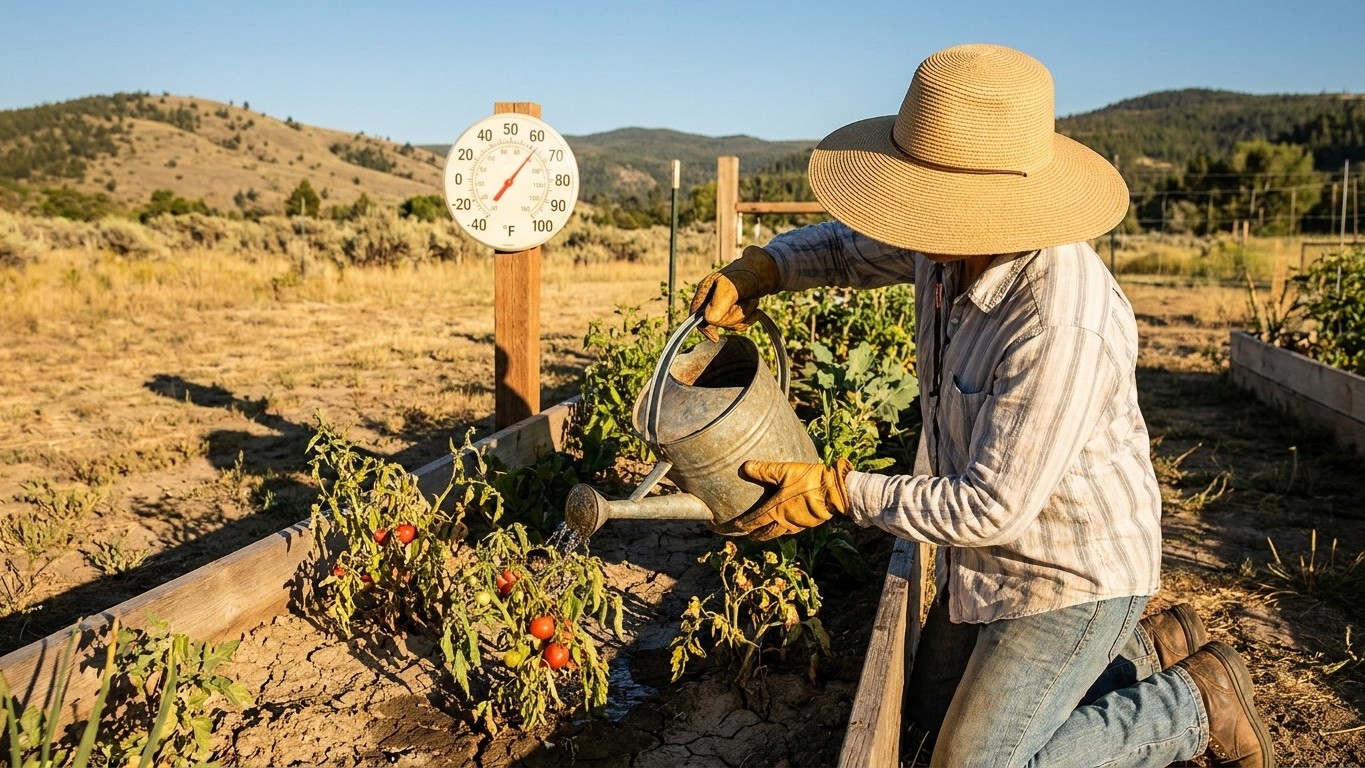

Montana gardens live and die on two numbers: how many days climb past 90F each summer, and how far apart the rain actually falls. At the reference station in Billings, the average is 28.3 days a year at or above 90F, according to NOAA’s 1991-2020 Climate Normals. That number alone tells you this isn’t a state where you can set a sprinkler timer once in May and walk away.
What the climate asks of you

Start with the heat. Billings averages 28.3 days a year above 90F, per NOAA NCEI’s 1991-2020 Climate Normals. That’s nearly a month of the growing season spent in stress territory for most vegetables and lawns, and it’s the figure that rules out cool-season grasses or shade-loving crops as a set-and-forget choice across much of the state.
Montana’s growing season is also short and unpredictable at the edges. Billings sees its last spring freeze between April 29 and May 10, and its first fall freeze between October 1 and October 14, based on the 30-70% probability band in NOAA’s 1991-2020 Climate Normals. That’s a window of roughly five months to get a garden planted, established, and harvested before frost returns. Gardeners in mountain valleys elsewhere in the state should treat those dates as optimistic; frost can arrive in any month at higher elevations.
The USDA Plant Hardiness Zone Map (2023 edition, based on 1991-2020 averages) places Montana across zones 3a to 6a. That’s a wide spread, from the coldest river bottoms and high valleys to the milder stretches near Billings. It means a planting or watering schedule built for one part of the state can be flatly wrong fifty miles away. When you’re dated a specific recommendation, treat Billings as a reference point, not a rule for the whole state.
The math you’re actually doing
A typical vegetable bed or lawn wants somewhere around an inch of water a week during the growing season. In a state where summer days regularly push past 90F and rainfall is inconsistent and often light east of the Continental Divide, that inch rarely falls on its own schedule. The gardener ends up supplying most of it, and on sandy or gravelly soils, which are common in river valleys like the Yellowstone, that water drains fast and needs to be replaced more often than it would on heavier ground. Check your local NOAA Cooperative Observer or Extension office for the actual rainfall pattern in your county before you build a schedule around a number you haven’t confirmed locally.
How much, how often
The rule that holds up almost everywhere in Montana is the same one that holds up in most dry Western states: water deep and water rarely, not shallow and often. A quick daily sprinkle wets only the top inch or two of soil, which trains roots to stay near the surface, right where the 90-degree days bake them hardest. Deep watering pushes moisture down to six or eight inches, where roots can actually reach it during a heat spell. This becomes especially critical when tackling Watering Through a Dry Spell in Montana, when those deep reserves are what keep a garden alive. The same principle applies to container gardens, though the details differ enough that it’s worth reading up on Watering Pots and Containers in Montana before assuming your raised beds or lawn schedule will transfer directly.
The simplest way to know when to water is to check the soil, not the calendar. Push a finger, or a trowel, about two inches down near the base of the plant. If it’s dry at that depth, it’s time. If it’s still cool and damp, wait. This single habit prevents the two most common mistakes: watering a bed that doesn’t need it, and letting one bake for days because the schedule said Tuesday.
Soil texture changes the plan more than most gardeners expect. Sandy and gravelly soils, common along Montana’s river valleys, hold onto very little moisture and need shorter, more frequent soakings to keep up with fast drainage. Heavy clay, more common in some benchlands and pockets across the state, holds a week’s worth of water but punishes overwatering badly. Clay that’s watered while still wet doesn’t drain, it drowns roots and compacts underfoot, and working or soaking clay before it’s actually dried out does long-term damage to its structure. Given the state’s frost-free window running roughly from early May to early October in the Billings area, and dry stretches during the growing season, most gardens here are effectively on irrigation, not on rainfall, for a good part of the summer.
A watering routine that works on Montana ground
- Check soil moisture two inches down at the base of the plant before turning anything on.
- Water early in the morning, before the heat of the day sets in and before wind picks up, which is common on the plains.
- Aim water at the soil and the base of the stem, never at the leaves, to cut down on fungal problems in humid pockets.
- On sandy or gravelly soil, water in shorter sessions two to three times a week rather than one long soak.
- On clay soil, water less often but more deeply, and let it dry most of the way between sessions.
- During stretches with several days above 90F, check soil moisture daily rather than relying on the usual schedule.
Restrictions and rules
Montana doesn’t have a single statewide watering ordinance that applies to every yard. Rules come from individual municipalities, irrigation districts, and water utilities, and they change from year to year depending on snowpack, reservoir levels, and drought declarations. A town drawing from a river system under stress in a low-snowpack year can impose odd-even watering days or time-of-day restrictions with little notice, while a neighboring district on a different water source may have none at all.
This matters more in Montana than in wetter states, precisely because so much of the growing season depends on supplemental watering rather than rainfall. A gardener who assumes unlimited access to a hose in July, based on last year’s rules, can be caught off guard by a mid-summer restriction notice. The safest approach is to check with your city or county water provider, or your local irrigation district if you’re on one, before the growing season ramps up, and again if a drought is declared.
For guidance specific to your county, soil, and local water rules, the Montana State University Extension Service maintains resources and county offices across the state, reachable through montana.edu/extension. They track drought conditions and can point you to the correct water authority for your address, which is more useful than any general rule printed in an article like this one.
Using less
Cutting water use in a Montana garden isn’t about sacrificing a productive yard. Most of the savings come from a handful of habits that also happen to reduce weeding, mowing, and general maintenance.
- Mulch: A two- to three-inch layer of straw, wood chips, or shredded leaves over garden beds slows evaporation dramatically, which matters most during the 28-plus days a year that push past 90F in the Billings area and even more in hotter pockets of the state.
- Drip irrigation: Delivers water directly to the root zone instead of spraying it into the air, where wind common across Montana’s open plains carries a real share of it away before it ever reaches the soil.
- Grouping plants by water need: Keeping thirsty vegetables like tomatoes and squash separate from drought-tolerant natives or perennials means you’re not overwatering the tough plants just to keep the thirsty ones alive.
- Organic matter in the soil: Working compost into sandy soil helps it hold water longer between sessions; working it into clay improves drainage so it doesn’t stay soggy after a deep soak.
- Rain barrels, where legal: An inch of rain falling on a 1,000-square-foot roof yields roughly 600 gallons of runoff. In a state where summer rainfall is often light and unevenly spread, that barrel fills slowly during the driest stretches of July and August and can sit empty for weeks at a time, so it’s a supplement to a well, tap, or municipal line, not a replacement for one. Some Montana municipalities and irrigation districts have their own rules on rainwater collection, so it’s worth a quick check with your local water provider before installing one.
Common questions
How often should I water a vegetable garden in Montana during summer?
Most vegetable beds need roughly an inch of water a week, but on sandy soil that often splits into two or three shorter sessions, while heavier clay soil can go longer between deep soakings. Check soil moisture two inches down rather than following a fixed calendar, especially during stretches of 90-degree days.
Does Montana have statewide watering restrictions?
No. Restrictions come from individual cities, utilities, and irrigation districts, and they shift year to year based on drought and reservoir conditions. Check with your local water provider or the Montana State University Extension Service for current rules in your area.
When can I safely plant without worrying about frost?
In the Billings area, the last spring freeze typically falls between April 29 and May 10, and the first fall freeze between October 1 and October 14, based on NOAA’s 1991-2020 Climate Normals. Higher mountain valleys elsewhere in Montana can see frost far outside that window, so treat these dates as a reference, not a guarantee.
Is my soil sandy or clay, and why does it matter for watering?
A simple squeeze test tells you a lot: soil that falls apart immediately when squeezed damp is sandy and drains fast, while soil that holds a tight ball is closer to clay and drains slowly. Sandy soil needs more frequent, lighter watering; clay needs less frequent but deeper watering, and should never be soaked or worked while it’s already wet.