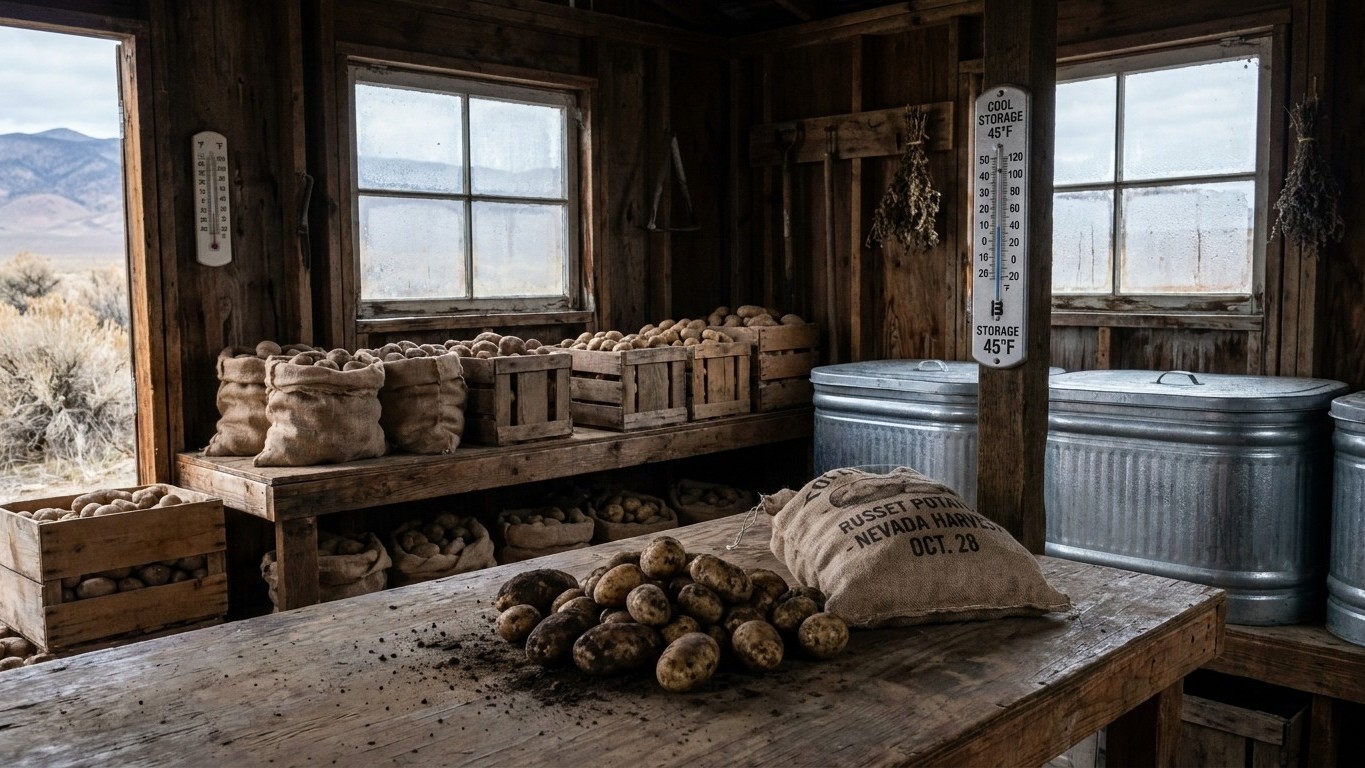

In most of Nevada, potatoes come out of the ground before the local first frost, which arrives far earlier at elevation than in the Las Vegas valley. Curing needs 55-60°F and high humidity for two to three weeks. Storage needs a dark space near 40-45°F. Whether an unheated garage or shed in your part of the state actually holds that range through winter is the real question, and the answer changes sharply between Las Vegas, Reno, and the high desert in between.
The short answer
NOAA’s Climate Normals for the Las Vegas reference station put the first fall freeze in a 30-70% probability window running from December 8 to December 23, and the mean daily minimum of that station’s coldest month sits at 39.6°F. Those two numbers matter, but only for the low desert around Las Vegas. This is a station sitting in a desert basin with a strong urban-heat-island effect, and it is not a workable planting or storage calendar for the rest of Nevada.
Nevada is mostly not Las Vegas. Reno, Carson City, and the rural high desert that makes up most of the state sit at elevations of 4,000 to 6,000 feet or more, and frost there shows up months earlier in fall and lingers months later in spring than anything the Las Vegas station records. A grower in Washoe or Douglas County who plans a harvest around a Las Vegas frost date will lose the crop to an early freeze that the valley figures never hint at. The only reliable move is to check frost timing with your county extension office rather than borrow a number from the far end of the state.
The 39.6°F mean minimum for Las Vegas’s coldest month does answer one practical question for growers in that specific region: an unheated interior space there, a closet or an attached garage that shares a wall with the house, will hover close to the low end of the 40-45°F storage target most winters, without the hard freezes that ruin a stored crop outright. That is a fairly forgiving number. It does not describe an unheated shed in Carson City or a detached garage on a ranch outside Elko. In those places, winter cold runs well past what the Las Vegas figure suggests, and an unheated outbuilding is a real freezing risk, not a marginal one. The practical split in this state is elevation: low desert basins where an unheated space is workable with some care, and everywhere higher and farther north where it is not.
Curing, and where
Utah State University Extension specifies curing at 55-60°F with high humidity, held for two to three weeks, before potatoes go into long-term storage. Finding that combination in Nevada at harvest time takes some deliberate choices, because the state’s air runs dry almost everywhere and its fall temperatures swing between still-hot desert afternoons and cold nights at elevation.
- Dig before the local frost, not the Las Vegas frost. Time the harvest to your own county’s typical first freeze, confirmed with your extension office, since a plan built around the December 8 to December 23 window will strand the crop in the ground almost anywhere outside the Las Vegas valley.
- Lift the tubers on a dry day and knock off soil without washing them. Washing adds moisture the dry Nevada air will fight throughout curing and invites the rot that humidity control is meant to prevent.
- Move them out of direct sun immediately. Early-fall sun in the low desert can still push surface temperatures well past the 55-60°F target, and full sun anywhere in the state will green the skins.
- Choose the space based on your region. Basements are uncommon in most Nevada home construction, which tends toward slab foundations, so that classic curing spot often is not available. A shaded, covered porch works well in the cooler weeks of late fall in the valleys. A detached garage or shed works in the high desert once daytime temperatures have dropped out of the heat but before hard freezes set in, provided it stays shaded and out of direct airflow.
- Add humidity by hand. Because Nevada’s air is dry almost everywhere, drape the tubers with damp burlap or keep them in ventilated boxes with a light misting every few days rather than relying on ambient moisture, which this climate simply does not supply.
- Check every few days and pull any tuber that softens or shows damage before it affects the rest of the batch.
Storing through this winter
Utah State University Extension recommends a dark storage space held at 40-45°F. The University of Maine Cooperative Extension gives a tighter target of 38°F at 95% humidity. Both point the same direction: cold, dark, and humid, which is a combination Nevada’s climate does not hand you for free in either half of the target range or the humidity.
In the Las Vegas valley, the 39.6°F mean minimum of the coldest month means an interior closet or an attached, unheated garage will usually sit close to the low end of the USU range through winter without freezing solid. That is workable storage, but it is close enough to the edge that a hard cold snap can still push an exposed corner below freezing, so keeping the container away from exterior walls and off a concrete floor is worth the small effort.
Farther north and at elevation, in Reno, Carson City, and the rural high desert, winters run considerably colder than that Las Vegas figure, and an unheated detached shed or garage is a genuine freezing risk rather than a borderline one. A frozen potato does not recover; the cell walls rupture and the tuber turns to mush on thawing. Growers in those regions need an insulated space, an interior closet away from heat vents, or a partially heated area that can be watched with an actual thermometer rather than assumed safe. On the other end of the risk, a mudroom or utility room near a furnace can easily run warmer than 45°F, which triggers early sprouting well before the stored potatoes should be used.
The humidity side needs its own fix statewide. Nevada’s arid air will pull moisture out of stored tubers no matter which region you’re in, so lining the storage container with damp sand, perforated plastic, or slightly moistened newspaper helps close the gap toward the 95% humidity the Maine extension describes, and it’s worth checking every few weeks rather than assuming the container holds moisture on its own.
What goes wrong here
- Harvesting on a calendar built for the wrong part of the state. Using a Las Vegas-area frost expectation anywhere in northern or high-elevation Nevada leaves the crop in the ground when an early freeze hits. Confirm your local first-frost window with your county extension office instead.
- Curing in a hot garage during early fall. Low desert garages can still sit near 90-100°F in early September, well above the 55-60°F Utah State University Extension calls for, which encourages rot rather than proper skin-set. Wait for cooler weeks or use a shaded porch instead.
- Letting the dry air shrivel the crop during curing or storage. Nevada’s low ambient humidity works against both stages. Damp burlap, perforated bags, or a layer of moist sand keeps tubers from shriveling faster than the recommended curing and storage windows allow.
- Storing in an unheated outbuilding in the high desert or Reno-Carson corridor. Winter cold there runs well past what the Las Vegas 39.6°F figure would suggest, and a hard freeze in a detached shed ruins the crop outright. Move storage to an insulated interior space and check it with a thermometer through the coldest weeks.
- Storing too close to a furnace or heat vent. Because many Nevada homes lack basements, potatoes often end up in a mudroom or closet near mechanical equipment, where temperatures climb well above the 40-45°F target and sprouting starts early. An unheated interior closet away from heating equipment works better.
Common questions
What temperature should I store potatoes at in Nevada?
Follow the same targets used anywhere: Utah State University Extension recommends 40-45°F in a dark space, while the University of Maine Cooperative Extension specifies 38°F at 95% humidity. Which one you can hit depends on your region; the Las Vegas valley’s cold-month mean minimum of 39.6°F sits close to both, while northern and high-elevation Nevada needs an insulated or interior space to avoid freezing.
Can I cure potatoes outside in Nevada?
Only in shade, and only once temperatures have cooled from summer highs. A covered porch works in the cooler fall weeks in valley regions; a shaded shed or garage works at elevation once the heat has broken but before hard frost sets in. Direct sun anywhere in the state defeats the purpose within hours.
Does Nevada’s dry climate affect potato storage?
Yes, more than most other factors. Both Utah State University Extension and the University of Maine Cooperative Extension call for high humidity during curing and storage, and Nevada’s air runs dry statewide. Damp burlap, perforated bags, or moist sand added to the storage container makes up for the lack of ambient moisture.
When should I harvest potatoes in Nevada?
Timing depends on where in the state you are. The Las Vegas area’s first fall freeze falls in a window of December 8 to December 23 per NOAA’s Climate Normals, but that is a desert lowland figure and does not apply to Reno, Carson City, or the high desert, where frost arrives far earlier. Check your local first-frost timing with your county extension office before setting a harvest date.