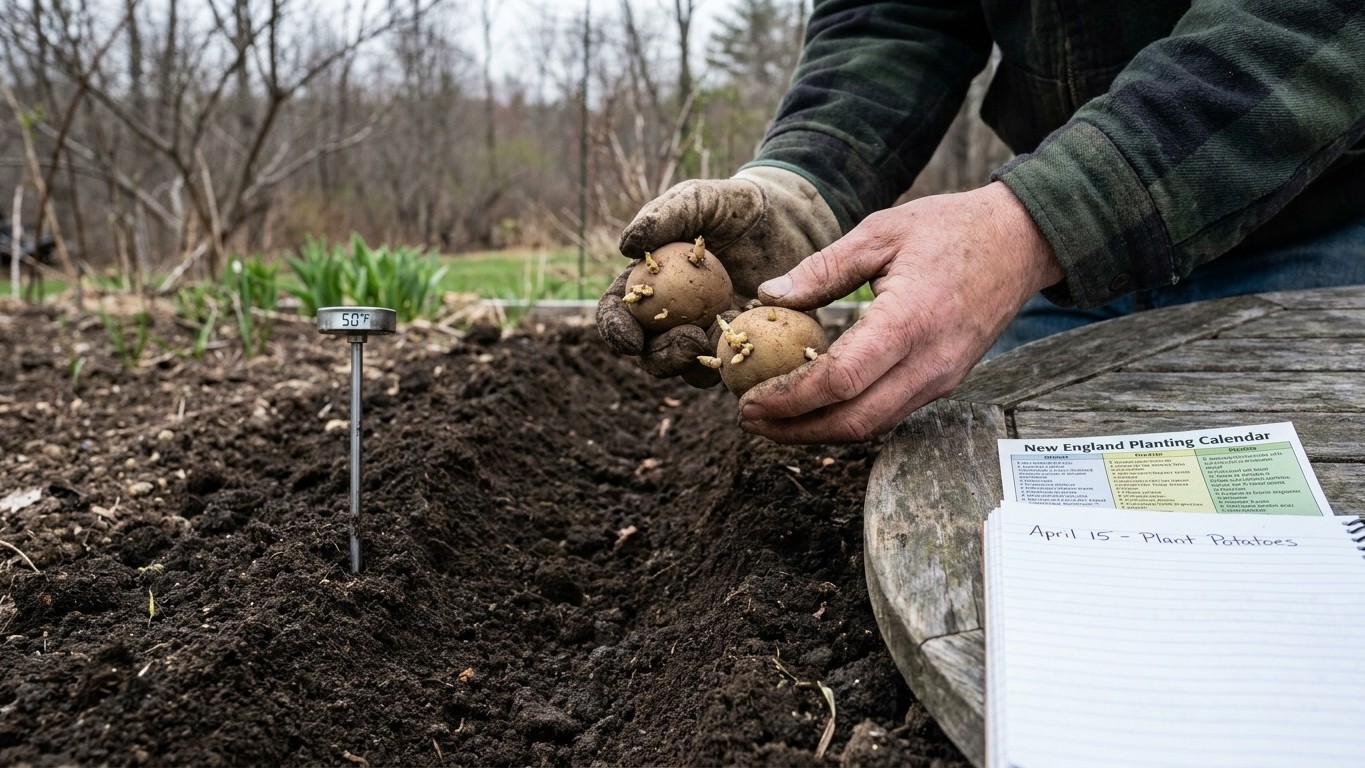

In the Concord, New Hampshire area, the last spring frost falls between April 16 and April 27, based on NOAA’s 1991-2020 climate normals. Potatoes go into the ground 14 to 21 days before that date, once the soil itself reaches 50°F, according to Utah State University Extension and the University of Maine Cooperative Extension. For most Concord-area gardens, that lands in the last week of March through the first ten days of April. Your own yard may run later.
The short answer
Start with the number: April 16 to April 27 is the window NOAA’s National Centers for Environmental Information gives for the last spring freeze at the Concord, New Hampshire weather station, drawn from the 1991-2020 U.S. Climate Normals. That’s not a guess pulled from folklore. It’s a 30-year statistical band built from freeze probabilities at that one specific station.
Count back 14 to 21 days from either end of that band and you land somewhere between late March and mid-April for a typical Concord-area yard. If you’re aiming off the early end of the frost window (April 16), your planting target runs from roughly March 26 to April 2. If you’re working off the later end (April 27), the target shifts to April 6 through April 13. That spread exists because Utah State and Maine Extension both frame the 14-to-21-day rule as a range, not a fixed number, since soil conditions vary from one spring to the next even at the same address.
Here’s the catch that matters more than the calendar math: the station behind that NOAA figure sits at an airport. Airport tarmac and open fields warm up faster in spring than a shaded suburban lot, a low-lying field, or anything with elevation gain. Gardens outside the immediate Concord area, especially those tucked into valleys, near the Connecticut River, or up toward the White Mountains, commonly see their last frost land one to two weeks later than the airport’s number suggests. The reverse can be true in first fall frost, which tends to arrive earlier away from the station.
That means the April 16-27 figure is a reference point, not a promise for your particular county. Anyone gardening outside the Concord area should treat this window as a starting estimate and adjust based on their own frost history or a nearby cooperative extension office, then apply the same 14-to-21-day count-back once they have a locally accurate date.
What actually decides it
The calendar date isn’t what a potato plant responds to. Soil temperature is. Everything about when to plant traces back to two thresholds published by Utah State University Extension and the University of Maine Cooperative Extension, and understanding both lets you plant confidently even in a spring the frost-date average doesn’t predict well.
The 50°F soil floor
Potatoes go into the ground as soon as soil temperature hits 50°F, which is why the 14-to-21-day count-back exists in the first place: it’s an estimate of how long it typically takes soil to warm from bare-ground conditions to that mark, not a rule with its own independent logic. In a cold, wet spring, soil can lag well behind that estimate even after the calendar says you’re within the window. In a dry, sunny stretch, soil can hit 50°F faster than the count-back suggests. The count-back is a planning tool for buying seed and prepping beds. The actual green light is a soil thermometer reading, not a date on a page.
The 90°F heat ceiling
The other threshold sits at the far end of the season and matters just as much, even though it gets less attention. Tuber set and tuber fill both shut down when soil temperature climbs above 90°F, and watering doesn’t reverse that. This is a hard biological ceiling, not a stress the plant can push through with extra irrigation. New Hampshire’s shorter, cooler summers keep most of the state well under that ceiling for most of the growing season, but conditions vary sharply by region. A sandy, south-facing plot in the Merrimack Valley heats up differently than a shaded bed farther north, and gardeners should watch their own soil rather than assume the state’s general climate protects every yard equally. Where extended hot stretches are common, the workable strategy is planting as early as the soil allows and digging an early crop, not stretching the season and hoping tubers size up once temperatures cool back down.
How to do it
- Find your own town’s typical last frost pattern rather than relying solely on the Concord-area figure, since gardens outside that immediate area often run one to two weeks later.
- Count back 14 to 21 days from your local last-frost estimate to set a target planting window, understanding it’s a starting point, not a fixed date.
- Check actual soil temperature with a garden thermometer inserted into the bed rather than trusting the calendar alone, and hold off until the reading reaches 50°F.
- Buy certified seed potatoes rather than grocery-store potatoes or tubers saved from a home bin. Uncertified seed can carry virus that reduces vigor and yield.
- Cut larger certified seed potatoes into pieces, making sure each piece carries at least one healthy eye, and let the cut surfaces callus over for a day or two before planting.
- Plant once soil has reached 50°F, working the seed pieces into well-drained, workable soil.
- Hill soil up around the stems as plants emerge and grow, which protects developing tubers near the surface.
- Track soil temperature through the growing season, and if extended stretches above 90°F show up in your area, plan to dig an early crop rather than let tubers sit through the heat.
What goes wrong
- Planting by date instead of by soil temperature. A calendar-based planting during a cold, wet spring puts seed pieces into soil that’s still too cool, which invites rot before sprouting even starts. Check soil temperature directly and wait for a genuine 50°F reading before planting, regardless of what the count-back suggested weeks earlier.
- Using uncertified seed potatoes. Grocery-store potatoes and tubers saved from a previous home harvest can carry virus that a home gardener has no easy way to detect. The plant may still grow, but yield and vigor suffer, sometimes for more than one season. Buy certified seed potatoes from a reputable source instead.
- Assuming the Concord-area frost date applies everywhere. Gardens away from that airport station, especially at elevation or in low-lying rural spots, often see a later last frost by one to two weeks. Planting on the Concord schedule in one of those locations risks frost damage on emerging shoots. Adjust the target window later, or use row cover if you’ve already planted ahead of your actual local frost date.
- Expecting a hot summer to finish sizing the tubers. Once soil climbs above 90°F, tuber set and fill stop, and no amount of extra watering brings that back. Plant early enough to size tubers before the hottest stretch of summer arrives, and dig that crop early in regions where sustained heat is common rather than waiting for a full season to play out.
- Choosing a season class without matching it to the local heat pattern. Utah State and Maine Extension publish season class, meaning early, mid-season, or late, but neither source publishes a fixed days-to-maturity number for any variety. Treat season class as a guide to plan around your soil’s heat pattern, not a countdown you can circle on a calendar.
Common questions
What’s the actual date to plant potatoes in New Hampshire?
There’s no single statewide date. For the Concord-area station, NOAA’s 1991-2020 climate normals put the last spring frost between April 16 and April 27, and counting back 14 to 21 days from that range puts most Concord-area planting in late March through mid-April. Gardens elsewhere in the state should adjust based on their own local frost pattern, since many run later than the airport figure.
Can I plant potatoes before the last frost date?
Yes, that’s the intended approach. The 14-to-21-day count-back exists specifically because potatoes are planted before the last frost, not after it, based on when soil temperature reaches 50°F rather than when frost risk fully ends.
Do I really need certified seed potatoes, or can I use ones from my own harvest?
Certified seed potatoes are the safer choice. Seed saved from a home harvest or bought from a grocery store can carry virus that isn’t visible at planting time but shows up later as reduced vigor and lower yield.
What if my soil hasn’t reached 50°F by the time the count-back suggests I should plant?
Wait for the soil, not the calendar. The count-back is an estimate built around typical warming patterns, but actual soil temperature is the real signal Utah State and Maine Extension point to. A cold, slow spring can push the true 50°F date later than the estimate, and planting into soil that hasn’t reached that mark raises the risk of seed piece rot.