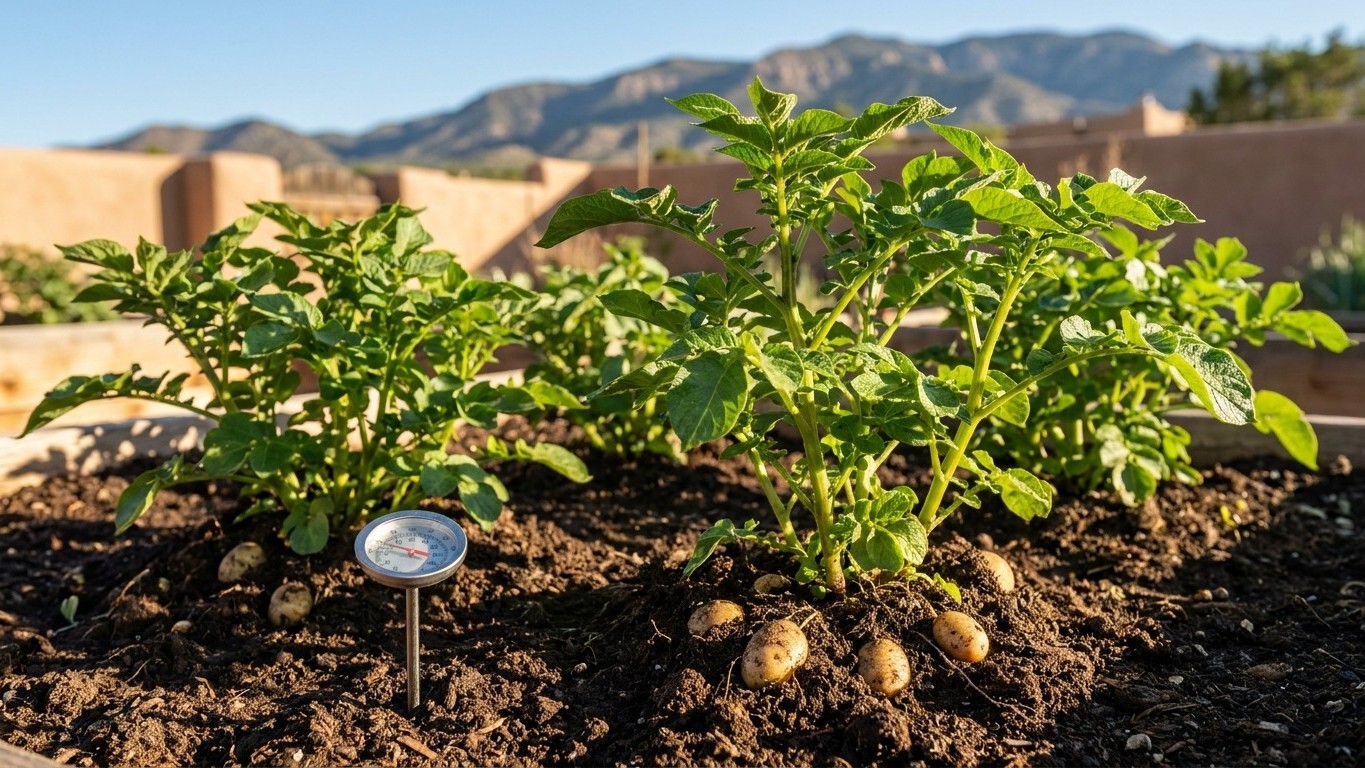

New Mexico’s best potato varieties are the early and mid-season types, not the late-season ones. The reason sits in the calendar: the reference frost window for the Albuquerque area runs March 31 to April 12 (NOAA NCEI, U.S. Climate Normals 1991-2020), and soil above 90 F stops tuber set and fill outright, according to Utah State University Extension and the University of Maine Cooperative Extension. That leaves a short cool stretch, and short-season potatoes are built for it.
The short answer
Start with the two numbers that actually run this decision. The last spring frost at the Albuquerque reference station falls between March 31 and April 12, per NOAA NCEI’s 1991-2020 climate normals. That date sets the back end of the planting window. The front end is set by soil temperature: potatoes go in the ground once soil reaches 50 F, which lands 14 to 21 days before that last frost date, according to Utah State University Extension. Put those two facts together and a New Mexico gardener is planting in late March or early April in most valley and mid-elevation locations, well before the frost date itself, because the seed piece needs the soil warm enough to sprout, not the air free of frost risk.
What happens after planting is where variety choice earns its keep. Utah State University Extension and the University of Maine Cooperative Extension both describe the same physiological wall: once soil temperatures climb above 90 F, tuber set and fill are inhibited, and no amount of irrigation reverses that. New Mexico’s low-desert and mid-elevation growing areas hit that soil temperature routinely by early to mid-summer. A late-season variety, which needs a long stretch of moderate soil temperatures to keep sizing tubers, runs straight into that wall before it finishes. An early or mid-season variety, by contrast, has already set and is filling its tubers while the soil is still in a workable range, and it can often be dug before the worst of the heat arrives.
That is the entire logic of variety selection here. It is not about flavor or skin color first, it is about season class matching the length of the cool window between a 50 F soil reading in spring and a 90+ F soil reading in summer. Neither Utah State nor Maine Extension publishes a days-to-maturity figure for named cultivars, so the honest way to plan is by season class, early, mid-season, or late, and by end use, baking or boiling, both of which are published traits. A gardener at 7,000 feet in northern New Mexico has a longer cool window than one in a low desert valley, and that difference alone can be the gap between a late-season variety succeeding or stalling out under heat stress.
What actually decides it
Soil temperature timing, not the calendar date
The planting trigger is a soil thermometer reading of 50 F, not a date circled on a wall calendar. Utah State University Extension frames it this way because seed potatoes planted into cold, wet soil are prone to rot before they sprout, while soil that has warmed to 50 F supports sprouting without needing frost-free air. That reading typically arrives 14 to 21 days ahead of the last frost date, which is why potato planting looks “early” compared to frost-tender crops like tomatoes. A reader gardening a case this page never covers, say a raised bed that warms faster than open ground, should still use the thermometer rule rather than a fixed date, because a raised bed can hit 50 F soil temperature well ahead of the surrounding ground.
The heat ceiling that ends the season
The 90 F soil threshold is the mechanism that decides whether a variety’s season class matches a given location, and it works independently of air temperature or watering schedule. Tuber set and fill are biological processes that slow and stop once the soil around the root zone crosses that line, according to both Utah State and Maine Extension sources. Irrigating more does not cool the soil enough to reverse the effect once it has set in; it can even encourage rot in tubers that have already stopped sizing. This is why the practical fix for a hot-summer county is not more water in July, it is choosing a season class short enough to finish, or close to finishing, before that soil threshold is crossed.
Elevation and local frost variance
The NOAA NCEI frost window cited above comes from a single weather station, and station data does not describe every garden equally. Suburban and rural sites, and especially anything at higher elevation than the reference station, commonly see their last spring frost land later and their first fall frost land earlier, sometimes by one to two weeks or more. A gardener planning around the Albuquerque-area figures should treat them as a reference point, not a guarantee, and check county-level frost history or a local extension office before locking in a planting date.
How to do it
- Find your own county’s typical last spring frost window rather than relying solely on the Albuquerque-area reference figure, since higher elevations and rural sites often run one to two weeks behind it.
- Buy certified seed potatoes. Uncertified seed can carry viruses that reduce yield and tuber quality with no visible warning at planting time.
- Choose a season class, early or mid-season, based on how short your cool window is between the 50 F soil-planting mark and the point where soil regularly exceeds 90 F in your area.
- Check soil temperature directly with a soil thermometer rather than guessing from air temperature; wait until it reads 50 F before planting seed pieces.
- Plant 14 to 21 days before your local last-frost date, timed to that 50 F soil reading, not to the calendar alone.
- Hill soil around the emerging plants as they grow, which protects developing tubers from sun exposure and helps regulate root-zone temperature.
- Track soil temperature through the growing season, and plan to dig early or mid-season varieties as they mature, before soil temperatures settle above 90 F for extended stretches.
- Store harvested tubers in a cool, dark location promptly, since heat exposure after harvest degrades quality as much as heat exposure before it.
What goes wrong
- Planting a late-season variety in a short-summer, hot-valley location. The plant runs out of cool soil before it finishes sizing tubers. The remedy is matching season class to your local window, choosing early or mid-season varieties where the gap between 50 F planting soil and 90+ F summer soil is narrow.
- Using uncertified or saved seed potatoes. Uncertified seed can carry viral disease invisibly, and an infected plant produces smaller, weaker tubers all season without any obvious symptom until yield is already lost. Certified seed, sourced fresh, is the direct fix.
- Planting by calendar date instead of soil temperature. A gardener who plants “on schedule” into soil still under 50 F risks seed rot in cold, wet ground before sprouting even begins. Checking soil temperature directly with a thermometer avoids the guesswork.
- Trying to water through a summer heat spike to save tuber sizing. Once soil crosses above 90 F, tuber set and fill are inhibited by the heat itself, and extra irrigation does not reverse that mechanism; it can instead promote rot. The remedy is timing the harvest of early and mid-season varieties before that heat threshold becomes sustained, rather than fighting it after the fact.
- Assuming the Albuquerque-area frost dates apply everywhere in the state. Elevation and local microclimate shift both the last spring frost and the first fall frost, often by one to two weeks or more compared to the reference station. Checking county-specific frost history closes that gap before it costs a planting.
Common questions
Which potato season class works best for high-elevation New Mexico gardens?
Higher elevations generally have a longer cool window before soil temperatures climb past 90 F, which gives mid-season varieties more room to finish than they would have in a low desert valley. The exact cutoff isn’t published for named cultivars, so the practical approach is checking your own soil temperature trend through the season rather than relying on a fixed rule.
Can I plant potatoes before the last frost date in New Mexico?
Yes, and the sourced planting rule says you generally should. Potatoes go in once soil reaches 50 F, which typically falls 14 to 21 days before the last frost date, according to Utah State University Extension. Seed potatoes tolerate cold soil poorly, but the plants that emerge handle a light frost far better than tender crops like tomatoes do.
Does watering more help potatoes size up during a New Mexico heat wave?
No. Once soil temperature climbs above 90 F, tuber set and fill are inhibited by the heat itself, a mechanism described by both Utah State University Extension and the University of Maine Cooperative Extension. Extra irrigation does not cool the root zone enough to reverse that effect and can increase the risk of tuber rot instead.
Why does certified seed matter more in New Mexico’s short growing window?
A short cool-soil window leaves little margin for a weak start. Uncertified seed potatoes can carry viral disease that reduces vigor and yield without visible symptoms at planting, and in a compressed season there’s no time for a stressed plant to catch up before the 90 F soil ceiling arrives. Certified seed removes that risk from the outset.