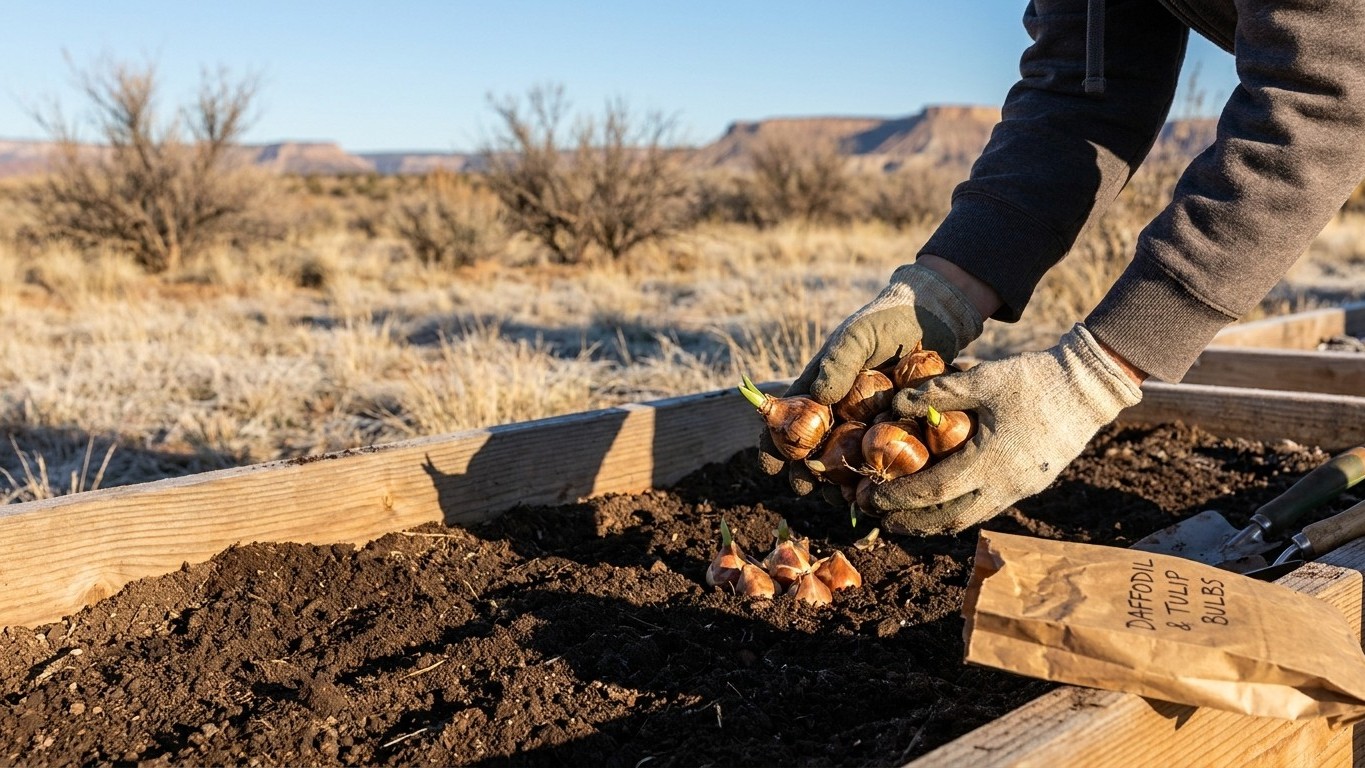

New Mexico’s high desert delivers plenty of winter cold for classic spring bulbs like tulips and daffodils to bloom reliably, no pre-chilling required across most of the state. But a handful of popular bulbs, especially tender corms suited to warmer climates, will rot, sulk, or simply skip flowering here. The dividing line is cold, not luck.
When to plant bulbs in New Mexico

Spring bulbs go into New Mexico soil in the six weeks or so before the ground freezes hard, which for the Albuquerque area lands the target window in mid-October through late November. The anchor point is the average first fall frost, recorded at October 29 to November 9 for the reference weather station (NOAA NCEI U.S. Climate Normals, 1991-2020). That date marks the freeze probability threshold, not a hard deadline, and it matters more for timing than for temperature itself: bulbs need the soil to have cooled from summer heat but not yet frozen solid.
Plant too early, while soil temperatures are still warm from a long New Mexico summer, and the bulb often pushes top growth before winter arrives. That green shoot gets caught by the first hard freeze and dies back, weakening the bulb before it has even rooted properly. Plant too late, after the ground has locked up, and the bulb goes in without enough time to grow roots before the coldest weeks hit. A bulb that skips root establishment comes up thin the following spring, if it comes up at all.
The frost date is an average, not a promise
Worth saying plainly: that October 29 to November 9 window is an average drawn from three decades of data. Roughly half of all years will see the first freeze arrive earlier than that range, and half will see it later. A gardener who plants exactly on the average date in a year that freezes early has already missed the rooting window. The safer approach is to watch soil temperature directly, using a simple soil thermometer, and aim to get bulbs in the ground once daytime highs have settled into the 50s consistently, rather than counting backward from a calendar date alone.
Elevation complicates this further. A garden at 7,000 feet in Santa Fe cools weeks earlier than one at 4,000 feet near Las Cruces, so the same calendar date means something different depending on where in the state a reader gardens. For those who would rather sidestep this elevation guesswork entirely, Growing Spring Bulbs in Containers in New Mexico gives more direct control over soil temperature and timing than an in-ground bed does.
Whether your winter is cold enough
This is the question that decides whether a spring bulb blooms at all. Most classic spring bulbs, tulips, daffodils, hyacinths, need twelve to fourteen weeks of soil temperatures below about 45°F to complete the internal process that builds a flower inside the bulb. Skip that cold exposure and the bulb still grows leaves the following spring, but the flower either never forms or emerges on a stem too short to see above the foliage. That number, twelve to fourteen weeks below 45°F, is the yardstick against which any bulb offered for sale should be measured, no matter where a gardener lives. Gardeners short on that natural chill, or who want blooms ahead of the outdoor season, can replicate the process indoors; see Forcing Spring Bulbs Indoors in New Mexico for how to do it.
New Mexico clears that bar without much drama, at least at the elevations where most of the state’s population gardens. The coldest month at the Albuquerque reference station averages a daily minimum of 26.4°F (NOAA NCEI Climate Normals, 1991-2020). That figure describes how cold nights typically get in January, not a record low, and a mean minimum in the mid-20s means soil temperatures spend a long stretch of the winter well under the 45°F chill threshold. Winter here typically runs from mid-November through early March with nights routinely dropping into the 20s and 30s, which adds up to roughly four months of chill exposure, comfortably past the twelve-to-fourteen-week requirement.
Where the margin narrows
That comfortable margin applies to the mid-elevation cities that anchor most of the state’s hardiness data. New Mexico’s USDA hardiness range spans 4b to 9a (USDA Plant Hardiness Zone Map, 2023), and the warm end of that range sits in the low desert of the far south, around Las Cruces and the Bootheel, where winters run milder and shorter. A garden in that zone 8b-9a strip may fall short of the full chill period some seasons, particularly for hyacinths, which are the most demanding of the common bulbs.
Where the chill period is genuinely short, twelve weeks in a refrigerator crisper drawer substitutes for the missing cold, provided the bulbs stay away from apples, bananas, or any ripening fruit. Ripening fruit releases ethylene gas, and ethylene destroys the flower bud forming inside a chilling bulb. A gardener who skips pre-chilling in a zone that cannot deliver the cold naturally has planted an expensive patch of leaves.
| Bulb | Weeks of cold below 45F required | What Albuquerque-area winter delivers | Verdict |
|---|---|---|---|
| Tulip | 12-14 weeks | ~16-18 weeks (mid-elevation) | No pre-chill needed; marginal in far-south low desert |
| Daffodil | 12-14 weeks | ~16-18 weeks (mid-elevation) | Reliable statewide except lowest, warmest pockets |
| Hyacinth | 13-15 weeks | ~16-18 weeks (mid-elevation) | Solid at mid-to-high elevation; pre-chill in zone 8b-9a |
| Crocus | 8-15 weeks | ~16-18 weeks (mid-elevation) | Reliable across nearly all of the state |
| Allium | 8-10 weeks | ~16-18 weeks (mid-elevation) | Easily satisfied statewide |
Which bulbs suit New Mexico
The bulbs below sit comfortably within their hardiness range across most of New Mexico’s elevations, and their chill requirement matches what the coldest months here reliably deliver:
- Tulip (zones 3-8, tolerant into 9 with caveats)
- Daffodil / Narcissus (zones 3-8)
- Hyacinth (zones 4-8)
- Crocus (zones 3-8)
- Allium (zones 3-8)
- Grape hyacinth / Muscari (zones 3-9)
- Snowdrop / Galanthus (zones 3-7)
- Fritillaria (zones 3-8)
A hardiness range is never a hard line drawn across a map. A tulip rated to zone 8 can perennialize for years in a sheltered courtyard bed against a south-facing adobe wall, while the same variety planted in an open, wind-scoured yard a few miles away struggles. Microclimate does real work here, especially in a state where elevation swings and exposure to wind vary block by block.
Bulbs that disappoint here
Some bulbs sold at big-box garden centers every fall simply are not built for New Mexico’s climate, and the failure shows up in a specific, recognizable way rather than a vague underperformance. Ranunculus and freesia corms, hardy only to zones 8-10, freeze solid in the ground across most of the state’s elevations and either rot or never sprout the following spring. Anemone blanda wants consistent winter moisture that New Mexico’s arid climate does not provide without irrigation, and without it the corms shrivel and fail to sprout at all. Tulips planted in the low desert near Las Cruces or Deming often put on a strong first-year display and then fade over subsequent seasons, an effect gardeners call “blind” bulbs, because the region’s mild winters shortchange the chill period needed to rebuild a flower bud inside the bulb.
What digs them up here
Squirrels and voles are selective diggers, and the pattern behind their choices comes down to chemistry rather than taste alone. Daffodils and anything in the onion family contain compounds that are bitter or mildly toxic to rodents, which is exactly why those bulbs survive undisturbed in the ground year after year. Tulips and crocus carry no such defense, and both rank among the most frequently raided bulbs in any yard where squirrels or voles are active.
- Bulbs squirrels and voles take: tulip, crocus, hyacinth
- Bulbs they leave alone: daffodil, allium, snowdrop, fritillaria
A gardener set on planting tulips despite the risk has one method that actually holds up: lay galvanized wire mesh or hardware cloth flat over the planting bed immediately after planting, pin it down at the edges, and leave it in place until the ground freezes solid, which cuts off digging access during the exact window when bulbs smell freshest to a hungry rodent. Repellent sprays and granules, by contrast, wash off with the first good watering or snowmelt and need constant reapplication to do anything at all.
Where to check for your own county
Every figure in this article, the frost date, the coldest-month minimum, the hardiness range, describes the Albuquerque reference station used in NOAA’s climate normals. New Mexico stretches across five degrees of latitude and a dramatic elevation range, from the low desert near the Texas border to alpine terrain above 10,000 feet near Taos, and that spread pushes the state across five USDA hardiness zones, 4b through 9a. A planting window built around Albuquerque’s numbers can run three weeks early for a garden in the northern mountains and three weeks late for one in the southern low desert.
New Mexico State University’s Cooperative Extension Service, the state’s land-grant extension program, keeps county-level guidance that adjusts for these differences. The service is reachable at aces.nmsu.edu, and every county in the state has a local extension office that can confirm frost dates and planting windows specific to that elevation and microclimate, rather than the airport-station averages cited here.