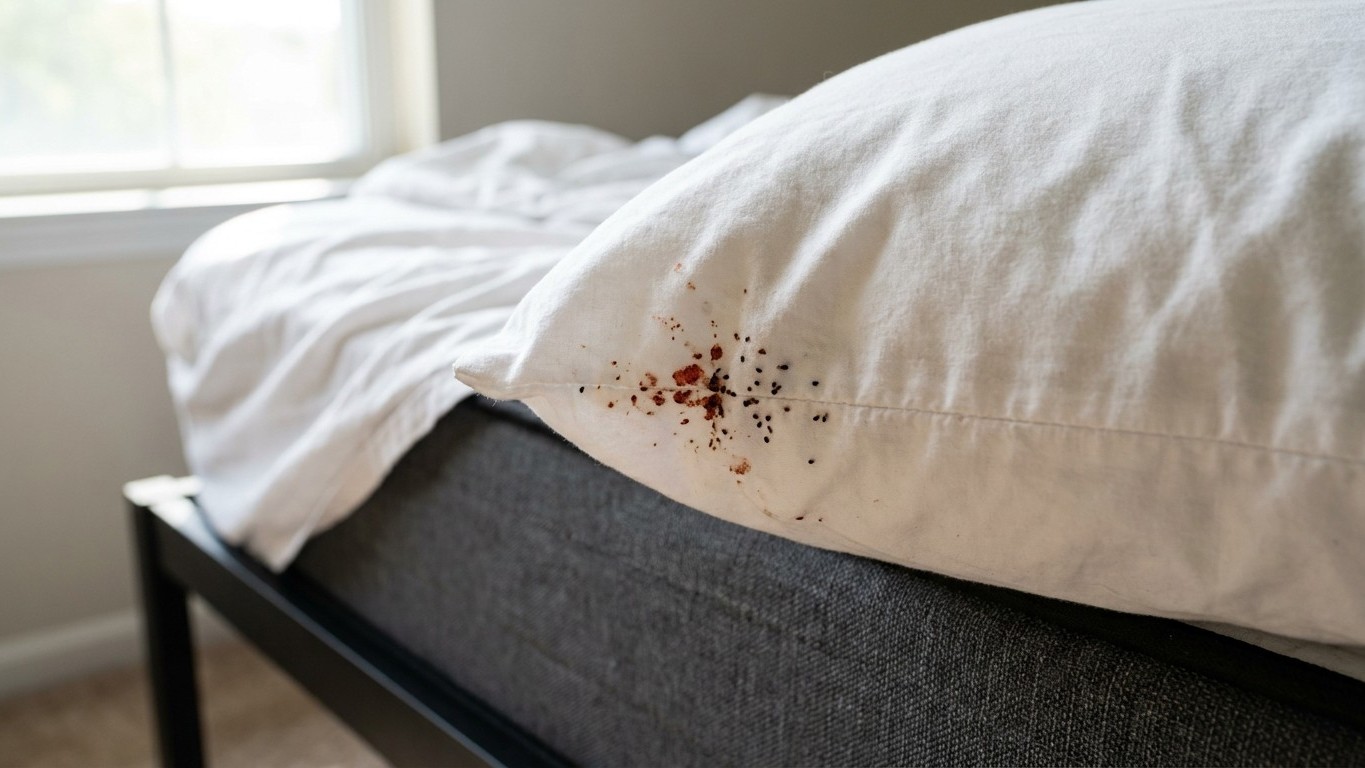

Bed bug signs show up in a specific order: small dark spots on sheets before you see a bug, then a musty odor in a heavily used room, then the bites themselves, and only later, if the population has grown, the insects out in the open. Because bed bugs travel in luggage, furniture, and clothing rather than breeding in dirt, finding them says nothing about how clean the house is. It says something moved through recently that shouldn’t have.
What you notice first

The first sign most people actually register is not a bug. It’s a stain. Reddish-brown or rust-colored spots on a mattress seam, box spring, or pillowcase are crushed, digested blood, left behind after a bug feeds and is disturbed. They look almost like a marker dot that bled into the fabric. Next to them, or sometimes instead of them, are darker spots that are fecal matter, roughly the size of a period at the end of a sentence, clustered along seams and in the corners where the mattress meets the frame.
Bites come next in most people’s timeline, though not everyone reacts to them, which is part of why this pest is so easy to miss for weeks. When bites do appear, they tend to show up in a line or small cluster on skin that was exposed during sleep, arms, shoulders, legs, and they itch more than a typical mosquito bite. But bite patterns alone are unreliable. Some people show no reaction at all even after repeated feeding, so relying on your own skin as a detector is a mistake.
A sweetish, musty smell in a bedroom that wasn’t there before is a sign people notice but rarely connect to bed bugs, since it resembles a damp closet or old linens. It comes from the insects’ scent glands and tends to show up only once numbers have grown enough to matter. Shed skins, pale and papery, and tiny white eggs the size of a pinhead tucked into seams are the signs almost everyone misses, because you have to be looking closely, with a flashlight, at the exact folds where a mattress tag or piping creates a hiding seam.
Why identification comes before anything else
This is the point where guessing becomes expensive. The U.S. EPA’s framework for pest management states that “IPM programs work to monitor for pests and identify them accurately, so that appropriate control decisions can be made.” Skipping that step, and jumping straight to a spray or a mattress replacement, is how people spend money on a problem they haven’t confirmed.
What it is confused with
Bed bug signs overlap with several other household issues closely enough that misdiagnosis is common, and the mistake is not free. Someone who tosses out a mattress over a carpet beetle problem, or fumigates for bed bugs when the itching is actually a skin condition, has spent money and disrupted a household without solving anything.
| What it looks like | What it might actually be | How to tell the difference |
|---|---|---|
| Small reddish-brown stains on sheets | Carpet beetle larvae shed skins or crushed larvae | Carpet beetle debris is fibrous and bristly under magnification; bed bug stains are flat, blood-based smears |
| Itchy bites in a line on the skin | Flea bites or a skin allergy | Flea bites cluster around the ankles and lower legs and come with a pet in the house; bed bug bites appear anywhere skin was exposed while sleeping |
| Bites with no visible insect | Contact dermatitis or a reaction to laundry detergent | Dermatitis doesn’t follow a sleep pattern and doesn’t come with stains, shed skins, or an odor in the bedroom |
| Tiny pale insects near a bed | Booklice or psocids drawn to damp, moldy paper or wallpaper glue | Booklice are soft-bodied, translucent, and found near humidity sources, not blood-fed and reddish like a bed bug |
The carpet beetle confusion is the one that wastes the most money, because it leads people to buy encasements, launder everything at high heat repeatedly, or hire a treatment for a pest that was never there. Carpet beetle larvae feed on wool, fur, and stored fabric, not blood, and their presence usually points to a different fix entirely, like sealing stored clothing rather than treating a mattress. A skin reaction gets misread the other way: someone assumes bed bugs, tears a room apart looking for evidence, and finds none, when the real issue was a product change or a different insect altogether, like fleas from a pet.
Telling a sighting from an infestation
One bug on a mattress seam is not proof of an infestation. It could be a hitchhiker from a recent trip, a secondhand piece of furniture, or a visitor’s bag, and finding it early is actually the good outcome, not a crisis. What separates a sighting from an established population is a set of measurable facts: how many you find, where, at what stage of life, and how often.
A true infestation shows a spread pattern. Instead of one insect in one seam, you find them at multiple points, the mattress, the box spring, the headboard, and sometimes the baseboard or outlet covers nearby. You also start finding different life stages together, eggs, translucent young nymphs, and darker adults, which means breeding is underway rather than a single insect having wandered in. Checking at night with a flashlight, since bed bugs feed while people sleep and hide during the day, is the most reliable way to confirm activity rather than guessing from bite marks in daylight.
This is exactly the judgment the EPA’s pest management framework is built around, and it applies as much to a bedroom as to a farm field. “Before taking any pest control action, IPM first sets an action threshold, a point at which pest populations or environmental conditions indicate that pest control action must be taken.” Treating a single unconfirmed sighting the same way you’d treat a spreading, multi-stage population means reacting to something that may not exist, which wastes money and, if a pesticide is involved, introduces exposure risk for no benefit.
The practical version of that threshold looks like this: one insect, found once, with no stains, no eggs, and no repeat sightings over the following week, is worth monitoring, not treating. Multiple insects across different hiding spots, found on more than one occasion, with eggs or nymphs present, is the point where action is warranted. Sticky interceptors placed under bed legs for a week are a low-cost way to get an actual count instead of relying on a single glance.
What to do once you are sure
Once the signs add up, meaning multiple locations, multiple life stages, and repeat activity, bed bugs move from a “watch it” situation to a “call it in” one. This is a pest where a do-it-yourself response is genuinely limited. Bed bugs hide in wall voids, electrical outlets, and furniture joints that a household treatment can’t reach, and an incomplete effort tends to scatter the population into neighboring rooms or units rather than eliminate it. A licensed pest control professional, working from the same identify-then-act order the EPA lays out, is the reasonable first call rather than a last resort here.
On health, the documented picture is limited but not nothing. Bed bugs are not currently known to transmit disease to people, but their bites can cause allergic reactions, secondary skin infections from scratching, and, for some people, real sleep disruption and anxiety tied to an infestation. Anyone with a severe reaction, or a household member who is very young, elderly, or immunocompromised and reacting badly to bites, should check with the CDC or their local health department rather than guessing at a home remedy.
If you’re weighing a store-bought product before a professional visit, the label on that specific product is the only guide that applies, since registered treatments and rules differ by state. Questions about a product’s safe use are better directed to the National Pesticide Information Center at 1-800-858-7378 than to general advice online.
Two follow-up questions naturally come after confirming an infestation: what actually draws bed bugs into a home in the first place, and what a realistic, staged control plan looks like once a professional or a monitoring period confirms the problem. Those are covered separately in this series, since jumping to control before identification is confirmed is the exact mistake this page is meant to prevent.
Common questions
Can bed bugs be present without any bite marks showing up?
Yes. Reactions to bites vary widely, and some people show no visible mark at all even after repeated feeding, which is why stains, shed skins, and eggs matter more than relying on skin reactions alone.
Do bed bug signs mean the house is dirty?
No. Bed bugs travel through luggage, secondhand furniture, and clothing, not through poor housekeeping, so their presence reflects what moved into the home recently rather than how clean it is.
How long can bed bug signs go unnoticed?
Weeks, in many cases, since early stains and shed skins are small and tucked into seams, and a low-level population doesn’t always produce a noticeable odor or visible bugs right away.
Is it worth calling a professional after finding just one bug?
Not necessarily. One insect with no stains, eggs, or repeat sightings over a week or two is worth monitoring first. A professional visit becomes the reasonable move once you confirm multiple locations, multiple life stages, or repeat activity.