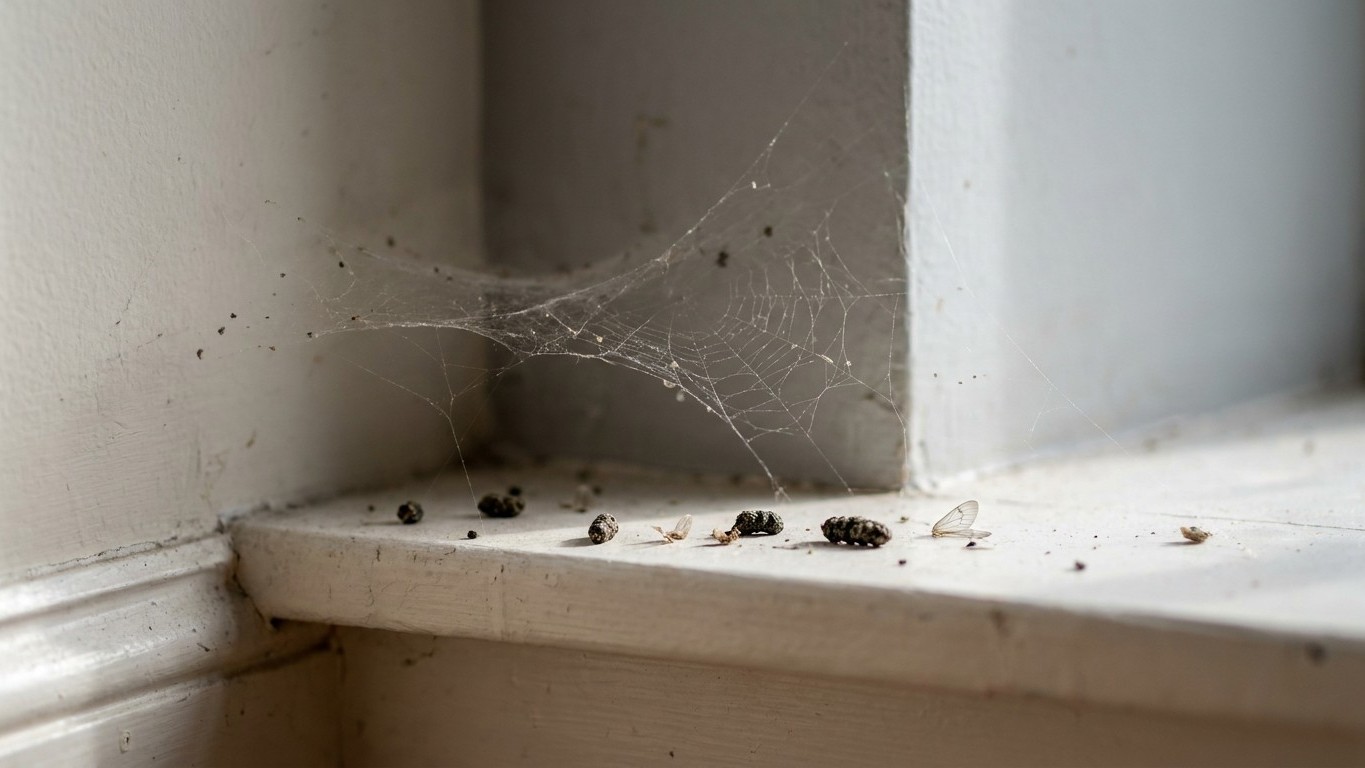

The clearest signs of house spiders are irregular, tangled webs in corners, closets, and window frames; small dark specks (droppings) scattered underneath those webs; pea-sized, papery egg sacs tucked into crevices; and the spiders themselves, most often spotted skittering along a baseboard after dark. But finding the spider is usually the last clue you get, not the first. House spiders don’t show up for no reason. They follow food, and figuring out what that food is decides whether your fix takes an afternoon or drags on for weeks.
What you notice first

Webs come first, almost always. Not the neat, wheel-shaped webs you see in a garden, but messy, funnel-shaped tangles wedged into corners, behind furniture, along window tracks, or in the dead space above a water heater. House spiders build and abandon webs quickly, so a home can end up with several old, dusty ones alongside one or two active, sticky ones. The dusty webs are the easy part to notice. The active ones, especially the low, half-hidden ones behind a dresser or under a basement shelf, are the ones people miss for months.
Right below an active web, look for the second sign: small dark droppings, sometimes mixed with the wings or shells of whatever the spider has been eating. This is the detail that matters more than the web itself, because it tells you what’s feeding the spider population. A cluster of gnat husks under a kitchen web points to a moisture or drain problem. Moth wings near a closet web point to fabric pests. The spider is a middleman. It’s easy to treat it as the whole problem when it’s really just evidence of something else going on in the house.
Egg sacs are the sign that’s easiest to overlook and the most important to catch. They look like small, off-white or tan balls of paper or cotton, roughly the size of a pea, often tucked into the same corners as the webs. One sac can hold well over a hundred eggs. Finding one means you’re not dealing with a single spider passing through, you’re dealing with a spider that has decided your house is a good enough place to reproduce.
Seeing the spider itself, usually at night when house spiders are most active, confirms what the other three signs already suggested. On its own, though, a single nighttime sighting tells you almost nothing about scale. That’s exactly why the U.S. EPA’s approach to pest management insists on this step before anything else: “IPM programs work to monitor for pests and identify them accurately, so that appropriate control decisions can be made.” Skipping straight to “there’s a spider, kill it” skips the part where you’d actually learn what’s going on.
What it is confused with
Misidentifying a spider is one of the most common and most expensive mistakes homeowners make, because different look-alikes call for completely different responses, and the wrong one wastes both time and money.
| Look-alike | What it might actually be | How to tell them apart | Why the mix-up costs you |
|---|---|---|---|
| Cellar spider (“daddy long legs”) | A separate, very common household species with extremely long, thin legs and a tiny body | Legs are disproportionately long and thin compared to the body; webs are loose and irregular, usually in damp basements or corners | Harmless, but frequently sprayed for out of unnecessary fear |
| Wolf spider | A ground-dwelling hunter that doesn’t build webs at all | No web present; larger, hairier body; found on floors rather than in corners | Sighted more in daylight, which gets mistaken for an “infestation” when it’s usually one wandering individual |
| Brown recluse | A medically significant species in parts of the central and southern U.S. | Uniform tan-to-brown color, faint violin-shaped mark on the back, six eyes instead of eight | People pay for full-scale extermination for a common house spider, or worse, dismiss a real recluse as harmless |
| Hobo spider | A species found mainly in the Pacific Northwest with its own bite concerns | Brown, no distinct markings, fast runner, found near ground level | Regional confusion leads to treating for the wrong regional species entirely |
The brown recluse mix-up is the one that causes the most wasted money. A homeowner spots a plain brown spider, assumes the worst, and pays for a broad pesticide treatment aimed at a species that was never actually in the house. Meanwhile the actual issue, a run-of-the-mill house spider following a gnat problem near a leaky drain, goes untouched because nobody looked at what the treatment was supposed to target in the first place. Getting the identification right isn’t a technicality. It’s the difference between a $20 fix and a $200 one that doesn’t even address the real cause.
Telling a sighting from an infestation
One spider crossing your living room floor is not an infestation. That distinction matters more than most people realize, because the instinct to act immediately on a single sighting is its own kind of mistake. The EPA’s own framework makes this explicit: “Before taking any pest control action, IPM first sets an action threshold, a point at which pest populations or environmental conditions indicate that pest control action must be taken.” Nowhere in that sentence does one sighting count as a threshold.
What actually separates a passing visitor from an established population comes down to a few measurable things. Location matters first: a spider in an open living space is often just passing through, while multiple active webs concentrated in one basement corner, one closet, or one crawl space points to a settled colony feeding on something specific in that spot. Count matters next: one web is a data point, three or more active webs across different rooms, or several webs in the same area rebuilt within days of being cleared, is a pattern.
Timing tells you something too. House spiders are nocturnal, so seeing one at night is normal behavior, not a red flag. Regularly finding them out in daylight, especially in open areas rather than tucked into corners, usually means the population has grown large enough that competition for space and food is pushing individuals into view during hours they’d normally avoid.
The most reliable marker, though, is whether you’re finding breeding evidence rather than just adult spiders. Egg sacs, or clusters of very small, newly hatched spiders near a web, mean the population isn’t just present, it’s actively growing. That’s the point where “I saw a spider” turns into “I have a spider problem,” and it’s the point where the action threshold the EPA describes has actually been crossed.
What to do once you are sure
Once the signs add up, meaning webs, droppings, egg sacs, and repeat sightings in the same locations, the next useful step isn’t reaching for a spray. It’s asking why that spot became attractive in the first place. House spiders don’t colonize a corner at random; they set up where there’s reliable prey and undisturbed shelter. That’s a separate question worth its own answer, and it’s covered in detail in our guide to what attracts house spiders to a home.
The EPA’s guidance is consistent on this point: prevention comes before any kind of chemical response. “As a first line of pest control, IPM programs work to manage the crop, lawn, or indoor space to prevent pests from becoming a threat.” Only after that does the framework move toward action, and even then it favors the least aggressive option available: “Effective, less risky pest controls are chosen first, including highly targeted chemicals, such as pheromones to disrupt pest mating, or mechanical control, such as trapping or weeding.” Broad chemical treatment sits at the very bottom of that list. “Broadcast spraying of non-specific pesticides is a last resort.” A step-by-step approach to clearing out an existing population, in that order, is laid out in our companion guide on how to get rid of house spiders.
Common house spiders are, for the most part, something a homeowner can handle without outside help once the source of food and shelter is addressed. That’s not true across the board. If your identification points toward a brown recluse or a hobo spider rather than an ordinary house spider, that’s a different situation, and calling a licensed pest control professional for a positive identification and a proper treatment plan is the reasonable first move rather than a home remedy. Pesticides, even common ones sold for household use, are made to be toxic to pests and can be toxic to people when used incorrectly, with children, older adults, and anyone with a compromised immune system at greatest risk. If you have questions about a specific product’s safety or use, the National Pesticide Information Center takes calls at 1-800-858-7378, and that’s a better source than guesswork.
Common questions
Do house spiders mean my home is dirty?
Not necessarily. They mean there’s a food source somewhere, usually small flying or crawling insects, not necessarily poor housekeeping. A clean but poorly sealed home can still attract them.
Are house spider egg sacs dangerous to touch?
No, but disturbing one releases dozens of spiderlings into your space at once. It’s more practical to remove the sac and web together, ideally with a vacuum, rather than knocking it loose by hand.
Why do I mostly see house spiders at night?
They’re nocturnal hunters, active while the insects they feed on are also moving. Seeing one after dark is normal behavior, not a sign of a growing problem on its own.
Can house spiders bite people?
Most common house spiders can bite if handled directly, but bites are rare and generally mild. If you’re uncertain whether you’re dealing with a species of more medical concern, identification matters more than reassurance, and a professional opinion is worth getting.