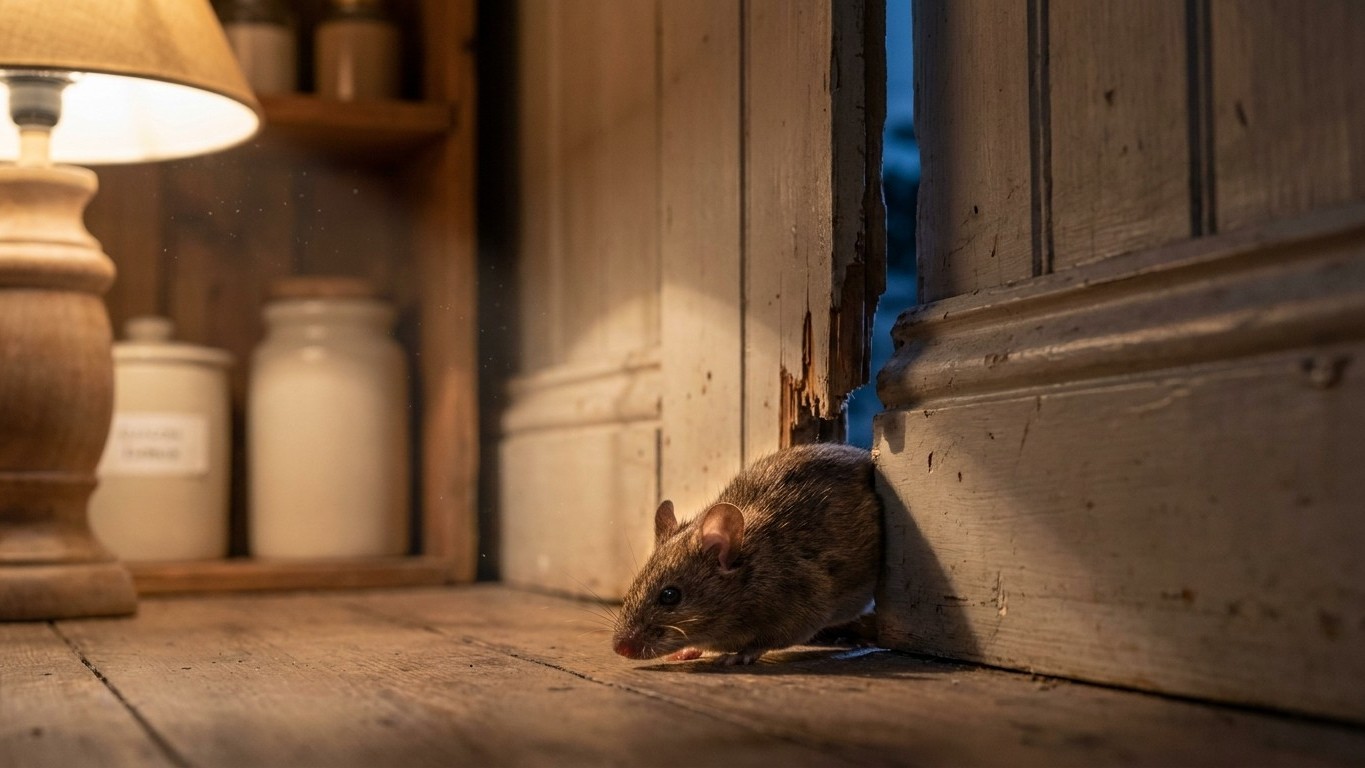

Mice enter homes because the outdoors stops offering what they need and a house almost always does: steady food, a warm dry place to nest, and water when the weather won’t provide it. A cold snap, a dry spell, or a harvested field nearby can push a population toward the nearest structure with an opening. The trigger shifts with the season and the region, but the pull is consistent: shelter and calories, not any interest in the house itself. Understanding that pull is what separates a fix that lasts from a fix that gets repeated every few months.
What they are actually looking for

Every pest that ends up inside a house is chasing one of three things: food, water, or shelter. For mice, the math leans hard toward two of those three. Water matters least, because a mouse can pull most of the moisture it needs from the food it eats, whether that’s pet kibble left in a bowl overnight or grain spilled behind a pantry shelf. Food and warmth are the real draw, and the two work together. A garage, a crawl space, or a wall void that’s dry and out of the wind is worth nothing to a mouse without something to eat nearby, and a kitchen full of food is worth nothing without a way to get to it undisturbed.
That’s where the third factor comes in, and it’s the one people underestimate: the size of the gap a mouse needs. It doesn’t take a hole. A mouse can flatten its skull and ribcage enough to pass through an opening about the width of a pencil, which means a house doesn’t have to be neglected to be vulnerable. A single unsealed gap where a cable enters a wall, or a gap under a door that’s been fine for years, is enough on its own.
This is the detail that makes prevention possible rather than reactive. A species drawn mainly by food and shelter responds to changes in food access and entry points, not to general tidiness alone, though tidiness still helps. The U.S. Environmental Protection Agency frames this as the starting point of any sound pest strategy, not an afterthought to whatever chemical control comes later. As the agency puts it: “As a first line of pest control, IPM programs work to manage the crop, lawn, or indoor space to prevent pests from becoming a threat.” For a mouse, managing the indoor space means closing the gaps and removing the easy meals before anything else happens. Skip that step and any control measure applied afterward is working against a house that’s still advertising exactly what the mouse came for in the first place.
How they get in
Mice don’t need a broken screen or a hole in the siding to get inside. Most entries happen through gaps that were never meant to be sealed tightly in the first place, and a walk around the exterior in this order catches the majority of them.
- Pipes and cable entries. Anywhere a water line, gas line, dryer vent hose, or electrical or cable line passes through an exterior wall or foundation, there’s usually a gap around it that was never packed with anything more durable than foam or nothing at all.
- Door sweeps. Garage doors, exterior entry doors, and even doors between an attached garage and the house itself often have a sweep that’s worn thin, warped, or was installed with a gap at one corner.
- Window screens and frames. A screen with a torn corner, or a frame that’s pulled slightly away from the siding due to settling, creates an opening most homeowners never think to check at eye level, let alone at the sill.
- Vents. Foundation vents, soffit vents, and dryer vents without a working flap or screen are wide enough for far more than a mouse.
- What they carry in on their own. Boxes stored in a garage, firewood stacked against an exterior wall, and potted plants brought indoors for winter can bring a mouse in as a hitchhiker rather than through a wall gap at all.
The pencil-width gap mentioned earlier applies to nearly every item on that list, which is the part worth sitting with. A gap that looks too small to matter, around a pipe, under a door, at the corner of a vent screen, is exactly the size that lets a mouse through without any visible sign of forced entry.
When they come, and why
The seasonal push behind mice moving indoors usually traces back to one of a few pressures outside. Cold is the most familiar one: as outdoor temperatures drop, the insulation and calorie cost of surviving in a burrow or a brush pile rises, and a heated structure becomes a much better deal. Drought works the same way from a different angle, pushing rodents toward irrigated lawns, gardens, and the structures near them once natural food and cover thin out in the open. Heavy rain can flush burrows and force a quick relocation regardless of temperature, and the tail end of a breeding season, when a colony’s population has grown all year and outdoor food starts to run short, tends to send the surplus looking for new territory, some of it toward houses.
None of these pressures land on a fixed date, and none of them trip at one universal temperature. A dry autumn in one region can trigger the same movement that a hard frost triggers somewhere else, and a rural property surrounded by fields behaves differently than a suburban lot with a tight perimeter. That’s the reason to check the page for your specific state or region rather than treat a national average as a countdown clock. What matters for timing is less the calendar and more what’s happening to food and cover just outside your walls right now.
The practical takeaway is to treat entry-point checks as tied to conditions rather than a season on paper. A stretch of dry weather, a neighbor’s harvested field, or a sudden cold spell are all better cues to walk the foundation than a date circled months in advance.
Fixing the reason rather than the symptom
A house that offers nothing gets fewer pests, and that’s the point the rest of this page has been building toward. Every trap set, every gap sealed after the fact, every treatment applied to a house that still leaves food out and gaps open has to be repeated, because nothing about the underlying draw has changed. The EPA’s Integrated Pest Management approach puts prevention ahead of any control action for exactly this reason, and it lays out the order deliberately rather than leaving it to guesswork.
The first step isn’t a spray, it’s a measurement: “Before taking any pest control action, IPM first sets an action threshold, a point at which pest populations or environmental conditions indicate that pest control action must be taken.” The next step is confirming what’s actually there: “IPM programs work to monitor for pests and identify them accurately, so that appropriate control decisions can be made.” Only after prevention and identification does the agency address the methods themselves, and it ranks them by risk: “Effective, less risky pest controls are chosen first, including highly targeted chemicals, such as pheromones to disrupt pest mating, or mechanical control, such as trapping or weeding.” The agency is direct about what comes last: “Broadcast spraying of non-specific pesticides is a last resort.”
That order matters for a health reason, too. Pesticides are built to be toxic to pests, and the EPA notes they can be toxic to people when used improperly, with children, older adults, and people with compromised immune systems named specifically as more vulnerable. Anyone unsure about a product already in their home should call the National Pesticide Information Center at 1-800-858-7378 rather than guess. If mice have already gotten into wall voids, insulation, or in numbers that traps aren’t keeping up with, that’s a job for a licensed exterminator rather than a homeowner remedy. This page is about the reason they showed up in the first place; the site’s dedicated control guide covers what to do about the mice that are already inside right now.
Common questions
Do mice come inside just because it’s cold?
Cold is one driver, not the only one. Drought, heavy rain, and the natural decline of outdoor food at the end of a breeding season can push mice toward a structure regardless of temperature.
Can a clean house still get mice?
Yes. Since shelter and a pencil-width gap matter as much as food, a tidy kitchen with one unsealed pipe entry or a worn door sweep still offers everything a mouse needs.
Do mice need a water source indoors to survive?
Not usually. Mice draw most of the moisture they need from food, which is why water access matters far less than food and shelter when it comes to why they move indoors.
Is a mouse problem a health concern, not just a nuisance?
Rodents in a home are a documented health question, and the details vary by exposure and region. For specific guidance, check the CDC or your local health department rather than relying on general assumptions.