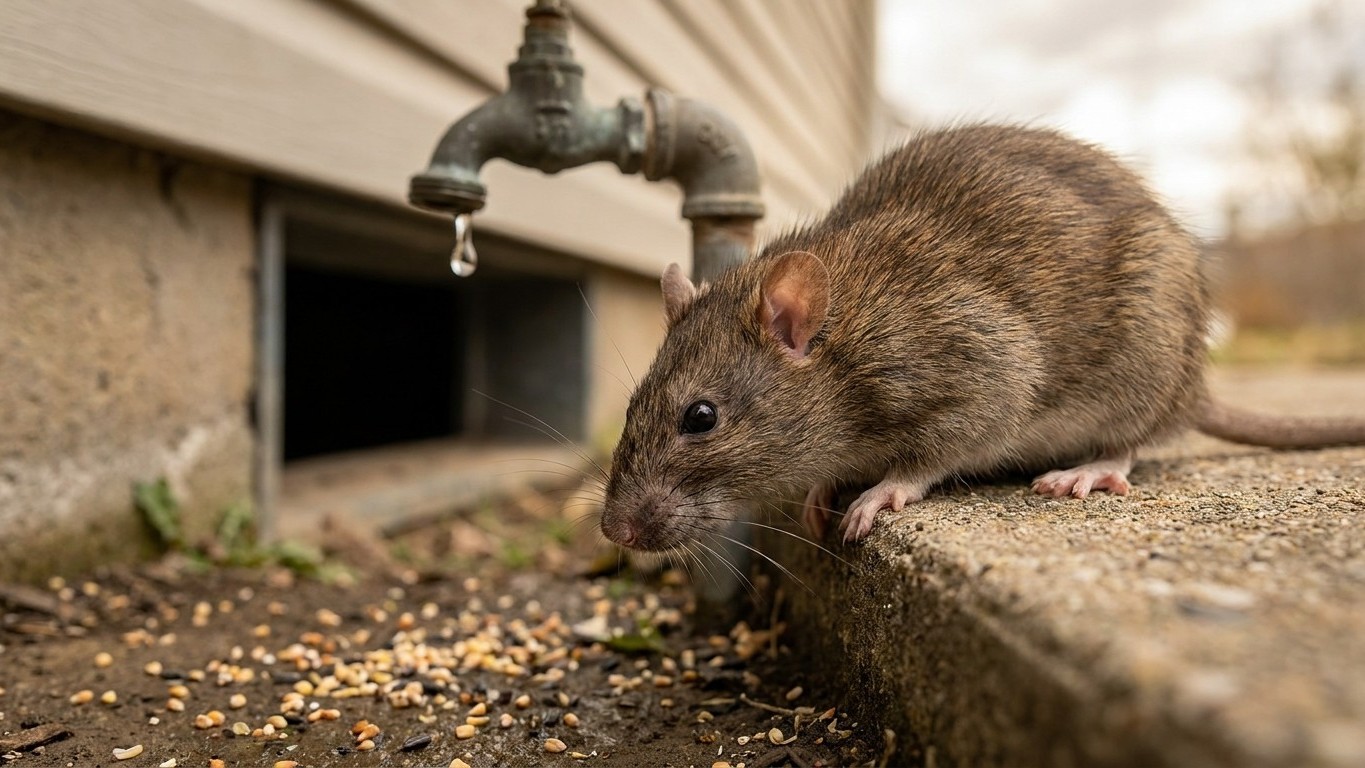

A rat that shows up in a garage or attic isn’t lost. It followed a specific trail of food, water, or shelter that led straight to your house, and it will keep coming back until that trail disappears. The species doesn’t care about the building itself; it cares about what the building offers. Understanding which of those three things a rat actually wants changes how you stop the next one from showing up.
What they are actually looking for

Every indoor pest is chasing one of three things: food, water, or shelter. For rats, the mix skews hard toward two of those. Food waste, whether it’s pet food left in a garage, birdseed spilled under a feeder, or a compost pile that’s easy to reach, pulls rats toward a property long before they ever try to get inside. Water is just as strong a draw. A leaking outdoor spigot, a clogged gutter that never quite drains, or a low spot where irrigation pools gives a rat everything it needs without setting a single paw indoors. Shelter, structurally speaking, tends to be the payoff rats collect once food and water have already brought them close to the foundation.
This distinction matters because prevention that ignores it doesn’t work. A homeowner who scrubs the kitchen counters but leaves a dripping outdoor faucet running has removed one attractant and left the other standing. Rats don’t need much water to sustain a colony, and a reliable source near a foundation, crawl space, or shed can keep them working a property for weeks even if every crumb indoors has been swept up.
This is also why federal guidance on pest management puts the emphasis where it belongs, not on the chemical response but on the conditions that invite the pest in the first place. The U.S. Environmental Protection Agency states it plainly: “As a first line of pest control, IPM programs work to manage the crop, lawn, or indoor space to prevent pests from becoming a threat.” That sentence is doing more work than it looks like. It means the spray, the bait, the trap, all of that comes second. The first move is always managing the space, and for rats, that means auditing food storage, water sources, and clutter before anything else gets touched.
A property with dry gutters, sealed trash, and no standing water gives a rat almost nothing to work with, regardless of how close the nearest colony happens to be. That’s the leverage point worth understanding before moving on to how they actually get inside.
How they get in
Once food and water have pulled a rat toward a structure, the entry itself usually comes down to a handful of predictable weak points. Walking the exterior of a house with these in mind, in roughly this order, catches most of what matters:
- Gaps around pipes and cables. Anywhere a utility line, dryer vent hose, or plumbing stack penetrates an exterior wall, there’s often a gap around it that was never sealed tight after installation.
- Door sweeps. Garage doors and exterior utility doors that don’t sit flush against the threshold leave a gap along the bottom edge that’s easy to miss from a standing height.
- Window screens. Torn or loose screens, especially at basement or ground-floor windows, are a quiet entry point that rarely gets checked until something’s already inside.
- Vents. Foundation vents, soffit vents, and roof vents without intact mesh covers are direct lines into a crawl space or attic.
- What they carry with them. Nesting material, whether it’s insulation, cardboard, or dried yard debris, tells you where a rat has already been working, even before you find the opening it used.
The gap size that surprises most homeowners is at the low end of that list. Openings that look far too small to matter often aren’t, because a rat’s skeleton flexes in ways a house cat’s never could, letting it compress its body through spaces that seem sealed at a glance. That’s why a visual check from a few feet away tends to miss the actual point of entry. Running a hand along a foundation line, a utility penetration, or a door threshold finds gaps that the eye skips right past.
It’s worth checking these points seasonally rather than once. Settling, weatherstripping wear, and minor foundation shifts open new gaps every year, even on a house that was fully sealed the season before.
When they come, and why
Timing with rats tracks conditions outside more than anything happening inside a house. Cold weather pushes rodent activity toward structures because outdoor food sources thin out and shelter options narrow at the same time. Drought does something similar from the water side: when natural sources dry up, a leaking spigot or a pet’s water bowl left outside becomes disproportionately valuable to a colony trying to survive. Heavy rain can flood burrows and nesting sites near a property, sending rats looking for dry ground, which sometimes means a crawl space or a garage. And toward the end of a colony’s breeding year, population pressure alone can push younger or displaced rats to test entry points that an established colony never needed to bother with.
None of those drivers map cleanly onto a single calendar date or a specific temperature. What triggers a rat surge in one region can look completely different a few states over, since local climate, building density, and food availability all shift the timing. A dry autumn in one part of the country might do what a hard freeze does somewhere else. This is exactly why a national article can only describe the mechanism, not the moment. If you want the timing that actually applies to where you live, the site’s territory-specific pages break that down by region rather than guessing at a national average.
What stays consistent, regardless of region, is the logic behind the timing: rats move toward structures when outdoor conditions make food, water, or shelter harder to find on their own. That’s the pattern worth watching, more than any specific week on a calendar.
Fixing the reason rather than the symptom
A house that offers nothing gets fewer pests. That sentence sounds almost too simple, but it’s the entire logic behind why some homes deal with a single rat sighting and never see another, while others treat the same infestation two or three times a year. Every trap set, every bait station placed, every call to a pest control service is treating a symptom if the food, water, and entry points that drew the rat in are still sitting there untouched. The treatment works for a while. Then it doesn’t, because nothing about the property actually changed.
Federal guidance on pest management backs this up in the order it lays out its own process, not just in its wording. The EPA describes Integrated Pest Management as an approach that “relies on a combination of common-sense practices,” and it doesn’t start with a chemical. It starts with a threshold: “Before taking any pest control action, IPM first sets an action threshold, a point at which pest populations or environmental conditions indicate that pest control action must be taken.” From there, the next step is confirming what you’re actually dealing with, since “IPM programs work to monitor for pests and identify them accurately, so that appropriate control decisions can be made.” Only after prevention has been tried does the guidance move toward intervention, and even then it’s specific about the order: “Effective, less risky pest controls are chosen first, including highly targeted chemicals, such as pheromones to disrupt pest mating, or mechanical control, such as trapping or weeding.” The last resort, by design, is “broadcast spraying of non-specific pesticides.”
That order matters for a practical reason. Pesticides are built to be toxic to the pests they target, and the EPA is clear that they can also be toxic to people when used improperly, with children, older adults, and people with compromised immune systems named as especially vulnerable. If a product question comes up that a label doesn’t answer, the National Pesticide Information Center takes calls at 1-800-858-7378 rather than leaving a homeowner to guess. And if what’s going on isn’t a rat or two but an established infestation inside walls or a structure, that’s a job for a licensed exterminator, not a home remedy.
Removing the food, sealing the water sources, closing the gaps described above is the work that actually holds. Trapping and targeted control deal with the rats that are already inside; this page is what keeps the next one from finding a reason to try.
Common questions
Do rats come inside just because it’s cold outside?
Cold weather is a factor, but it’s rarely the only one. Rats move toward structures when outdoor conditions make food, water, or shelter harder to find, and a drop in temperature is one of several pressures that can push that decision, alongside drought, heavy rain, or thinning food sources.
What attracts rats more, food or water?
Both matter, but water sources near a building, leaking spigots, clogged gutters, standing puddles from irrigation, tend to sustain rat activity even after food waste has been cleaned up. A property with no accessible water is harder for a colony to keep working.
Can a rat really fit through a small gap?
Yes. Gaps around pipes, vents, and door thresholds that look too small to matter are often exactly where rats get in, since their bodies compress through openings that would stop most other animals.
Is it safe to handle rat control myself?
For a single rat sighting tied to a clear entry point, sealing gaps and removing food and water sources is reasonable DIY work. For an infestation established inside walls, attics, or a structure, or for any pesticide product questions, contact a licensed exterminator or call the National Pesticide Information Center at 1-800-858-7378 rather than guessing.