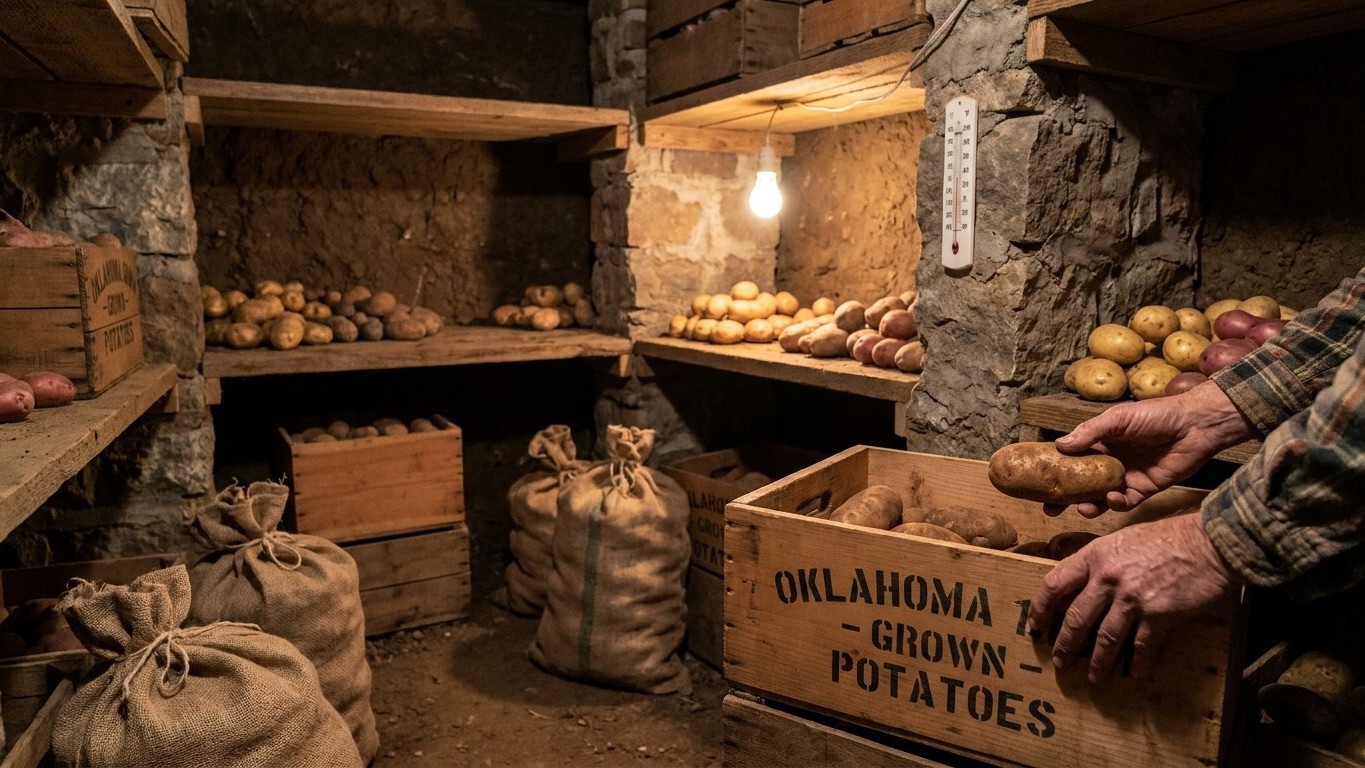

Dig potatoes before the ground freezes, cure them at 55-60°F for two to three weeks, then move them somewhere that holds 40-45°F all winter. In Oklahoma, that last part is the catch. The state’s coldest month averages a nightly low of 27°F, well below what stored potatoes can tolerate, so an unheated shed or garage will not carry them through January. A basement or insulated cellar will.
The short answer
Oklahoma’s first fall frost typically arrives between October 29 and November 8, based on NOAA climate normals for the reference station. That’s a range, not a single date, and it’s built from an airport weather station reading. Gardens outside town, especially at higher elevation or in low-lying spots where cold air pools, often see frost a week or two earlier. Check your own county’s typical frost date before you plan a harvest weekend around this window.
The mechanism that matters here is simple: a hard freeze collapses potato vines and can chill tubers sitting near the soil surface, so the goal is to get the crop out of the ground before that first frost date, not after. Once the vines die back on their own, from age or from a light frost, that’s the harvest signal. Waiting past a hard freeze risks tubers picking up cold injury that shows up later as soft, discolored flesh.
Storage temperature is where Oklahoma’s climate creates a real problem. The 40-45°F range that stored potatoes need is a narrow target, and the state’s coldest month runs a mean minimum of 27°F. That’s a 13 to 18 degree gap below freezing on an average night in the depth of winter. An unheated garage, a metal shed, or an outbuilding without any insulation will track close to outdoor air on cold nights, which means it will drop well below the safe range and freeze the crop solid. A freeze doesn’t just chill a potato, it ruptures its cell walls, and a thawed potato that’s been frozen turns soft, sweet-tasting, and unusable within days.
So the short answer has two parts. Dig around the first fall frost window for your area, earlier if vines have already died back, and store in a space that’s insulated enough to stay above freezing and cool enough to stay below the 45°F mark where sprouting picks up speed. In most of Oklahoma, that space is a basement, a cellar, or an interior closet against an insulated wall, not a stand-alone structure that shares the outdoor temperature swing.
Curing, and where
Before potatoes go into long-term storage, they need to cure. Utah State University Extension recommends holding freshly dug potatoes at 55-60°F with high humidity for two to three weeks. Curing lets the skin thicken and lets small nicks and scrapes from digging seal over, which is what keeps a stored potato from rotting from the inside out. Skip this step and you’re stacking thin-skinned, unhealed tubers into a bin for months, which is asking for trouble.
Finding 55-60°F in an Oklahoma fall
At harvest time in late October or early November, outdoor daytime temperatures in Oklahoma are often still well above 60°F, and nights can already be dipping toward frost. Neither extreme matches the curing window on its own, so the trick is finding an indoor or semi-indoor space that buffers both. A detached garage, an enclosed and shaded porch, or a basement corner away from a furnace typically holds closer to that 55-60°F band than the open air does at this time of year. A sunny porch that bakes in the afternoon sun runs too warm; an exposed carport with no walls tracks the cold nights too closely once frost arrives.
- Dig potatoes on a dry day and let them sit on the soil surface for an hour or two to shed loose dirt, without washing them.
- Move them out of direct sun immediately, since sunlight causes greening and off-flavors within hours.
- Spread them in a single layer, or in shallow crates, somewhere shaded and out of the wind, such as a garage bay, a covered porch, or a basement room.
- Hold them there for two to three weeks, checking that the space isn’t dropping toward frost overnight as the season turns.
- Sort out any potato with a soft spot, a deep cut, or visible rot before it goes into the curing pile, since one bad tuber speeds up decay in the ones around it.
- Once skins feel set and no longer rub off with light pressure, move the batch to its winter storage location.
Storing through this winter
Once cured, potatoes need a dark spot in the 40-45°F range, according to Utah State University Extension, and the University of Maine Cooperative Extension gives a tighter figure of 38°F at 95 percent humidity as an ideal storage target. Both sources agree on the fundamentals: cold, dark, and humid, without dropping to freezing. The gap between those two numbers, 38°F and 40-45°F, matters less than making sure the space doesn’t swing outside either end.
Set against Oklahoma’s coldest month, with its 27°F average nightly minimum, that target becomes a building problem more than a gardening one. A space with real insulation, thermal mass, or a connection to a heated part of the house will buffer that outdoor swing and settle somewhere in the safe zone. An uninsulated structure sitting on its own, exposed to open air on all sides, will follow the outdoor temperature down and freeze the crop on the coldest nights of January and February, the same nights that produce that 27°F average.
A basement is usually the best option in Oklahoma homes, since it sits partly below grade and stays buffered by surrounding soil, often landing in or near the 40-45°F range without any extra heating. An interior closet against a shared wall with the living space can work too, especially if it’s on the north side of the house away from direct sun and away from heating vents. What doesn’t work reliably is a garage that isn’t insulated, or a shed, or an unheated outbuilding, once the season turns toward that coldest stretch. If a basement or cool closet isn’t available, insulating a storage bin itself, burying it partway, or adding a layer of straw or blankets around the container can narrow the swing enough to keep tubers out of freezing range on the worst nights, though it takes more attention than a naturally cool room.
Darkness matters as much as temperature. Light causes potatoes to green and develop solanine, a compound that makes them bitter and unsafe to eat in quantity, so whatever space is chosen should block outside light or use covered containers, not just clear bins or open shelving near a window.
What goes wrong here
- Digging after a hard freeze hits the vines. Waiting too long past the first frost window risks a colder night catching the crop before harvest. Watch your local frost date rather than the airport-station range alone, and dig as soon as vines die back.
- Curing outdoors on a day that swings from warm sun to frosty night. An open curing pile left outside in late October can bake in the afternoon and chill after dark. Move the crop into a shaded, sheltered spot like a garage or porch instead of leaving it exposed to the day’s full swing.
- Storing in an unheated garage or shed once winter sets in. With the coldest month averaging a 27°F nightly minimum, an uninsulated outbuilding will freeze stored potatoes solid on the coldest nights, turning them soft and sweet within days of thawing. Move stock indoors to a basement or insulated closet before the first hard freezes of winter arrive.
- Storing near a furnace, water heater, or heating vent. A basement corner that seems cool in October can run too warm once the furnace kicks on for winter, pushing well past 45°F and speeding up sprouting. Choose the coolest, most stable corner of the basement, away from any heat source.
- Leaving damaged or diseased tubers in with the healthy batch. Digging with a fork or shovel often nicks a few potatoes, and a bruised or cut tuber rots faster than the rest of the bin. Sort before curing and again before storage, and treat any pest damage with an appropriate insecticide during the growing season rather than after harvest, since storage won’t fix field problems.
- Storing in a lit space or clear container. A basement shelf near a window, or a see-through storage bin, lets enough light through to green the skins over weeks of winter storage. Use opaque bins or paper bags, and pick a spot with no direct light source.
Common questions
Can I leave potatoes in the ground over winter instead of storing them indoors?
Not reliably in Oklahoma. With a coldest-month average nightly minimum of 27°F, soil at typical planting depth will often drop into freezing range, and a hard freeze reaching the tubers causes the same cell damage as freezing them in storage.
How do I know if my county’s frost date differs from the reference figure?
The October 29 to November 8 window comes from a single reference weather station, and NOAA notes that outlying areas, especially rural spots or those at higher elevation, often see frost a week or two earlier than an airport-based reading. Local extension offices or a home weather station over a couple of seasons are the most reliable way to narrow this down for your specific garden.
Is a root cellar necessary, or will a basement work?
A traditional dug root cellar isn’t required. A basement, especially an older, partly below-grade one without much heating, often lands close to the 40-45°F range on its own and works well as long as it stays dark and isn’t near a furnace or heat vent.
What temperature turns curing into a problem instead of a help?
Curing specifically calls for 55-60°F, per Utah State University Extension. Temperatures that drop toward frost during the curing period risk chilling injury before the skins have even finished setting, which is why a sheltered, shaded space rather than open outdoor air matters during those first two to three weeks after digging.