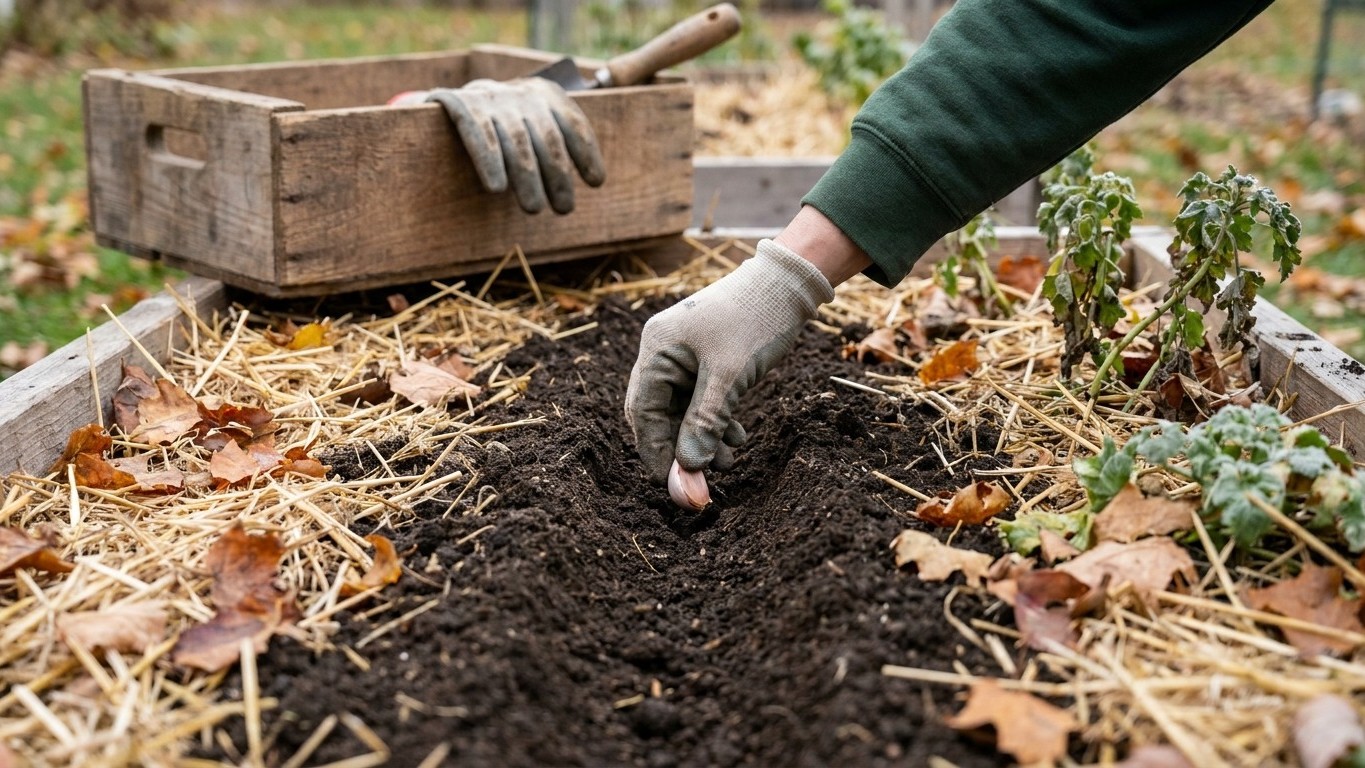

November straddles Oregon’s first fall frost window, so the honest answer depends on where you garden. In the Willamette Valley and coastal areas, garlic, shallots, cover crops and hardy greens under cover still go in. In central and eastern Oregon’s high desert, frost has usually already closed the ground, and the work shifts to dormant tasks and planning.
What goes in the ground in November

The calendar says November, but the soil doesn’t read calendars. What actually decides whether something goes into open ground is soil temperature and where you sit relative to the first fall frost window, which NOAA NCEI’s 1991-2020 climate normals put at November 11 to November 27 for the Portland area, west of the Cascades. That means early in the month, west-side gardeners are often still working with unfrozen, workable soil. By the back half of the month, frost becomes the rule rather than the exception.
Central and eastern Oregon is a different climate entirely. That high desert country runs a far shorter season, and frost there typically arrives weeks ahead of the Portland-area window. If you garden east of the Cascades, treat November as a month when the ground is likely already closed, and skip straight to the dormant-season jobs below.
For west-side gardens still workable, this is prime time for garlic and shallot cloves, pushed into loosened, well-drained soil so they can root before hard freezes lock things down. Fall cover crops, cereal rye, crimson clover, fava beans, still make sense where beds are bare, protecting soil structure over winter and adding organic matter come spring. Spring-flowering bulbs, tulips, daffodils, crocus, belong in the ground now too, while the soil is soft enough to dig.
Hardy greens started as transplants, mache, claytonia, spinach, can still go into a cold frame or under a low tunnel, where the cover buys several extra weeks of growing conditions. Bare-root fruit trees, roses and cane berries can begin going in as nurseries release dormant stock, provided the ground isn’t frozen or waterlogged. What doesn’t belong outdoors: anything tender. Tomato starts, basil, peppers, dahlia tubers left in the ground, none of it survives the frost window closing in.
What to start under cover
Sowing under cover in November isn’t about racing toward spring transplant dates, since those calculations run backward from the last spring frost window of March 6 to March 21, putting most indoor seed-starting for tomatoes and peppers months away yet. Instead, cover-grown sowing this month is aimed at a nearer target: baby greens and salad crops that mature in a cold frame or unheated hoop house over the following weeks.
Lettuce, spinach, mache and arugula sown now under glass or plastic can size up into harvestable greens even as outdoor beds shut down, because the cover buys enough heat and frost protection to keep growth ticking over slowly. The arithmetic that matters here isn’t days to last frost, it’s day length and available light, both shrinking fast in November.
That shrinking light is exactly why timing under cover is trickier than it looks. Sow too early relative to the light you actually have, and seedlings stretch thin and leggy reaching for weak sun, never filling out properly. Sow too late, and there isn’t enough remaining growth window before the cold locks things down almost completely, leaving you with seedlings that stall rather than mature.
Forcing crops indoors is the other November under-cover project worth naming: potted bulbs like paperwhites and amaryllis started now for indoor winter bloom, or chicory roots dug and forced in a dark spot for a crop of tender chicons. Rhubarb crowns can be lifted, chilled, and forced indoors the same way, giving an unusual early harvest well before the outdoor plant would ever show a stalk. None of it depends on frost dates at all, since it happens entirely indoors.
What is ready to pick
Outdoors, November harvests thin out fast as the frost window closes, and in most of the state there’s genuinely little coming out of open beds by month’s end. What remains standing tends to improve with the cold rather than suffer from it. Kale, leeks, parsnips and Brussels sprouts all sweeten once frost has hit them, the cold converting starches to sugars in a way that actually improves flavor, so there’s no rush to pull them before a freeze.
Cold frames and low tunnels are doing real work this month, protecting lettuce, spinach and mache that would otherwise be finished. Check under cover every few days; growth is slow but real, and a head of mache or a handful of baby spinach leaves is a legitimate harvest even in late November.
Indoors, sprouts and microgreens fill the gap, ready in a week or two from seed with nothing more than a tray and a windowsill, and they’re worth starting on a rolling basis through the cold months.
Stored crops need attention now too. Winter squash, potatoes and onions curing in the pantry or root cellar should get a check for soft spots, sprouting or mold, since one turning squash can spread rot to its neighbors if left in a bin. Pull anything questionable and use it first rather than let it sit.
The jobs that matter this month

November carries plenty of work even where nothing new goes into open ground, and skipping it costs real ground come spring. Dormant pruning starts as fruit trees finish dropping their leaves: removing dead, damaged or crossing wood now, while the tree’s structure is visible, sets up cleaner cuts than waiting until the whole canopy needs attention in late winter.
Seed catalogs and nursery stock move fast over winter, and ordering now, rather than waiting until January, is the difference between getting the variety you actually want and settling for whatever’s left. This is also the month to sketch next season’s rotation on paper, tracking where tomatoes, brassicas and legumes grew so nothing repeats in the same bed and builds up soil-borne problems.
Soil testing and amending belong here too, while beds are bare and workable. Lime, compost, or other amendments applied now have the whole winter to break down and integrate before spring planting, rather than fighting for time in a rushed spring window. Turning the compost pile, and insulating it with straw or leaves if it’s running cold, keeps decomposition moving through the winter months instead of stalling out entirely.
Garlic and any overwintering perennial beds need a mulch layer of straw now, ahead of the hardest freezes, to buffer root zones from repeated freeze-thaw cycles. Tools deserve the same attention: cleaning soil off, sharpening blades, and oiling metal parts before winter storage saves both the tools and next spring’s first few hours of work. Fences, raised bed corners and cold frame hardware are worth a walk-through too, since minor repairs now beat discovering a broken latch during the first hard freeze.
What not to do in November
The classic November mistake is trusting a warm afternoon over the calendar and the frost window. A mild stretch of weather doesn’t mean the season has reopened; soil several inches down cools far more slowly than air temperature, and tender starts put into ground that feels warm on the surface can still be sitting in soil too cold to support real root growth.
Uncovering cold frames or low tunnels too eagerly after a warm spell is a related error. Plants hardened off under cover, then suddenly exposed, can be knocked back hard by the next cold night, undoing weeks of protected growth in a single evening.
Nitrogen fertilizer applied late in the season is another common misstep. Nitrogen pushes soft, leafy new growth, and that new growth has no time to harden off before a freeze, leaving plants more vulnerable rather than stronger heading into winter. If anything needs feeding this month, a balanced or lower-nitrogen approach, or simply waiting until spring, serves the plant better.
Leaving harvested squash, onions or garlic sitting in wet soil or a damp garage instead of curing them properly is the last frequent slip. Curing in a dry, airy spot for a couple of weeks before storage is what actually extends how long these crops keep; skip it, and rot sets in far sooner than it should.
Checking this against your own county
A statewide month is a starting point, not an instruction. Oregon’s hardiness zones span 4a to 9b on the USDA map, and that range alone tells you how much elevation, the Cascade divide, and coastal versus inland exposure can shift a frost window by weeks in either direction. A garden a few hundred feet higher, or on the wrong side of the mountains, can be closing down while a nearby valley floor is still workable.
Before acting on any date in this piece, check it against your own county through Oregon State University’s extension service at extension.oregonstate.edu, which maintains local planting guidance built for Oregon’s specific microclimates.
Common questions
Can you plant garlic in Oregon in November?
Yes, and it’s one of the most reliable November plantings in west-side gardens. Cloves go into loosened, well-drained soil while it’s still workable, ideally with time to root before the hardest freezes arrive.
Is it too late to start a fall garden in Oregon in November?
For open-ground vegetable sowing, largely yes in most of the state, since the first fall frost window runs November 11 to November 27 in the Portland area. Cold frames and low tunnels extend the window for hardy greens, but new open-ground sowing isn’t a good bet this late.
What USDA hardiness zone is Oregon?
Oregon spans USDA Plant Hardiness Zones 4a through 9b, a range wide enough that a single statewide recommendation rarely fits every garden; check your specific zone rather than assuming the state average applies.
When does frost typically arrive in Oregon?
In the Portland area, NOAA NCEI’s 1991-2020 climate normals place the first fall frost between November 11 and November 27. Central and eastern Oregon’s high desert climate typically sees frost arrive well ahead of that window.
Gardeners who plant by the Moon can check the November 2026 moon planting calendar, a tradition rather than a proven method.
Related guides
Elsewhere? See what to plant in November in every state and province.