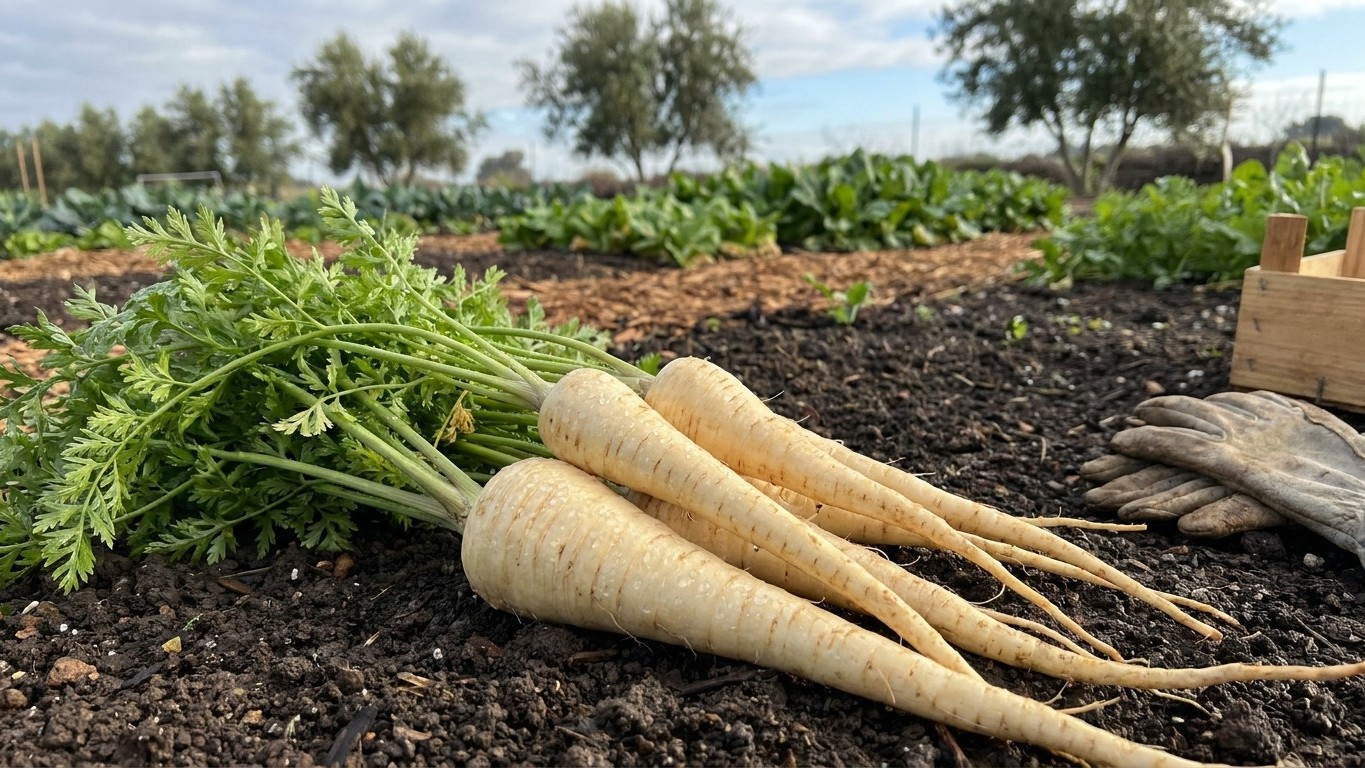

West of the Cascades, lift parsnips when the roots reach full size, 100 to 120 days after seeding, and don’t wait on a deep frost that may never arrive. In a Portland-style winter, a parsnip is usually a good vegetable rather than a sweet one. Once lifted, the roots keep four to six months, but only if they stay cold, damp and away from the fruit bowl. Central and eastern Oregon follow different rules.
The short answer
Frost, not zone, makes the sugar
Does this territory deliver several frosty weeks? For the Portland reference station, the answer leans no. NOAA’s climate normals put the mean daily minimum of the coldest month at 36.2°F. The average night in the dead of winter stays above freezing, by more than four degrees.
Frost does show up. The 30 to 70 percent freeze-probability band runs from March 6 to March 21 in spring and from November 11 to November 27 in fall. But scattered frosty nights are not the same thing as weeks of sustained cold. Utah State University Extension says parsnips taste best after several weeks of cool, frosty weather, which converts stored starch to sugar. That is exposure to frost, a different measure from hardiness zone. A zone tells you whether a plant survives winter, and a parsnip survives nearly anything. A comfortable zone says nothing about how many frosty weeks the root actually sits through.
So plan on a parsnip that grows well here and may not sweeten much. If you want the full reasoning, Will Parsnips Sweeten in Oregon? goes through it. The practical consequence for lifting: once roots are full size, holding them in the ground for sugar that mild winters rarely deliver buys little, and roots left in the soil stay exposed to whatever is feeding on them (What Eats Parsnip in Oregon, and When covers that). For the full growing picture, start with Growing Parsnips in Oregon.
How long they keep once lifted
The USDA’s Agricultural Handbook 66 says parsnip roots can be stored four to six months at 32 to 34°F (0 to 1°C) with 98 percent relative humidity. Four to six months is a long keeper by any standard. The figure assumes those conditions are held steady, and almost no house does that. A cool, damp cellar comes closer than a kitchen shelf.
The handbook is blunt that parsnips are not chilling sensitive, so cold is not what ruins them. Ethylene is. Parsnips themselves give off very little (under 0.1 µL per kilogram per hour at 68°F), yet even low levels of the gas in cold storage cause bitterness, likely through a buildup of a compound called xanthotoxin. That means no parsnips in the same crisper as apples, pears or any ripening fruit, even at the right temperature. The handbook’s chapter on parsnips also says to top the roots after harvest but not to trim into the crown.
Does the season fit?
Parsnips are sown in place, so the 100 to 120 day clock runs from seeding, not from transplanting. Here is the arithmetic for the Portland station, step by step.
- Start from the spring frost window. The last frost falls between March 6 and March 21, and the sowing target is 2 to 3 weeks before it. Counting back, that puts seed in the ground from roughly mid-February to the first week of March.
- Allow for germination. Seed takes 14 to 21 days to come up, which is long enough that a gardener looking at bare soil on day ten might assume failure and re-sow. Don’t. Mark the row and wait the full three weeks.
- Add the growing time. A mid-February sowing plus 100 to 120 days lands between late May and mid-June. A sowing in the first week of March lands between mid-June and early July. Full-size roots, arrive in early summer.
- Compare against the fall window. The first frost arrives between November 11 and November 27, more than four months after even the latest finish. The season fits comfortably, with a wide margin to spare.
- Read the margin honestly. Slack is good for the crop’s size, but it also means the roots finish months before any frost, and the frost they eventually meet is thin, given that coldest-month mean of 36.2°F.
None of this applies statewide. Portland sits west of the Cascades, while central and eastern Oregon are high desert with a far shorter season and colder winters. The frost dates above should not be borrowed for Bend or Pendleton. No station figures for those areas are published here, so check the frost normals for your own nearest station before you count days.
What goes wrong here
- Forked roots from heavy or stony ground. Utah State University Extension calls for deep sandy soil and says heavy soil must be double dug. Much of western Oregon’s valley ground runs heavier than that, and a root that hits a clod or a stone splits around it. Dig a test hole in your own bed first, because a regional soil map is a starting point, not a diagnosis of your garden.
- Forked roots from overwatering. This is a separate cause with a separate fix. Soil kept constantly wet can also produce forked, hairy roots even in loose ground, so water on a steady schedule that lets the bed drain between soakings rather than keeping it soggy. Don’t assume a forked root means the soil is wrong when the hose may be the culprit.
- No sprouts, so a hasty re-sow. Germination takes 14 to 21 days. Digging up the row at two weeks and starting over wastes seed and resets a clock that already needed the whole window.
- A season that runs out. On the west side this is rare, since the arithmetic above leaves months of margin. In the colder high-desert counties it is a real risk, because a shorter frost-free window can squeeze 100 to 120 days. Count backward from your own fall frost date before sowing.
- A winter too mild to sweeten. A parsnip can be fully grown and still taste plain, because the starch-to-sugar change needs several frosty weeks. The remedy is mostly expectation: lift at size, and treat any sweetness from a cold snap as a bonus rather than a plan.
- Bitterness in storage. The cause is ethylene from nearby fruit, not temperature. Keep the roots in a separate container or room from apples and pears, and top them without cutting into the crown.
- Roots that go limp or shrivel. The 4 to 6 month figure depends on 98 percent humidity, which a dry kitchen can’t offer. Cool and damp wins over warm and tidy, and if your storage can’t hold it, plan on eating them sooner.
Common questions
Can I lift parsnips before any frost?
Yes. Mature roots are edible once they reach full size, roughly 100 to 120 days from seeding. They just won’t have the extra sweetness that several frosty weeks produce, and in a mild Oregon winter you may not get those weeks anyway.
How long until parsnip seed comes up?
Fourteen to 21 days. Slow, patchy germination is normal for parsnips, and it is the most common reason gardeners re-sow a row that was never failing.
Can I store parsnips next to apples?
No. Ripening fruit gives off ethylene, and even low levels in cold storage make parsnips bitter. The roots tolerate cold fine, so the fix is distance from the fruit, not a warmer shelf.
Should I trim the tops and crowns before storing?
Remove the tops after harvest, but don’t cut into the crown. The USDA handbook gives that instruction directly, along with 32 to 34°F and 98 percent humidity as the target conditions for the four to six month keeping time.