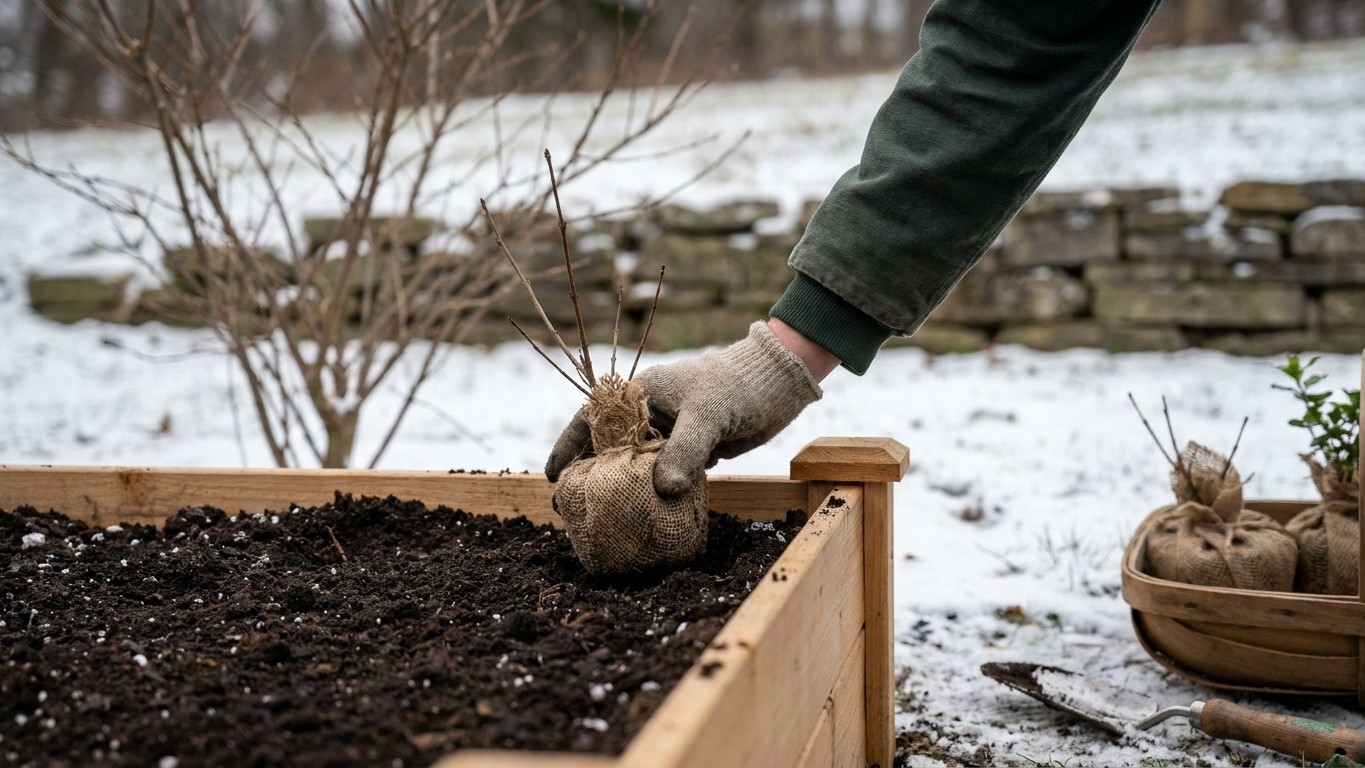

Nothing goes into open ground in Pennsylvania in December. The state sits weeks past its first fall frost window of November 5 to November 16, soil is frozen or close to it across most counties, and the growing season is closed until spring. But December is not an empty month in the garden: it’s when dormant planting, cold-frame work, and next season’s setup happen.
What goes in the ground in December

The decision here isn’t the calendar, it’s the soil. Once ground temperature drops below the point where roots can establish, even cold-hardy crops sit and rot rather than grow. Pennsylvania crossed its first fall frost (November 5 to November 16, per NOAA climate normals) weeks before December opens, and by now most of the state has had several hard freezes on top of that single frost date. Direct-sowing anything in open soil this month is a gamble that almost never pays off.
Say it plainly: for the vast majority of Pennsylvania gardens, nothing new goes into unprotected open ground in December. That’s not a failure of planning, it’s just where the season sits.
What still happens outdoors
A few things remain possible, and they’re worth doing rather than skipping the month entirely:
- Garlic and shallots, if the ground in your specific spot hasn’t fully frozen yet, especially in the milder southeastern counties near Philadelphia. Get cloves in and mulched heavily before the ground locks up for good.
- Bare-root and dormant plantings of fruit trees, roses, and shrubs, timed to soil that’s workable, not waterlogged or frozen solid.
- Cold frames and low tunnels, which buy several extra weeks of growth for crops already established, like spinach or mâche sown in fall.
- Forcing rhubarb or chicory (Belgian endive) indoors from dug roots, in a dark, cool space, which produces edible growth through the darkest weeks of the year.
None of this replaces a spring planting season. It’s maintenance and a head start, not a harvest push.
What to start under cover
Starting seeds indoors in December only makes sense when you count backward from Pennsylvania’s last spring frost window of March 29 to April 6, and even then, only for the slowest, longest-season crops. Onions and leeks grown from seed need roughly ten to twelve weeks of indoor growth before they’re ready to go outside near the frost-free date. Counting back from early-to-mid April puts the sowing window for those two crops squarely in December through early January, especially in colder counties where the last frost runs two to four weeks later than the Philadelphia reference dates.
Almost everything else is too early. Tomatoes, peppers, and brassicas started now will be leggy, rootbound, and stressed long before it’s safe to plant them out, since their indoor windows fall six to ten weeks before frost, not fourteen or sixteen. That’s the first failure mode: starting too early and ending up nursing overgrown seedlings under grow lights for months, watching them decline before the garden is even ready.
The second failure mode runs the other direction. Gardeners who skip December and wait until February to start alliums often find their onions and leeks never bulk up properly, because they’ve lost that early runway. If leeks or onions are on your list, December (or very early January) under lights or on a sunny windowsill is the actual window, not a suggestion to get ahead, but the last reasonable point to start without shortening the crop.
Microgreens and sprouts don’t follow this arithmetic at all. They’re ready in one to three weeks regardless of the outdoor season, which makes them the one thing worth starting indoors purely for the kitchen, any week of December.
What is ready to pick
Outdoors, the honest answer is little to nothing across most of Pennsylvania in December. The garden proper is closed. But a working kitchen garden still produces food this month, just not from freshly growing plants in open beds.
Kale, and to a lesser extent leeks, that were left in the ground under a thick mulch or a layer of snow often remain harvestable well into winter in the milder parts of the state, particularly near Philadelphia where the growing zone runs warmer than the northern tier. Snow itself acts as insulation rather than a threat, so don’t rush to dig plants out from under it. Cold frames holding fall-sown spinach, mâche, or hardy lettuce can still be opened on above-freezing days for a cutting.
Indoors, sprouts and microgreens are the most reliable “harvest” of the month, ready on a rolling basis from jars or trays on a counter.
Checking stored crops
This is also the month stored produce starts to show its weak points. Go through winter squash, potatoes, and onions in storage and pull anything with a soft spot, a sprouting eye, or a moldy patch before it spreads to the rest of the bin. One rotting squash in a crate can take down its neighbors within a couple of weeks if it’s not caught.
The jobs that matter this month

December carries real deadlines even though nothing is being planted or harvested at scale. Skip these and the cost shows up in spring, not now.
Pruning and dormant work
Dormant pruning of fruit trees, brambles, and grape canes is best done while the plant has no leaves and the wood’s structure is fully visible. Cuts made now heal cleanly before spring sap flow starts, and there’s no foliage in the way to hide dead or crossing branches. Wait too long, past the point buds start to swell, and pruning cuts into active growth instead of dormant wood, which stresses the plant.
Seed and planning
Seed catalogs move fast in the weeks after they drop, and popular varieties, especially disease-resistant tomatoes and heirloom favorites, sell out before February. Ordering now secures the actual list you planned, not whatever’s left. Pair that with mapping next season’s crop rotation on paper: which bed had tomatoes, which had brassicas, so nothing repeats in the same soil for at least three years.
Soil, compost, and tools
A soil test taken now gives results back in time to amend before spring planting, and it’s far easier to spread lime or compost on bare, frozen-firm ground than on wet spring soil that compacts under boots. Turning the compost pile, even in cold weather, keeps decomposition moving instead of stalling completely. Cleaning and sharpening pruners, shovels, and hoes now means they’re ready to grab in March instead of rusted shut. Walk fence lines and raised bed frames for winter damage while repairs are still easy to schedule.
What not to do in December
The classic December mistake in Pennsylvania is trusting a warm afternoon. A stretch of 55-degree days can feel like spring, but soil temperature and the calendar haven’t moved, and the state is still four months from its last spring frost window of March 29 to April 6. Uncovering cold frames or pulling mulch off garlic beds during a mild spell, then getting caught by the next cold snap, undoes weeks of protection in a single night.
Fertilizing with nitrogen this month is another common error. Nitrogen pushes soft, leafy growth, and any new growth triggered now has no time to harden off before the next freeze. It’s wasted on dormant plants and actively harmful on anything still semi-active, like fall-planted garlic. Hold nitrogen until active spring growth resumes.
Working frozen or saturated soil is a third trap. Digging, tilling, or even walking heavily on wet clay soil this time of year compacts it into a dense mass that drains poorly for the entire following season. If the ground squishes or is frozen solid, stay off the beds and do the planning and tool work instead.
Finally, don’t wait on seed orders. Treating December as too early to think about spring means missing the varieties that sell out first, often the exact disease-resistant or short-season types that matter most in a state with a frost window this variable.
Checking this against your own county
Everything above is a state-wide starting point, not a fixed instruction. Pennsylvania’s hardiness zones run from 5a to 7b under the USDA Plant Hardiness Zone Map, and that spread matters: the Philadelphia area sits at the mild end, while the northern tier and the Alleghenies run two to four weeks behind it in both spring thaw and fall freeze. Elevation alone can shift a frost date by a week or more within the same county.
For a planting window tuned to your actual location, check the Penn State Extension service, which publishes county-level guidance that adjusts for these local differences.
Common questions
Can I still plant garlic in December in Pennsylvania?
Only if the ground in your specific location hasn’t frozen solid yet, which is more likely near Philadelphia than in the northern counties. Get it in with heavy mulch immediately if you try.
Is it too late to start onion or leek seeds indoors?
No. Counting back ten to twelve weeks from the last spring frost window (March 29 to April 6) puts December and early January right in the workable range for these two slow-growing crops.
Why is nothing supposed to grow outdoors this month?
Pennsylvania’s first fall frost arrives November 5 to November 16, and by December the ground is typically frozen or near-frozen across most of the state, which stops root establishment for anything newly planted.
What’s the single most important job in December?
Dormant pruning of fruit trees and canes and getting seed orders in early both carry real deadlines this month; skipping either one shows up as a cost in spring rather than now.