
January doesn’t ask Pennsylvania gardeners to plant much outdoors, but it does ask them to get the timing right on everything that happens behind glass, under cover, or on a spreadsheet. The frost window that governs the whole season, March 29 to April 6 for the Philadelphia area, sits weeks away, and until it opens the real planting work happens indoors and in the planning that decides how the rest of the year goes.
What goes in the ground in January

Frozen ground beats calendar every time. Across zones 5a to 7b, per the USDA Plant Hardiness Zone Map, January soil sits below the workable threshold for weeks at a stretch, and pushing a spade into it does more harm than good to soil structure. That single fact rules out direct sowing almost everywhere in the state this month, from Erie’s lake-effect belt to the southeastern counties.
There’s one exception worth naming: garlic and shallots. If cloves missed the ground before it locked up in fall, a rare thaw in the counties where the frost-free window opens earliest can still make room for a late planting. Push a finger into the bed first. If it goes in past the first knuckle without resistance, the soil is workable. If it bounces back, wait.
Cold frames, low tunnels and dormant stock
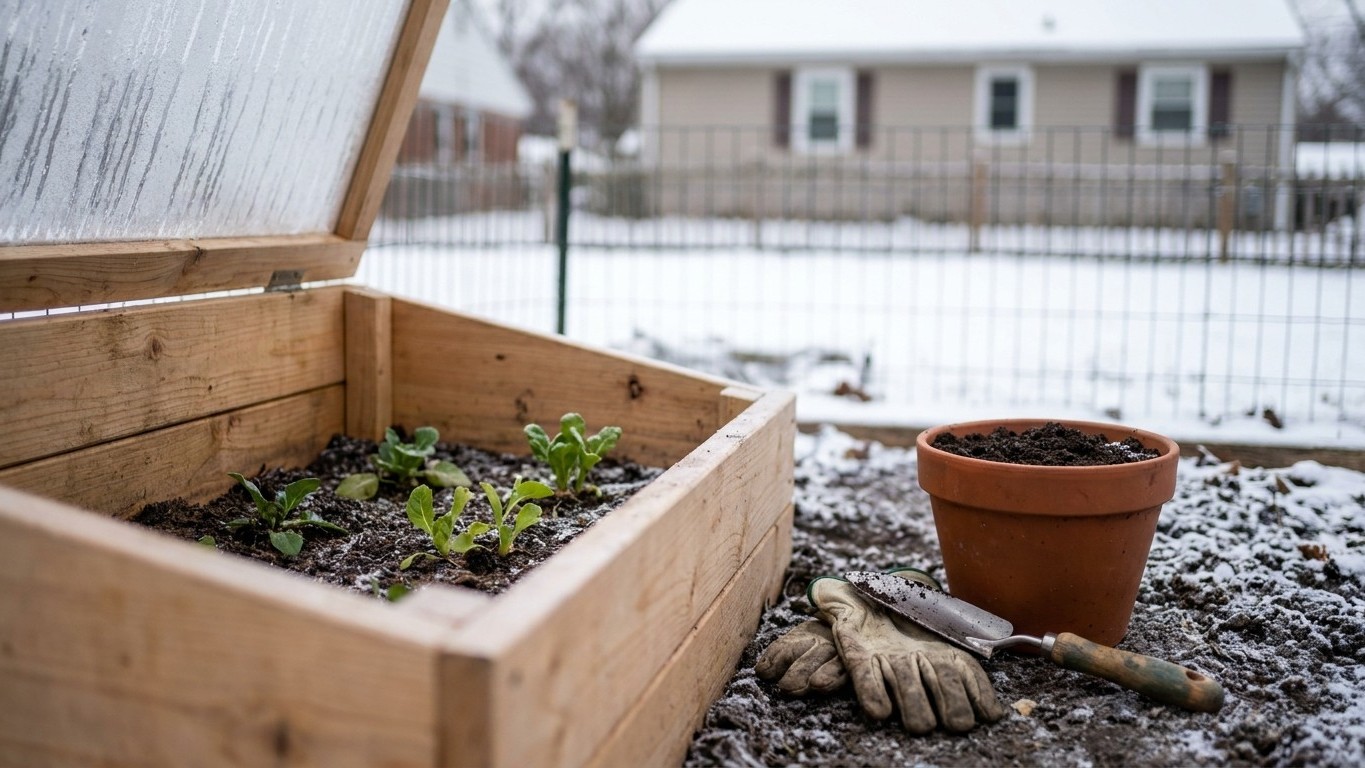
Cold frames and low tunnels change the math without changing the calendar. Under two layers of row cover, hardy greens like spinach, mache and claytonia that were already established in fall keep producing at a crawl. That isn’t new planting, it’s harvest management, covered further below.
Bare-root fruit trees, roses and dormant shrubs are the other legitimate January planting, but only where the ground is workable and only if the plant stays fully dormant. Nurseries ship them this month because the plant doesn’t know the difference between a root cellar and a garden bed until it’s unwrapped. Heel them into a trench of loose soil or mulch if the ground refuses to cooperate, and get them into their final spot as soon as it thaws.
Indoors, forcing takes over where outdoor planting can’t. Potted rhubarb crowns and chicory roots, lifted from the garden or bought dormant, force into pale, tender growth in a dark closet or basement within three to four weeks. It’s the closest thing to a January harvest that also starts as a January planting.
What to start under cover
Every seed-starting date this month works backward from one anchor: the March 29 to April 6 frost window for the Philadelphia area, pushed two to four weeks later across the northern tier and the Alleghenies. Count backward from whichever end of that range matches the reader’s own county, not from a date on a calendar.
| Crop | Weeks needed before transplant | Start indoors in January? |
|---|---|---|
| Onions | 10-12 | Yes |
| Leeks | 10-12 | Yes |
| Celery | 10-12 | Yes |
| Peppers | 8-10 | Wait until February |
| Eggplant | 8-10 | Wait until February |
Onions, leeks and celery are the crops that reward an early start, since 10 to 12 weeks of indoor growth lines up almost exactly with a frost date in late March or early April. Start them now under grow lights and they’ll be stocky, pencil-thick seedlings by transplant time. Start them in March instead and they’ll go into the ground thin and underdeveloped.
The two ways to get the timing wrong
Starting too early produces the same problem twice: cramped roots circling a pot too small, and pale, stretched stems reaching for light a windowsill can’t supply. Starting too late runs out the season from the other end, with transplants going into cold soil before they’ve built the root mass to handle it. Onions and leeks tolerate an early start better than almost anything else in the seed catalog, which is exactly why they’re the safe January project.
What is ready to pick
Little comes out of open Pennsylvania soil this month, and that’s worth saying plainly rather than padding a list with crops that are really just surviving under cover. What’s actually feeding the table right now comes from three places: what was tucked under insulation before the ground froze, what’s growing under glass, and what’s sitting in storage.
Kale, leeks and Brussels sprouts left in the garden under a thick mulch or a blanket of snow keep sweetening as the cold concentrates their sugars, and can be dug or cut whenever the ground softens enough for a fork. Snow acts as insulation more than obstacle. Pull it back, check for firm leaves, and replace the covering afterward.
Cold frames extend this further. Spinach, mache, tatsoi and other hardy greens planted in fall keep cropping in small amounts under a frame or double row cover, though growth slows to nearly nothing below a certain light and temperature threshold, so cutting is light and occasional rather than a full harvest.
Indoors: sprouts, microgreens and the storage check
Sprouts and microgreens are the one true January harvest that starts and finishes indoors on a countertop, ready in five to fourteen days depending on the seed. They don’t need soil, sun, or a frost date, which makes them the most reliable fresh green of the month.
Storage crops need a different kind of attention now, not harvesting but inspection. Squash, potatoes and onions put up in fall are three or four months into their storage life, and this is when soft spots, sprouting eyes and mold show up. Go through the bins every couple of weeks and pull anything turning before it takes the rest of the batch with it.
The jobs that matter this month

Dormant pruning tops the list, and January is one of the few windows to do it right. Apple, pear and stone fruit trees, along with raspberry and blackberry canes, are fully dormant now, with no leaves hiding the branch structure and no sap flow to bleed from a cut. Prune while the tree sleeps and it heals before spring growth resumes; wait until buds swell and every cut costs stored energy the tree needs for that first flush.
Seed ordering has its own deadline, driven by other gardeners rather than the weather. Popular varieties, especially open-pollinated and heirloom onions, tomatoes and peppers, sell out from small seed houses by late winter. Ordering now, while the full catalog is still in stock, beats discovering in March that the variety grown for years is gone.
Soil, compost and the beds themselves
A soil test taken as soon as the ground is workable comes back in time to guide any lime or amendment before spring planting. Compost piles built in fall still need turning even in cold weather; it aerates the pile and keeps the center from going anaerobic, which can slow the whole process for months if it’s ignored.
Tool maintenance and bed repair round out the list, unglamorous but timed to matter: sharpening pruners and hoes now means no dull-blade struggle in March, and fixing a sagging trellis or a gap in the fence now means it’s solid before anything is growing through it. Rotation planning, sketched out on paper while the beds sit empty, is far easier to do without a crop already in the way.
What not to do in January
The most common mistake is reading a mild stretch of air temperature as permission to plant. A 55-degree afternoon in late January doesn’t mean the soil four inches down has warmed at all, and warm-season seeds sown into cold, wet ground rot before they ever germinate. Soil temperature, not air temperature, decides the planting date, and in Pennsylvania in January that number rarely moves.
Uncovering cold frames or removing row cover during a warm spell is the second trap. A few mild days can tempt a gardener to air things out, but the cold that follows hits plants that have lost the acclimation the cover was providing. Leave the cover on through brief warm-ups and vent it instead of removing it outright.
Feeding at the wrong moment
Nitrogen fertilizer applied to dormant plants, whether fruit trees, garlic or overwintering greens, does close to nothing for the plant and can wash through frozen or saturated soil into groundwater. Dormant plants aren’t taking up nutrients the way they will once growth resumes, so a January feeding is largely wasted. Hold nitrogen until active growth starts, and use this month for the soil test that will show how much to apply and when.
The last mistake is starting long-season transplants, tomatoes especially, too early out of impatience. Eight extra weeks on a windowsill doesn’t produce eight extra weeks of harvest; it produces a rootbound, stressed plant that takes longer to recover after transplant than one started on schedule.
Checking this against your own county
Everything above is built on the Philadelphia area’s frost window, and that’s the mildest corner of the state by a wide margin. The northern tier, the Alleghenies and anywhere with real elevation run two to four weeks behind that timeline in spring, which pushes every backward-counted seed-starting date in this piece earlier for those counties, not later.
Lake Erie’s shoreline complicates it further, moderating winter lows in ways a state-wide frost range can’t capture. A single Pennsylvania planting calendar is a starting point, not an instruction. For guidance built around a specific county, Penn State Extension publishes region-specific planting calendars and takes soil and frost questions directly.
Common questions
Can I plant grass seed in Pennsylvania in January?
No. Grass seed needs soil temperatures well above what January delivers anywhere in the state; wait for the soil to warm in spring or plan a fall seeding instead.
Is it too late to plant garlic in January?
It’s late, not impossible. Garlic planted in January instead of the usual fall window tends to produce smaller bulbs, but cloves tucked in during a workable thaw in the milder counties still have a shot at a harvest.
What zone is Pennsylvania for planting purposes?
The USDA Plant Hardiness Zone Map places Pennsylvania between zones 5a and 7b, a range wide enough that a frost date or zone number quoted for Philadelphia won’t hold for the Alleghenies or the northern tier.
When should I start onion seeds indoors for a Pennsylvania garden?
Count back 10 to 12 weeks from the local last-frost date. For the Philadelphia area’s March 29 to April 6 window, that lands in early to mid January, earlier still for counties where spring arrives later.