
By December, Prince Edward Island’s soil is either frozen solid or buried under snow, and the mean first fall frost at Charlottetown A already passed back on October 17. So the honest answer is that almost nothing goes into open ground this month. What does work: forcing rhubarb and chicory indoors, tending cold frames and low tunnels holding hardy greens, checking dormant bare-root stock if the ground still gives, and using the quiet weeks for pruning, planning, and seed orders before catalogs sell out.
What goes in the ground in December

The calendar says December, but the ground doesn’t care what the calendar says. What matters is soil temperature and whether the frost window has already closed, and on Prince Edward Island it has. The mean first fall frost at Charlottetown A lands October 17, and that’s an average, not a promise, meaning frost arrives later than that in half the years on record. By the time December opens, the soil has typically been through weeks of freezing and thawing, and in most winters there’s already a snow layer sitting on top of it.
That rules out direct-sowing anything. Garlic and shallots, which are the classic “still going in” crops on a lot of December planting lists, needed to go into the ground back in October or early November while the soil was still workable enough to dig a trench. If a stretch of mild weather has kept a patch of garden unfrozen, a late garlic planting is possible and better than skipping the year entirely, but it’s a gamble, not a plan.
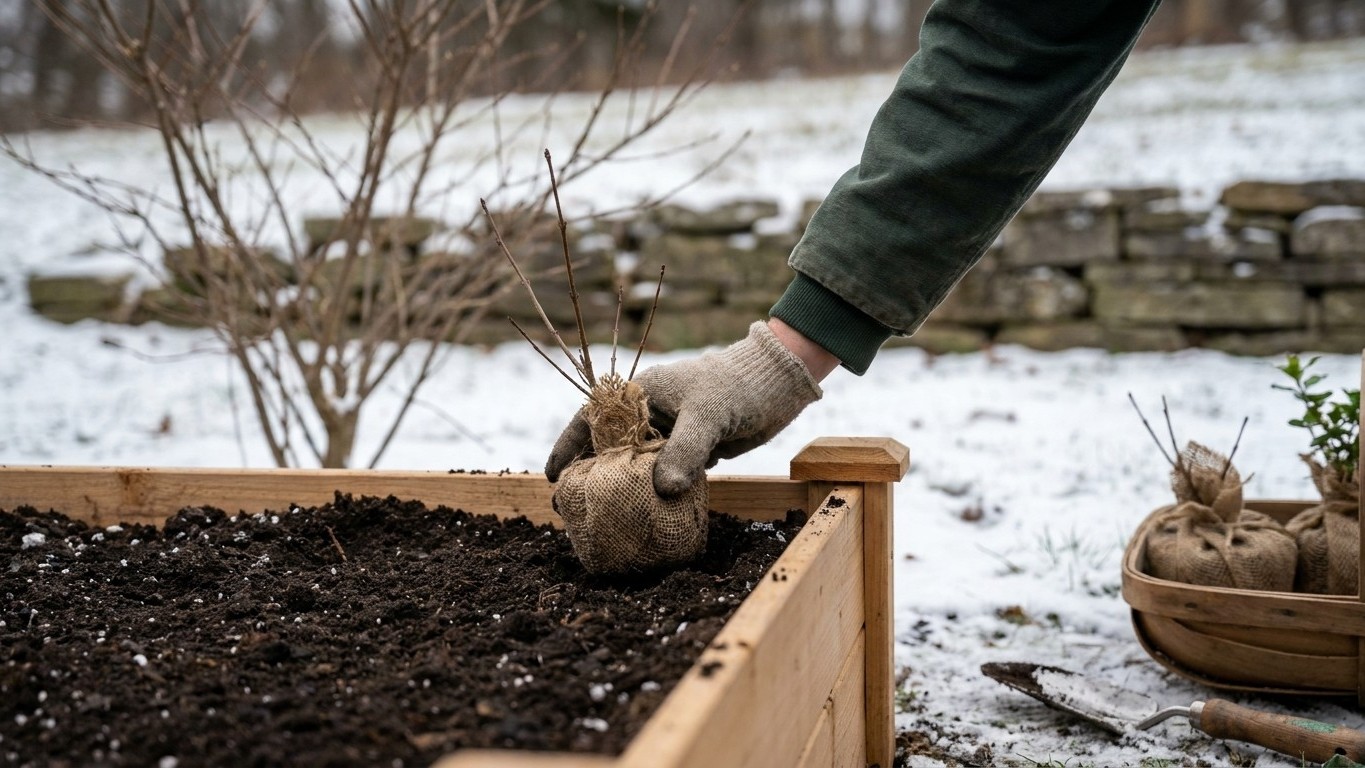
Where December planting still makes sense is under some form of protection. Cold frames and low tunnels can hold hardy greens like spinach, mache, and claytonia that were seeded earlier in fall, and a frame can sometimes squeeze in one more sowing of a fast, cold-tolerant green if there’s still light and the soil inside hasn’t frozen. Dormant bare-root fruit trees, shrubs, and canes can go in if a supplier has stock and the planting hole can still be dug, though on Prince Edward Island that window usually closes before December starts.
Indoors, this is the month for forcing. Rhubarb crowns lifted and left outside to chill can be brought into a dark, warm space to push tender stalks weeks ahead of the outdoor season. Belgian endive (chicory) roots dug in fall can be forced the same way, in a dark box or bucket, for a harvest that has nothing to do with frost at all.
What to start under cover
The arithmetic for indoor seed starting runs backward from the last spring frost, not forward from today’s date. On Prince Edward Island that mean date is May 16, and even that comes with a caution: frost falls later than May 16 in about half the years on record, so growers who push transplants outside right at that mark are betting on the better half of the odds. Counting backward from a date five months out, December is too early for almost every warm-season seed. Tomatoes, peppers, and eggplant started now would be rootbound and leggy long before the soil has any hope of warming enough to receive them.
What does make sense in December is prep work that isn’t tied to that clock at all: sprouting seeds and microgreens on a windowsill or under a light, which go from seed to harvest in one to three weeks regardless of the outdoor calendar. Onions and leeks, which need the longest indoor head start of any common garden crop, aren’t started this early either, since even a twelve-week lead time puts their sowing date in late winter, not now.
The two failure modes worth naming plainly: start too early and the seedlings outgrow their pots before it’s safe to plant them out, stretching thin and pale under indoor light and losing vigor they never fully recover. Start too late and there isn’t enough season left for a crop to mature before the fall frost window closes again. December sits well on the early side of that trap for nearly everything except sprouts, microgreens, and the very earliest onion and leek sowings still weeks away.
What is ready to pick
Outdoors, there’s little to bring in this month, and pretending otherwise does the reader no favors. Kale and leeks left standing under a blanket of snow or a layer of straw mulch often survive and can still be dug or cut on a mild day, since both crops tolerate hard freezing better than almost anything else in the garden. A cold frame with spinach, mache, or arugula can keep producing small pickings through the darkest weeks, provided it isn’t opened during a deep cold snap that would let stored ground heat escape.
Indoors, sprouts and microgreens fill the gap. A tray of sprouting seeds on a counter can be ready inside a week, and microgreens grown under a simple grow light give fresh, tender greens with none of the frost risk of the outdoor bed.
This is also the month to walk the storage shelves. Squash should feel firm with no soft spots near the stem end. Potatoes need checking for sprouting eyes or a shriveled, rubbery feel, both signs they’re on their way out. Onions that have gone soft at the neck or started to smell should be pulled and used first, before they take neighboring bulbs down with them. Catching one turning squash or a soft onion now can save the rest of the bin.
The jobs that matter this month

A winter month on Prince Edward Island isn’t an empty page, it’s a working one, and the jobs that get done now are the ones that save time and money come spring.
Pruning, ordering, and planning
Dormant pruning of fruit trees, brambles, and grapevines is best done while the plant is fully asleep and the wood’s structure is easy to see without leaves in the way. It’s worth avoiding pruning cuts during the coldest snaps, since wood cut in extreme cold is more prone to cracking and dieback around the wound. Seed catalogs move fast this time of year, and the varieties that sold out first last season tend to sell out first again, so ordering early beats hoping a favorite is still listed in February. This is also the natural planning window: sketching next season’s rotation on paper while last year’s results are still fresh, so beds that grew heavy feeders don’t get asked to do it again.
Soil, tools, and structures
Where the ground isn’t frozen solid, soil testing and amending can still happen, giving lime or organic matter a season to work in before spring planting. A compost pile benefits from an insulating layer of leaves or straw now to keep the pile from stalling out completely in the cold. Tools cleaned and sharpened before storage come out of the shed ready to use instead of needing an hour of work before the first planting day. Raised beds, fencing, and cold frame frames are easier to repair now, in the slow season, than in the rush of spring.
What not to do in December
The classic mistake this month is trusting a mild afternoon over the calendar and the soil itself. A stretch of unusually warm days can trick a gardener into pulling back mulch or opening a cold frame fully, only for a hard freeze days later to hit crowns and roots that had just started to lose their winter hardening. Mulch and row covers earn their keep by staying put through these swings, not by coming off at the first sign of sun.
Feeding nitrogen at this point in the season is another common misstep. Dormant plants aren’t taking up nutrients the way they do in active growth, and a nitrogen feed now can push soft, untimely growth in a mild spell, growth that then has no defense against the next freeze. Fertilizing is a spring job, not a December one.
Walking on frozen or waterlogged garden beds compacts the soil structure that took all season to build, squeezing out the air pockets roots need later. It’s better to stay off beds entirely until they’re solidly frozen through or fully thawed and dry enough to work. And in storage, ignoring the squash and potato bins for weeks at a stretch lets one rotting item spread to its neighbors; a quick check every week or two catches problems while they’re still small.
Checking this against your own county
A province-wide month is a starting point, not an instruction, and Prince Edward Island is no exception. Coastal areas hold heat longer than inland fields, elevation shifts frost timing by days or weeks, and a sheltered garden against a south-facing wall behaves differently than an open field a few miles away. The Charlottetown A figures don’t describe every backyard on the Island.
For local specifics, the Prince Edward Island government’s agriculture portal is the place to check current guidance and planting resources tailored to the province.
Common questions
Can garlic still be planted in December on Prince Edward Island?
Only if the ground hasn’t frozen yet, which is uncommon by December in most years. Garlic ideally goes in during October or early November, giving roots time to establish before hard freezes settle in.
What hardiness zone is Prince Edward Island in?
The reference city sits in Canadian hardiness zone 5b, based on Natural Resources Canada’s system, which uses seven climate variables. This is not a USDA zone and shouldn’t be compared directly to US zone numbers.
Is it too early to start tomato or pepper seeds indoors in December?
Yes. With a mean last spring frost of May 16, starting long-season transplants in December leaves months for them to outgrow their pots indoors before it’s safe to plant outside.
What can still be harvested in December on Prince Edward Island?
Outdoors, only cold-hardy crops like kale and leeks under snow or mulch, plus whatever a cold frame protects. Indoors, sprouts and microgreens are the reliable options, alongside checking stored squash, potatoes, and onions for spoilage.
Gardeners who plant by the Moon can check the December 2026 moon planting calendar, a tradition rather than a proven method.