
November in Prince Edward Island sits well past the average first fall frost, so the open-ground planting season is essentially closed. What is left is narrow but real: garlic and shallots where soil is still workable, protected sowing under cold frames, dormant bare-root planting, and a long list of jobs that decide how next spring’s garden performs.
What goes in the ground in November

Environment and Climate Change Canada’s Charlottetown A station puts the average first fall frost at October 17. That is a mean date, not a hard line, so in roughly half the years frost arrives later than that, and in the other half it comes earlier. By the time November opens, most of the Island has already had at least one killing frost on tender crops, and soil temperatures are dropping steadily even where the ground has not frozen solid.
That single fact decides everything else this month. Direct-sown annual vegetables (lettuce, beans, squash, anything that dies at 32 F) are done for the season across the province. What remains possible depends on whether the ground is still workable, meaning not yet frozen and not saturated with standing water.
What still fits in early November
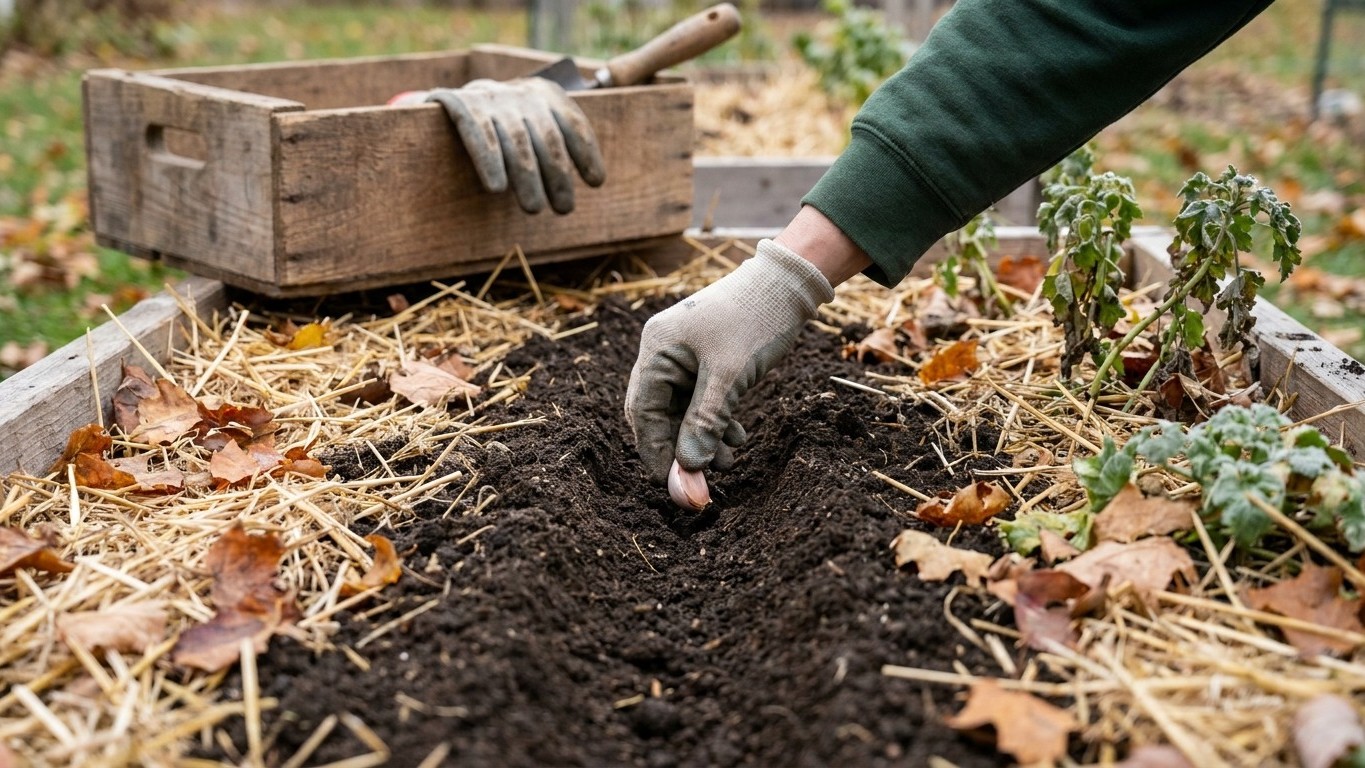
Garlic and shallot cloves can still go into open ground in the first half of the month in most PEI counties, provided the soil has not frozen and drains reasonably well. Plant them at the usual depth, then bury the bed under a heavy mulch of straw or shredded leaves once the surface starts to firm up, not before. That mulch layer is what carries the cloves through the freeze-thaw cycles of a Maritime winter.
Bare-root fruit trees, cane fruit, and dormant shrubs can also go in while the ground is still diggable and the plant itself is fully dormant. Nurseries selling bare-root stock in the region typically time shipments to this window. Cold frames and unheated low tunnels can shelter greens that were already established by fall, but sowing fresh seed into them this late rarely leaves enough daylight and warmth for germination and real growth.
For gardeners who want a project indoors, forcing rhubarb or Belgian endive (chicory) is a legitimate November task: dig dormant roots, pot them, and hold them in a dark, cool space to push blanched growth over the following weeks.
What to start under cover
Almost nothing sown now will reach a harvestable size before winter shuts the growing window down, and that includes most cold-frame greens started fresh in November. The more useful way to think about “starting under cover” this month is to work backward from the other end of the calendar: the Charlottetown A average last spring frost is May 16, and in one year out of two, frost actually falls later than that. Anything meant to be ready for transplant near that date, like onions or leeks started from seed, typically needs eight to ten weeks indoors under lights before it goes out, which puts the realistic sowing window in late winter, not now.
That arithmetic matters because the two failure modes run in opposite directions. Start too early and the seedlings sit under grow lights for months, become rootbound in their trays, and stretch into leggy, weak transplants that sulk after they finally go outside. Start too late and there is not enough runway left before the last frost window to get a stocky, productive transplant, so the harvest slips later into a summer that is already short on this side of the Gulf of St. Lawrence.
What does make sense in November under cover is a dormant-seeding trick some Island gardeners use for spinach and mâche: sow directly into a cold frame or unheated tunnel now, let the seed sit ungerminated through the coldest weeks, and let it sprout on its own as soil temperatures climb in earliest spring. It costs nothing but seed and patience, and it beats trying to start anything meant to grow to size before the ground freezes.
What is ready to pick
Outdoors, the honest answer for most of Prince Edward Island by November is very little. Any tender crop still standing in the garden has almost certainly already been touched by the average October 17 frost, and what survives is limited to genuinely cold-hardy plants.
Kale, Brussels sprouts, and leeks can often still be harvested through early November and sometimes later, since all three improve in flavor after a light freeze and hold in the ground far better than most vegetables. Check leeks before the soil locks up hard, since digging them out of frozen ground is close to impossible. Cold-frame greens planted earlier in the fall, things like spinach, mâche, and hardy lettuces, can keep producing light pickings as long as the frame is vented on mild days and closed tight on cold nights.
Indoors, sprouts and microgreens fill the gap when the garden has nothing left to give, and they take only days from seed to plate regardless of the weather outside. This is also the month to walk the root cellar or storage shelves and go through stored squash, potatoes, and onions by hand. Squash that feels soft near the stem, potatoes with dark eyes or a sweetish smell, and onions gone papery and soft at the neck should come out now, before they spread rot to everything stored around them.
The jobs that matter this month

A garden with nothing left to plant still has a full task list, and November is when the work either gets done or gets pushed into a spring that is already too busy.
Dormant pruning of fruit trees and cane fruit can start once the leaves are down and the plant is fully asleep, though many Island gardeners hold the heaviest cuts for late winter when the risk of a mild spell triggering new growth is lower. What can absolutely happen now is cleaning and sharpening pruning tools so they are ready when the real cutting window opens, and clearing out any diseased wood or fallen fruit that could carry pests or fungus through the winter.
Seed catalogs are worth ordering from now rather than in late winter, because the varieties that sell out first, the disease-resistant tomatoes, the reliably hardy garlic strains, tend to go quickly once the new season’s stock lists appear. Pair that with planning next year’s crop rotation while this year’s layout is still fresh in memory, so beds that grew heavy feeders don’t repeat the same crop in the same spot.
Soil testing and amending both work best now, while the ground is still open enough to dig in compost, lime, or other amendments and let them integrate over winter rather than scrambling in spring. Turning the compost pile one more time before the cold locks it up keeps the decomposition moving and gives finished compost ready for spring beds. Round out the list with checking sheds and cold frames for storm damage, mending fencing before snow load makes repairs harder, and giving stored crops another look partway through the month, since rot spreads fast once it starts.
What not to do in November
The most common mistake this month is mulching too early. Piling straw or leaves over garlic beds or perennial crowns before the ground has actually started to freeze traps warmth and moisture underneath, which invites rot and gives rodents a cozy place to nest right next to the plants you’re trying to protect. Wait until the soil surface has firmed up with cold before laying mulch down.
A mild stretch of weather partway through the month tempts gardeners to vent or uncover cold frames and low tunnels for “fresh air,” but that swings the temperature inside the frame widely and can shock hardy greens that had settled into a slower, cold-adapted rhythm. Vent briefly if condensation is heavy, then close back up.
Feeding nitrogen to perennials, fruit trees, or overwintering greens this late pushes soft new growth right when the plant should be shutting down for dormancy, and that tender growth is exactly what a hard frost kills first. Hold off on nitrogen until active spring growth resumes. And if a warm afternoon makes the soil feel workable, resist planting anything tender into it; air temperature is not soil temperature, and a cold snap a week later will undo the gesture entirely.
Checking this against your own county
The frost dates and hardiness figures above come from a single reference station, and Prince Edward Island is not one climate. Coastal areas along the Northumberland Strait often run a little milder than inland pockets, elevation shifts timing further, and a garden a short drive from Charlottetown can freeze solid days before or after the average date used here. Treat every figure in this article as a starting point for planning, not an instruction for your own backyard.
For local guidance tuned to specific counties and conditions, the province’s agriculture resources are the next stop: Prince Edward Island’s agriculture page.
Common questions
Is it too late to plant garlic in November on Prince Edward Island?
Not necessarily, as long as the soil is still workable and hasn’t frozen solid. Early November is generally the safer window; once the ground firms up with cold, planting becomes impractical and the cloves are better held until spring.
Can I still start vegetable seeds indoors this month?
Most vegetable starts sown in November would be leggy and rootbound long before the average last spring frost of May 16 arrives, since that date is still roughly six months away. Indoor sowing makes more sense closer to late winter, counted backward from that frost window.
What can I still harvest outdoors in November?
Cold-hardy crops like kale, Brussels sprouts, and leeks can often still be picked, especially early in the month, since a light frost tends to improve their flavor rather than ruin it. Cold-frame greens can also keep producing light harvests if the frame is managed carefully.
Does Prince Edward Island’s hardiness zone matter for November tasks?
The reference city sits in Canadian hardiness zone 5b, a figure from Natural Resources Canada built on seven climate variables and not comparable to the USDA system used elsewhere in the United States. It’s more useful for choosing perennials and fruit stock than for deciding this month’s exact tasks, which depend more directly on soil temperature and the frost window.
Gardeners who plant by the Moon can check the November 2026 moon planting calendar, a tradition rather than a proven method.
Related guides
- the Prince Edward Island planting calendar
- What to Plant in Prince Edward Island in October
- What to Plant in Prince Edward Island in December
Elsewhere? See what to plant in November in every state and province.