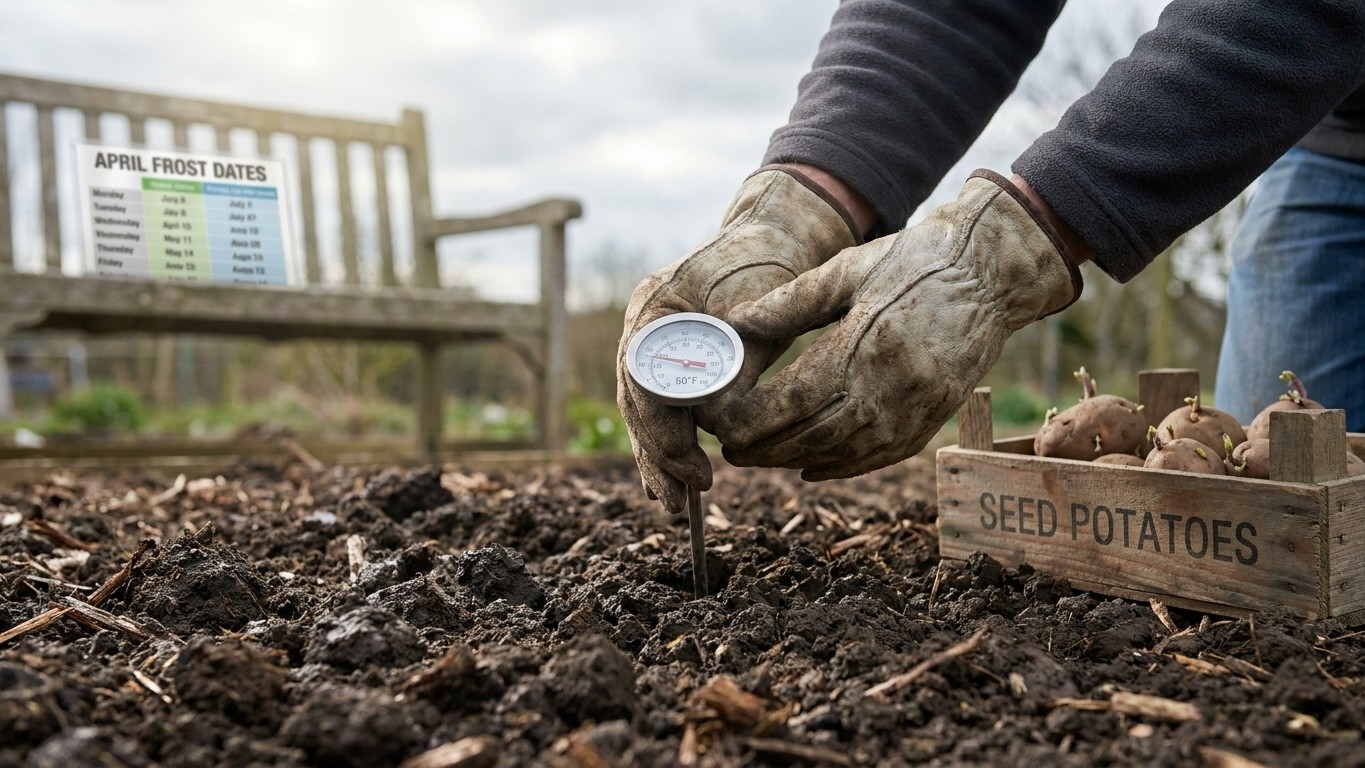

Prince Edward Island gardeners aiming for spring-planted potatoes should target roughly late April through the first days of May, counting back from the Island’s average last spring frost of May 16 at the Charlottetown A station (Environment and Climate Change Canada, Canadian Climate Normals 1981-2010). Potatoes go into the ground once soil reaches 50°F, which lands 14 to 21 days ahead of that frost date, not on a fixed calendar day. The mean date isn’t a guarantee, so treat it as a midpoint, not a safe line.
The short answer
Work the math from the one figure that’s actually published for this region: an average last spring frost of May 16, recorded at the Charlottetown A station and reported by Environment and Climate Change Canada in the Canadian Climate Normals for 1981-2010. Potatoes are planted 14 to 21 days before that date, once soil temperature hits 50°F, according to guidance from Utah State University Extension and the University of Maine Cooperative Extension. Counting back 14 days from May 16 puts you at May 2. Counting back the full 21 days lands on April 25. That window, late April into the first days of May, is the practical planting range for anyone gardening near Charlottetown.
Two things matter here that a single date can’t capture. First, May 16 is a mean, not a probability threshold. Environment and Climate Change Canada’s normals describe an average across three decades of records, which means in roughly half those years the actual last frost fell later than May 16. Planting on the assumption that frost is finished by mid-May is a coin flip, not a plan.
Second, the Charlottetown A station measures one location. Prince Edward Island is a small province, but it isn’t one climate. Coastal areas near Charlottetown warm earlier than upland or northern districts, where soil can lag weeks behind the station’s readings. A grower in a low-lying inland field or a shaded northern lot should expect their own soil to hit 50°F later than the Charlottetown count suggests, and should push their planting window back accordingly rather than copying this date outright.
It’s also worth flagging a quirk of the data itself: the Canadian normals used here run 1981-2010, an older baseline than the 1991-2020 window commonly cited for US locations. That difference doesn’t change the mechanism, soil temperature still drives the planting decision, but it means direct year-over-year comparisons with US frost tables aren’t apples to apples.
What actually decides it
The calendar is a proxy. What actually determines when a potato goes into Prince Edward Island soil is temperature, both at planting and later in the season when tubers are sizing.
Soil temperature, not the calendar
Potato seed pieces are planted as soon as soil reaches 50°F, according to Utah State University Extension and the University of Maine Cooperative Extension. That threshold, not a date on a wall calendar, is what triggers sprouting and root growth without rotting the seed piece in cold, wet ground. Because soil warms more slowly than air, and more slowly still in clay-heavy or poorly drained ground, two fields ten miles apart can cross 50°F days apart even under identical air temperatures. A soil thermometer read at planting depth is the only way to know where a given plot actually stands.
The 90°F ceiling that ends sizing
The other end of the season carries its own hard limit. Both extension sources describe tuber set and fill as inhibited once soil temperatures climb above 90°F. This isn’t a stress the plant shrugs off with extra watering, once soil crosses that ceiling, tubers stop sizing regardless of moisture. That single fact reshapes how a PEI gardener should think about season length: where summer soil heat is a real risk, the goal is an early-planted crop dug before the ceiling hits, not a late-planted crop nursed through peak summer.
One station, many microclimates
Because the only published frost figure for this region comes from a single station, applying it province-wide misreads the Island’s geography. A gardener working land further from the coast, at higher elevation, or in a low frost pocket needs to treat the Charlottetown figure as a starting reference, then adjust by watching their own soil rather than assuming their plot behaves identically.
How to do it
- Starting in mid-April, check soil temperature at planting depth using a soil thermometer, rather than relying on air temperature or the calendar.
- Order certified seed potatoes ahead of the planting window; certified seed is grown under inspection to keep it free of the viruses that build up in uncertified stock and quietly cut yield.
- Choose a season class, early, mid-season, or late, based on how much heat risk your specific site carries later in summer, since neither Utah State nor the University of Maine publishes a days-to-maturity figure for named varieties.
- Once soil holds steady at 50°F, cut seed pieces if needed and plant, timing this to fall within the 14-to-21-day window counted back from your local expectation of last frost.
- Hill the rows as plants emerge, covering developing tubers and protecting shallow sprouts from any late cold snap.
- Keep frost protection, such as row cover, on hand through May, since the Charlottetown average of May 16 is a midpoint and frost arrives later than that in roughly half of all years.
- Watch soil temperature again as summer approaches; if it’s trending toward 90°F, plan to dig an early or mid-season crop before that ceiling stalls tuber fill.
What goes wrong
- Planting by date instead of soil temperature. Seed pieces set into cold, wet soil below 50°F rot before they sprout. Check soil with a thermometer at planting depth and wait for the threshold, regardless of what the calendar says.
- Treating uncertified seed as good enough. Seed saved from the grocery store or an uninspected source often carries viral disease that quietly reduces yield year after year. Buy certified seed potatoes specifically.
- Assuming frost is over by mid-May. May 16 is an average, and in about half the years on record the last frost at Charlottetown A fell later. Keep row cover ready into late May rather than planting on the assumption the risk has passed.
- Applying the Charlottetown figure to a different microclimate. Upland, inland, and northern PEI locations warm slower than the coastal station used for this figure. A gardener in one of those areas who plants on the Charlottetown-derived date risks setting seed into soil that hasn’t yet reached 50°F.
- Expecting a late-season variety to keep sizing through summer heat. Once soil crosses 90°F, tuber set and fill stop, and extra watering doesn’t reverse it. In areas where summer soil heat is a real concern, plant early and dig before that ceiling arrives instead of counting on a long summer season.
Common questions
Can I plant potatoes before the last frost date in PEI?
Yes, and that’s the point of the 14-to-21-day window. Potato seed pieces go into the ground once soil hits 50°F, which happens well before the average May 16 frost date at Charlottetown A. The plant’s early growth is what needs protecting from frost, not the seed piece itself.
What happens if soil is too cold when I plant?
Seed pieces set into soil below 50°F are prone to rotting before they sprout, according to Utah State University Extension and the University of Maine Cooperative Extension. Waiting for the soil to reach that threshold matters more than hitting a specific calendar date.
Does PEI get soil temperatures above 90°F often?
That figure isn’t published for this region here, so no province-wide claim can be made either way. What’s established is the mechanism itself: wherever soil does cross 90°F, tuber set and fill stop, which is reason enough to plan an early harvest on sites known to run hot.
Should I use seed potatoes from the grocery store?
No. Uncertified seed, including grocery store potatoes, can carry viral disease that reduces yield without obvious symptoms. Certified seed potatoes are grown and inspected specifically to avoid that problem.