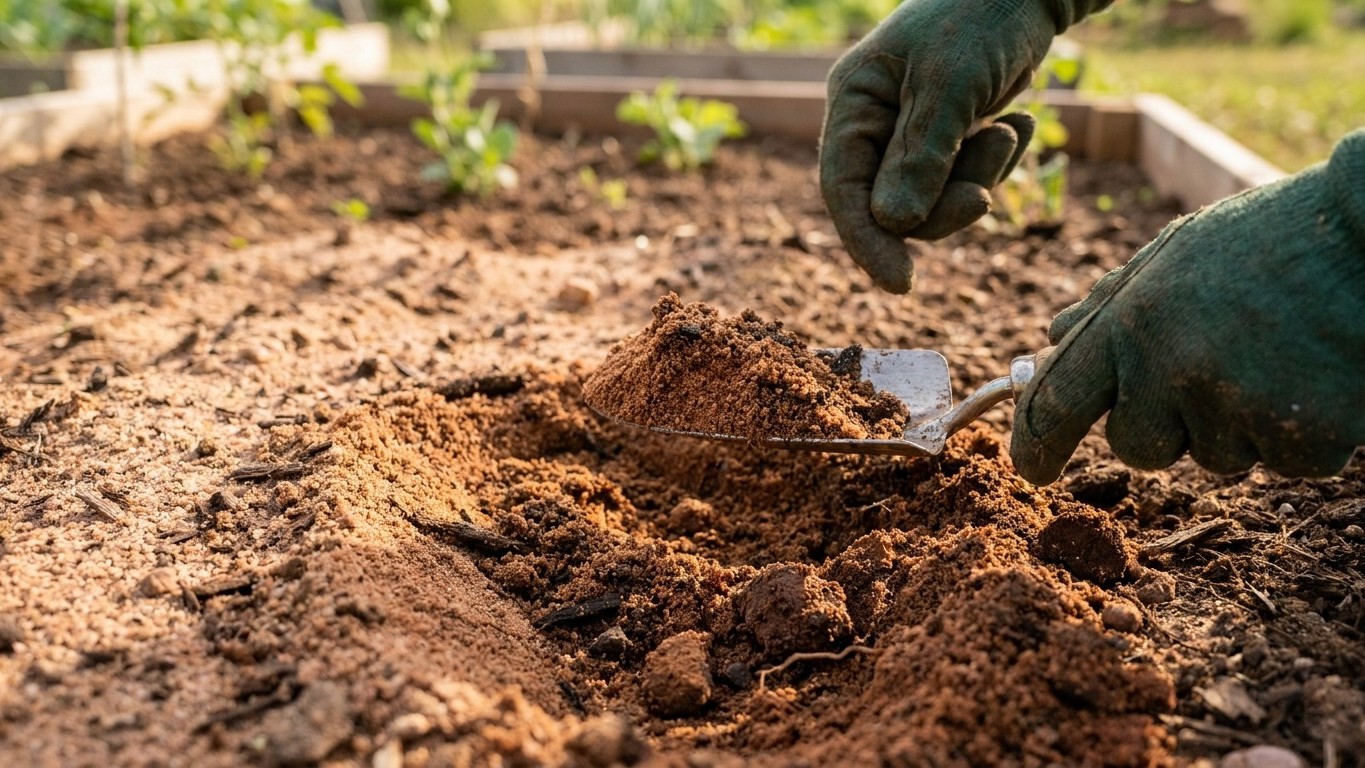

Prince Edward Island soil is, more often than not, an acid, sandy Podzol with a median surface pH near 4.8, only 7 percent clay, and about 2.2 percent organic matter. That combination drains fast in places, sits wet in others, and starves easily unless you feed it. Here’s what that means for your own patch of dirt, and how to fix what needs fixing.
What is under your garden

The soil that dominates Prince Edward Island’s mapped agricultural land is a Podzol, the acid, leached soil type that forms under conifer forest, where centuries of rain have washed the bases out of the topsoil and carried them downward. Podzols make up 33 percent of the province’s mapped surface, more than any other soil order; Gleysolic soils, the wetter, poorly drained cousins that form where water sits, come in second. That single fact tells you a lot about the province before you’ve turned a shovel: this is old, rain-washed, forest-derived ground, not the deep prairie loam some gardeners picture.
The numbers back it up. According to the Canadian Soil Information Service’s mapped soil data for the province, the median surface pH sits at about 4.8, which is strongly acid. The texture runs 66 percent sand, 7 percent clay, and 27 percent silt, a light, sandy composition that drains quickly but holds almost nothing back. Organic matter averages around 2.2 percent, on the lean side. Drainage across the mapped surface is classed as imperfectly drained, meaning water moves through but not always fast enough after a heavy rain.
What this figure is, and isn’t
This is the dominant profile among 542 mapped soil components across the province’s agricultural belt, not a single official state soil the way some places name one. It’s a median, not your address. A garden on a river flat, a patch of reclaimed muskeg, or a yard where a builder scraped topsoil and dumped fill will read completely differently from this number. Treat it as a starting expectation for what the region’s ground tends to do (run acid, drain unevenly, hold little organic matter) and then check your own dirt.
You can do that in about five minutes with two low-tech tests. For the ribbon test, take a handful of moist soil, squeeze it between thumb and forefinger, and push it upward into a ribbon. Sandy soil like the provincial median won’t ribbon at all; it just crumbles and falls apart, which is itself useful information. For the jar test, fill a clear jar about a third with soil, top it with water, shake hard, and let it sit overnight. Sand settles first at the bottom, silt forms a middle layer, and clay stays suspended longest or forms a fine cap on top. Read the layers the next morning and you’ll know, in plain terms, what you’re digging into.
Testing before you amend
A soil test tells you what your eyes cannot: the actual pH of your ground, not the regional median, plus available phosphorus, potassium, and often organic matter content. Guessing wrong wastes money twice over, once on the amendment you didn’t need, and again when you have to correct the imbalance you created. Sulphur poured onto ground that’s already acid, or lime dumped on soil that’s already near neutral, sets a garden back a full season or more.
A representative sample takes a bit more effort than scooping a single trowelful. Pull several small cores, six or eight across the bed or lawn area you’re testing, each one dug to the depth where roots actually live (roughly the top 6 to 8 inches for vegetables and most ornamentals). Mix those cores together in a clean bucket, remove stones and roots, and send in one composite sample rather than several separate ones. Testing each bed separately makes sense if you suspect they differ; testing the whole yard as one blend is fine if it’s been treated the same way for years.
When the results come back, the pH number is the one to read first, because it governs how available every other nutrient is, regardless of how much fertilizer you add. Given that the regional median on Prince Edward Island runs about 4.8, it’s reasonable to expect your own soil leans acid too. But expecting isn’t knowing. Fill dirt, old ash pits, years of wood ash on a garden bed, or a previous owner’s heavy liming can all push a specific yard well off the provincial norm in either direction. The lab test settles the question a guess never can.
Amending it
With a median pH around 4.8, the direction is clear: this ground, more often than not, needs lime, not sulphur. Acid soil in this range locks up phosphorus so plants can’t take it up even when it’s present in the soil, and it creates exactly the conditions that clubroot, a soil-borne disease of cabbage, broccoli, and other brassicas, thrives in. Raising the pH with an agricultural lime application is the standard correction, applied according to your actual test result rather than the regional median, since the amount needed depends on how far below target your specific soil sits and how much clay or organic matter is present to buffer it. Lime is slow by nature; it reacts with soil moisture and microbial activity over months, so expect the shift to show up over a season or two of gardening, not within weeks of application. Sulphur, which is what you’d use on soil that’s too alkaline, would be the wrong tool entirely here and would only push already-acid ground further in the wrong direction.
Working with the texture you have
At 66 percent sand and only 7 percent clay, this is light, fast-draining ground, and the fixes for sand differ from the fixes for clay. Since clay content here is low, none of the usual clay warnings (never add sand to clay, never work it wet) really apply to the provincial median soil. What applies instead is the sand playbook: organic matter, in the form of compost, aged manure, or leaf mold worked into the top several inches, is what gives sandy soil something to hold onto. Without it, water and nutrients wash straight through the root zone, which is also why watering strategy has to shift toward shorter, more frequent sessions rather than a deep soak once a week; a heavy soak on sand just drains past the roots and out of reach.
Organic matter is the amendment that pays off fastest here. Add compost each season and you’ll see a measurable difference in water-holding capacity within a single year, since the effect is largely physical (organic material acts like a sponge among the sand grains) rather than chemical. Correcting pH with lime is the slower project, typically stretching over two or three growing seasons before the soil settles at its new target range, because lime has to dissolve and react through the full root zone rather than just sit on the surface.
Drainage and compaction
Imperfectly drained is the classification that applies across most of the province’s mapped soil, and it describes a middle ground: not the standing puddles of a poorly drained clay basin, but not the crisp runoff of a well-drained gravel slope either. In practice, that means water moves through the sandy topsoil quickly at first, then can hesitate where a denser subsoil layer or a compacted zone sits underneath, leaving the root zone soggier than expected for a day or two after a heavy rain.
You can check your own drainage with a simple percolation test. Dig a hole about a foot deep and roughly the same across, fill it with water, and let it drain completely once to saturate the surrounding soil. Fill it a second time and time how fast the water level drops. A rate of an inch or more per hour is workable for most garden plants; less than half an inch per hour signals a drainage problem serious enough to plan around, whether that’s raised beds, added organic matter, or routing runoff away from the area entirely.
Compaction compounds drainage trouble, and it doesn’t take heavy machinery to cause it; repeated foot traffic across the same path in a garden bed, or a wheelbarrow rolled over wet ground, presses soil particles together and squeezes out the pore space water needs to move through. Double digging, once the standard fix, has largely fallen out of favor because it disturbs soil biology and structure that took years to build, often making the compaction problem worse over time rather than better. On ground that combines sandy texture, low organic matter, and imperfect drainage, the honest answer is frequently a raised bed filled with a better blend, rather than three seasons of amending native soil that will keep reverting to its sandy, low-organic-matter baseline. A raised bed sidesteps the compaction and drainage issues at once, and it gives roots the depth of good soil immediately instead of gradually.
Local help
Prince Edward Island’s Department of Agriculture handles soil questions for home gardeners and farmers alike through its provincial agriculture program. Contact the office directly for current soil test options and fees, since prices change and aren’t listed here. Bring your sample and, where possible, review the result with staff in person; they can read the numbers against local norms and suggest amendments suited to your specific bed, not just the provincial median.
Common questions
Is all Prince Edward Island soil red?
The red color often associated with the province comes from iron oxide in the parent material, and it shows up widely, but the pH, texture, and drainage described here vary by location regardless of color. Red soil can still be sandy, acid, and imperfectly drained, or it can differ substantially depending on the underlying rock and local topography.
Do I need to lime every year?
No. Lime reacts slowly and its effect lasts multiple seasons, so annual applications usually aren’t necessary once pH reaches target range. Retest every two to three years to see whether pH has drifted back down, which is common on soil this sandy since it holds amendments poorly, then lime again only if the number calls for it.
Can I just add sand to loosen heavy clay spots?
That’s not usually the issue on Prince Edward Island’s typical soil, since clay content runs low at 7 percent province-wide. If you do encounter a genuinely clay-heavy pocket, adding sand is a common mistake anyway, since the two can bind into something closer to concrete; organic matter is the safer fix in that situation too.
Why does my garden still look pale and yellow after I added fertilizer?
On acid, sandy soil like the provincial median, fertilizer applied without correcting pH first often doesn’t help much, because low pH locks up phosphorus and other nutrients regardless of how much you apply. A soil test that checks pH before your next fertilizer purchase usually solves more than another bag of feed would.
Related guides
- New Brunswick Soil: What You Are Digging Into, and How to Improve It
- Nova Scotia Soil: What You Are Digging Into, and How to Improve It
- Quebec Soil: What You Are Digging Into, and How to Improve It
- Will Carrots Fork in Prince Edward Island Soil
- Beet Soil in Prince Edward Island
- Growing Apples in Prince Edward Island
- Manitoba Soil: What You Are Digging Into, and How to Improve It