
By December, the growing season in Quebec has already closed outdoors. The ground is frozen or close to it across most of the province, so nothing goes into open soil this month. What’s left is indoor forcing, cold-frame maintenance, dormant orchard work, and the planning tasks that decide how well next spring goes.
What goes in the ground in December

The short answer is nothing, and it helps to say that plainly instead of dancing around it. Quebec’s average first fall frost lands around October 5, based on Environment and Climate Change Canada’s 1981-2010 normals for the Montreal/St-Hubert A station. By the time December arrives, the region is typically two months past that average frost, and the soil itself has usually frozen solid at the surface, sometimes several inches down depending on snow cover. Snow actually acts as insulation once it accumulates, but before that blanket forms, bare frozen ground can go colder than most root systems can handle. Direct-sowing anything into that is not a gamble, it’s simply not possible.
Garlic and shallots, which many Quebec gardeners plant in fall, need to go in before the ground locks up, generally weeks ahead of that October frost average. If yours never made it into the bed, December is too late for outdoor planting, full stop. Trying to force cloves into half-frozen soil damages the root plate and wastes good seed garlic.
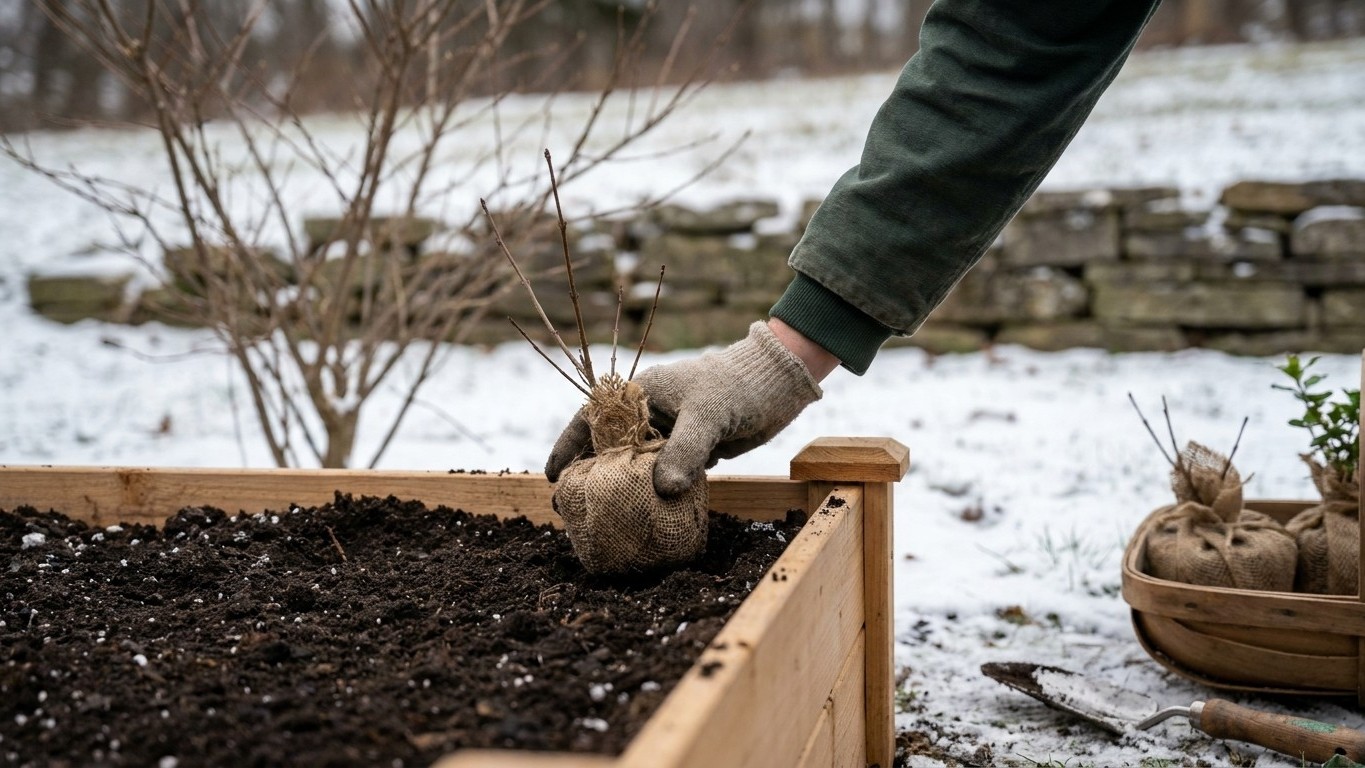
What still counts as “planting” this month happens under cover or indoors. Forcing rhubarb crowns in a dark, cool basement or root cellar produces pale, tender stalks weeks ahead of the outdoor season, and it’s a genuinely productive use of a dormant plant. Forcing witloof chicory roots the same way, packed in sand or soil in a dark box, gives you fresh chicons through the darkest part of winter. Cold frames and low tunnels set up earlier in fall can still shelter hardy greens that were transplanted before frost, though this month is about protecting what’s already there, not adding new plants to it. Bare-root fruit trees and shrubs, if you have any waiting, stay heeled into a sheltered spot or unheated garage until the ground softens; planting them into frozen holes now would leave roots exposed to freeze-thaw damage all winter.
What to start under cover
Almost everything for the coming season still needs to wait, and the arithmetic explains why. Quebec’s average last spring frost falls around May 6, again based on the Montreal/St-Hubert A normals, and remember that’s a midpoint, not a guarantee: in roughly half of all years, frost arrives after that date. Onions and leeks, which need the longest indoor head start among common vegetables, are typically sown 10 to 12 weeks before transplanting outdoors, and transplanting itself usually waits until a couple of weeks after the last frost risk has passed. Counting back from mid-to-late May, that puts onion and leek sowing in late January or February for most of the province, not December.
Peppers and eggplants, needing 8 to 10 weeks before a transplant date well after the frost window, land even later on the calendar, typically March. Starting them in December means seedlings sit under lights for months, stretching thin, getting rootbound, and losing vigor long before the garden is ready for them. That’s the first failure mode: jumping the gun and ending up with leggy, stressed transplants. The second is just as costly in the other direction, waiting so long that fast-maturing crops never catch up to the short growing window between frost dates.
December’s real under-cover work is different. Sprouts and microgreens on a windowsill or under a grow light don’t run on the frost calendar at all, since they’re harvested in days, not months, and they give a fresh green to the table when nothing else does. If you’re growing perennials or shrubs from seed that need a cold, moist stratification period, this is a reasonable month to set that process going in the refrigerator or an unheated porch, timed to finish around late winter.
What is ready to pick
Outdoors, there’s little to nothing left to harvest, and any Quebec gardener who’s walked a snowed-in bed this month already knows it. Kale, and sometimes leeks, can survive under a thick mulch or snow cover and still be dug out during a thaw, since both crops tolerate hard freezes better than almost anything else in the vegetable garden. The trick is checking after snow rather than trying to force a shovel through ice; a mild spell often exposes just enough ground to pull a few stalks.
Cold frames extend this further. Spinach, mâche, and other cold-hardy greens planted in September or October often keep producing small pickings through a cold frame well into winter, as long as the frame stays closed on the coldest nights and vented briefly whenever the sun warms the interior.
Indoors, sprouts and microgreens fill the gap, ready to cut within a week or two of sowing, no soil frost to worry about. The other job this month is inspection rather than harvest: go through stored squash, potatoes, and onions and pull anything showing a soft spot, a sweet smell, or shriveling skin. One rotting squash in a bin can spread mold to its neighbors within days, so a five-minute check now saves a much bigger loss later.
The jobs that matter this month

December carries more real work than its quiet reputation suggests. Dormant pruning of apple, pear, and plum trees can begin once the leaves are down and the wood is fully dormant, since cuts made now heal cleanly without the sap flow and disease pressure of a growing tree. The same goes for raspberry and currant canes, where removing old, spent wood now opens up airflow before spring growth crowds the bed.
Seed ordering belongs on this month’s list too, and it’s easy to underrate. Popular varieties, especially short-season vegetables bred for northern climates, sell out early, and a Quebec gardener who waits until February often finds the best cold-tolerant cultivars already gone. Pairing that with a written rotation plan, deciding which bed grew tomatoes last season so it doesn’t again, costs an evening now and prevents a soil-borne disease problem later.
Soil testing is worth doing while beds are idle, since results take weeks to come back and any lime or amendment recommended needs time to work into the ground before spring planting. Turning a compost pile, even a frozen one, keeps the decomposition process from stalling completely and prevents it from compacting into an anaerobic mass by spring.
Tool maintenance rounds this out: cleaning soil and sap off pruners and shovels, sharpening blades, and oiling wooden handles all take an afternoon and make spring work faster and safer. Checking beds, cold frames, and fencing for storm or frost damage now, rather than in the scramble of April, means less lost time when the ground finally thaws.
What not to do in December
The most common misstep is trusting a warm afternoon over the calendar. A stretch of unseasonably mild weather can make frozen soil feel workable near the surface, but a few inches down it’s often still solid, and any seed or transplant put in will simply sit in cold, wet conditions until it rots. Wait for a genuine, sustained thaw, not a single warm day, before touching a bed.
Uncovering mulched garlic, perennials, or cold frames too early after a mild spell is a close second. Removing protective mulch because the weather turned pleasant exposes crowns and roots to the next cold snap, and Quebec winters are rarely done delivering one. Leave winter mulch in place until it’s clearly time to plant, not just comfortable to walk outside.
Feeding nitrogen this late in the season is another mistake worth naming. Nitrogen pushes soft, leafy growth, which is exactly what a plant doesn’t need heading into or sitting through a hard freeze. Any fertilizing that still needs doing on perennials or fruit trees should have happened well before dormancy, not now. If you’re unsure whether a plant needs feeding at all, a soil test answers that more reliably than a bag of fertilizer applied on guesswork.
Finally, resist the urge to walk on frozen or waterlogged beds. Compacting wet soil now creates a dense layer that root systems will struggle against for the whole next season, even after everything thaws and dries.
Checking this against your own county
Everything above is a provincial starting point, built from a single weather station’s averages, not a promise for your backyard. Elevation, distance from the St. Lawrence, and how far north or south you garden can shift these frost windows by two weeks or more in either direction. A garden in the Laurentians or the Gaspé behaves differently than one near Montreal, even in the same month. For local planting calendars and season-specific advisories, check with Quebec’s Ministère de l’Agriculture, des Pêcheries et de l’Alimentation (MAPAQ), which tracks regional conditions more closely than any province-wide average can.
Common questions
Can I still plant garlic in December in Quebec?
Generally no. Garlic needs to go into unfrozen soil well ahead of the average October 5 fall frost so roots can establish before winter. By December the ground is typically frozen, and cloves planted now won’t root properly before spring.
What Canadian hardiness zone does Quebec fall under?
Montreal sits in Canadian hardiness zone 5b, based on Natural Resources Canada’s 1991-2020 normals. That’s the Canadian system, built on seven climate variables, and it does not convert directly to a USDA zone or apply uniformly across the whole province.
Is it too late to start seeds indoors in December?
For most vegetables, yes, since sowing dates are counted backward from the average May 6 last frost, putting onions and leeks around late January or February and peppers around March. Sprouts and microgreens are the exception, since they’re grown and harvested indoors within days regardless of the outdoor calendar.
Why does my garlic bed still show green shoots in December?
Some fall-planted garlic sends up a few inches of green growth before hard frost fully sets in. That’s normal and doesn’t harm the clove; a thick layer of mulch protects the shoots and the bulb through winter, and growth resumes on its own in spring.
Gardeners who plant by the Moon can check the December 2026 moon planting calendar, a tradition rather than a proven method.