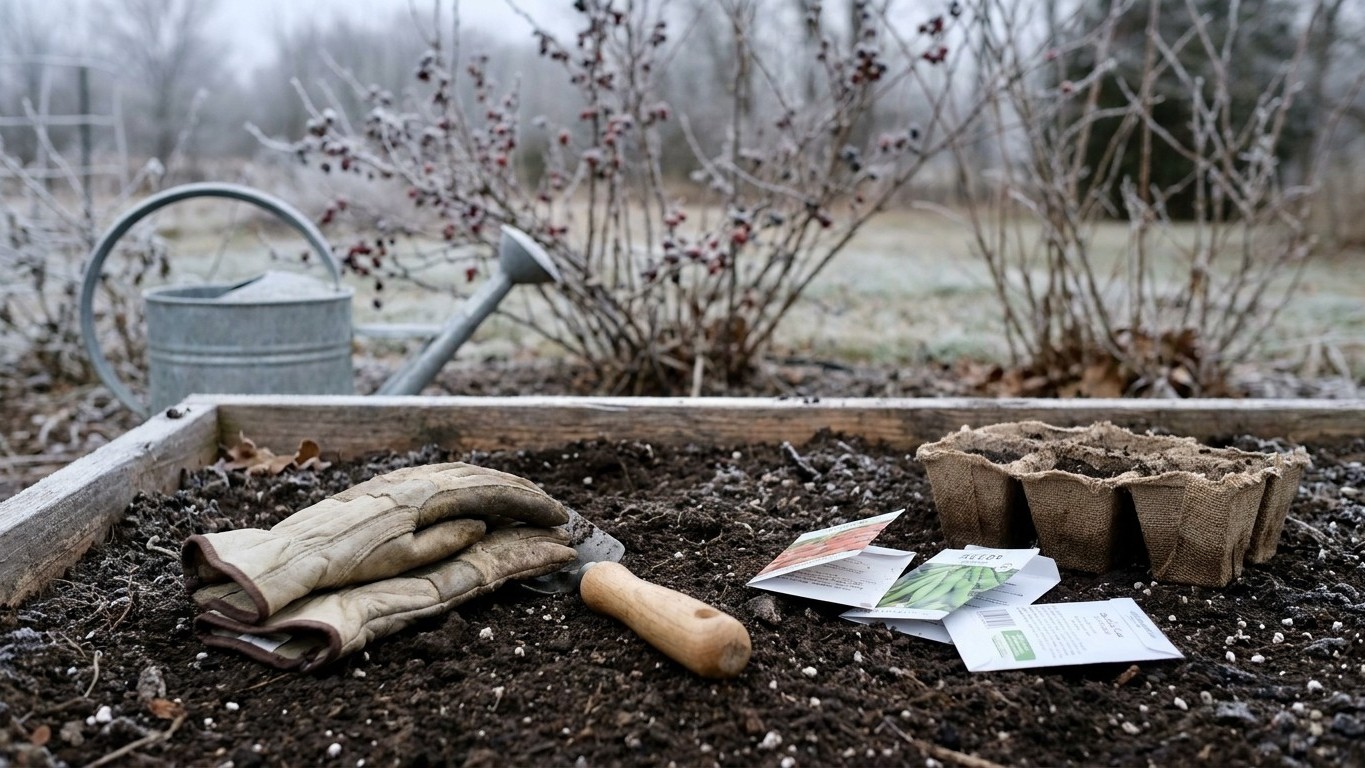

In February, Quebec’s ground is frozen solid under a blanket of snow, so nothing goes into open soil this month. The work that matters happens indoors and under cover: forcing rhubarb and chicory, chitting seed potatoes, ordering seed before good varieties sell out, and pruning dormant fruit trees on any day the thermometer climbs above freezing.
What goes in the ground in February

Quebec’s growing season is bookended by frost dates that move around a lot depending on where you garden. Environment and Climate Change Canada’s Canadian Climate Normals, drawn from the Montreal/St-Hubert A station, put the average last spring frost at May 6 and the average first fall frost at October 5. Those are averages from the 1981-2010 normals period, not guarantees. In one year out of two, frost falls later than May 6 in spring, which means treating that date as a safe planting cutoff is a mistake gardeners make every season.
None of that matters much in February, because the frost window is still three months away. The soil across most of Quebec is frozen well below the surface, buried under snow that will not melt for weeks. Cold frames sitting outside are frozen too, and low tunnels do nothing against ground that hard. Direct sowing or transplanting outdoors is simply off the table this month, and no amount of a mild afternoon changes that.
What actually happens this month
What you can do is work with dormant material indoors or in protected spaces that never freeze. Seed potatoes can start chitting in a bright, cool room so they have sprouts ready by planting time. Garlic and shallot bulbs meant for spring planting stay in cold, dry storage rather than going into the ground, since Quebec’s frozen soil won’t accept them until well into spring. Rhubarb crowns and chicory roots lifted the previous fall can be forced indoors in a dark, cool spot for an early harvest of stalks or chicons, something many Quebec gardeners rely on for fresh greens when nothing grows outside.
| Task | Where | Why now |
|---|---|---|
| Chitting seed potatoes | Indoors, bright and cool | Sprouts need weeks to develop before planting |
| Forcing rhubarb or chicory | Indoors, dark and cool | Produces a harvest while the garden is dormant |
| Storing garlic and shallot sets | Cold, dry indoor storage | Ground stays frozen until spring |
| Repairing cold frames | Garage or workshop | Frames need to be ready before soil thaws |
What to start under cover
Counting backward from the average last frost date of May 6 is the only reliable way to time indoor seed starting, and it works better than picking a fixed calendar date because it forces you to think about your own microclimate. Long-season crops that need eight to ten weeks indoors before transplant, such as onions and leeks, land their start date somewhere in February for many Quebec gardeners, particularly in milder pockets near Montreal. Peppers, which also want a long head start, fit the same window.
The arithmetic is simple once you set it up. Take May 6, subtract the number of weeks a given crop needs indoors before it can go outside, and that lands you on a start week. Onions needing ten weeks land in mid-to-late February. Peppers needing eight weeks land close to the same period. Remember that May 6 is a mean date, not a safe one, so gardeners in cooler regions north of Montreal or at higher elevation should push their transplant date later and their indoor start correspondingly later too.
The two ways this goes wrong are familiar to anyone who has started seeds too early or too late. Start too soon and you end up with leggy, rootbound seedlings sitting in small pots for weeks past their prime, stretching toward whatever light they can find. Start too late and the plant never catches up, arriving at transplant time undersized just as the short Quebec season starts working against it. Neither mistake is fixable once it happens, which is why counting backward from your own local frost expectation, rather than trusting a printed date, matters here.
What is ready to pick
Outdoors, the honest answer for Quebec in February is nothing. Snow cover and frozen ground rule out any harvest from open garden beds, and that will not change until well into spring. What still feeds a household this month comes from what was put by earlier and from what grows indoors.
What is still on the table
Kale and other hardy overwintered greens tucked under a thick blanket of snow can sometimes be dug out and harvested on a mild day, since snow itself insulates the plants beneath it better than exposed cold air would. Leeks left in the ground under mulch or snow cover can do the same in a mild pocket, though a hard-frozen bed makes digging them out nearly impossible some winters. Indoors, sprouts and microgreens started on a windowsill or under a grow light can be ready in a week or two and give a fresh green harvest with none of the outdoor guesswork.
Stored crops deserve a check this month too. Squash, potatoes, and onions put up in the fall are now several months into storage, and this is when rot starts to show. Go through the bins and look for squash with soft spots or a sweet smell, potatoes that have gone soft or sprouted excessively, and onions that feel mushy at the neck. Pull anything questionable before it spreads to the rest of the batch, since one rotting squash in a bin can take out its neighbors within days.
The jobs that matter this month

February carries more real garden work than its frozen ground suggests. Dormant pruning of fruit trees, brambles, and grapevines is one of the biggest jobs of the whole year, and it belongs here because the plants are fully dormant, the wood structure is easy to see without leaves in the way, and the wounds from cutting have time to heal before spring growth resumes. Wait too long into spring and pruning cuts into rising sap and active buds, costing the tree more than it should.
Ordering, planning, and maintenance
Seed catalogs move fast this time of year, and the popular varieties, particularly heirloom tomatoes and unusual squash, sell out well before planting season arrives. Getting orders in now avoids scrambling for substitutes in April. This is also the natural point to plan next season’s crop rotation on paper, walking through which beds grew what the year before so nightshades, brassicas, and legumes don’t land in the same soil two years running.
Soil testing can happen now too, since many labs process samples year-round and a February result gives plenty of time to source and apply amendments before the ground even thaws. Compost piles started in the fall benefit from a turn if they are not frozen solid, keeping the decomposition process moving. Tools are worth pulling out of the shed for cleaning, sharpening, and oiling before the rush of spring work makes that fifteen minutes impossible to find. Beds, trellises, and fencing damaged by winter weight or wind are easier to repair now, standing in the quiet garden, than in the middle of a busy planting week.
What not to do in February
The classic mistake this month is reading a stretch of warmer air as a sign that soil has warmed too. Air temperature and soil temperature move on different schedules, and a few mild days do nothing to thaw ground that has been frozen for months. Gardeners who uncover cold frames or pull back mulch after a warm spell often expose plants and soil to a hard refreeze days later, undoing whatever head start they thought they were getting.
Timing mistakes worth avoiding
Starting warm-season seeds like tomatoes or squash indoors this early is another common error. Counted backward from the average last frost of May 6, these fast-growing crops don’t need eight or nine weeks indoors, they need closer to six, and starting them in February means battling leggy, overgrown seedlings by the time it’s actually safe to transplant. Better to wait and start them on schedule than to fight weak, stretched plants for two extra months.
Fertilizing dormant plants, particularly with a heavy dose of nitrogen, wastes the fertilizer and can even push a premature flush of growth during a mild spell, growth that then gets killed back hard when cold returns. Hold off on feeding anything outdoors until active growth resumes in spring. The same caution applies to pruning frost-tender shrubs too early. Stick to plants that are fully dormant and cold-hardy this month, and save the tender stuff for later.
Checking this against your own county
A province-wide frost window is a starting point, not an instruction. Quebec spans a huge range of elevation and latitude, and the difference between a garden near Montreal and one further north or at higher elevation can run to several weeks on either end of the season. Local hills, lake effect, and even which side of a valley a garden sits on shift these dates in ways a single province-wide figure can’t capture. The Natural Resources Canada hardiness zone of 5b cited here reflects the reference area near Montreal, not the whole province.
Before committing to any date in this guide, check it against your regional MAPAQ office and Quebec’s own planting resources at mapaq.gouv.qc.ca for guidance closer to your specific county or region.
Gardeners who plant by the Moon can check the February 2027 moon planting calendar, a tradition rather than a proven method.
Common questions
Can I plant garlic outdoors in Quebec in February?
No. The ground is frozen and typically covered in snow across the province this month. Garlic sets belong in cold, dry indoor storage until the soil is workable again in spring.
When should I start onion and leek seeds indoors for a Quebec garden?
Count backward roughly ten weeks from your local expected last frost. With the provincial average last frost around May 6, that puts many Quebec gardeners starting these long-season crops in mid-to-late February, adjusted earlier or later for their specific region.
Is it too early to prune fruit trees in February?
No, this is one of the best months for it. Trees are fully dormant, their branch structure is easy to see, and pruning wounds have time to heal before spring growth begins.
Why does the average frost date feel unreliable some years?
Because it’s a mean date, not a guaranteed one. Environment and Climate Change Canada’s normals show that frost falls later than the average last frost date in about half of all years, so treating it as a firm cutoff for planting is risky.