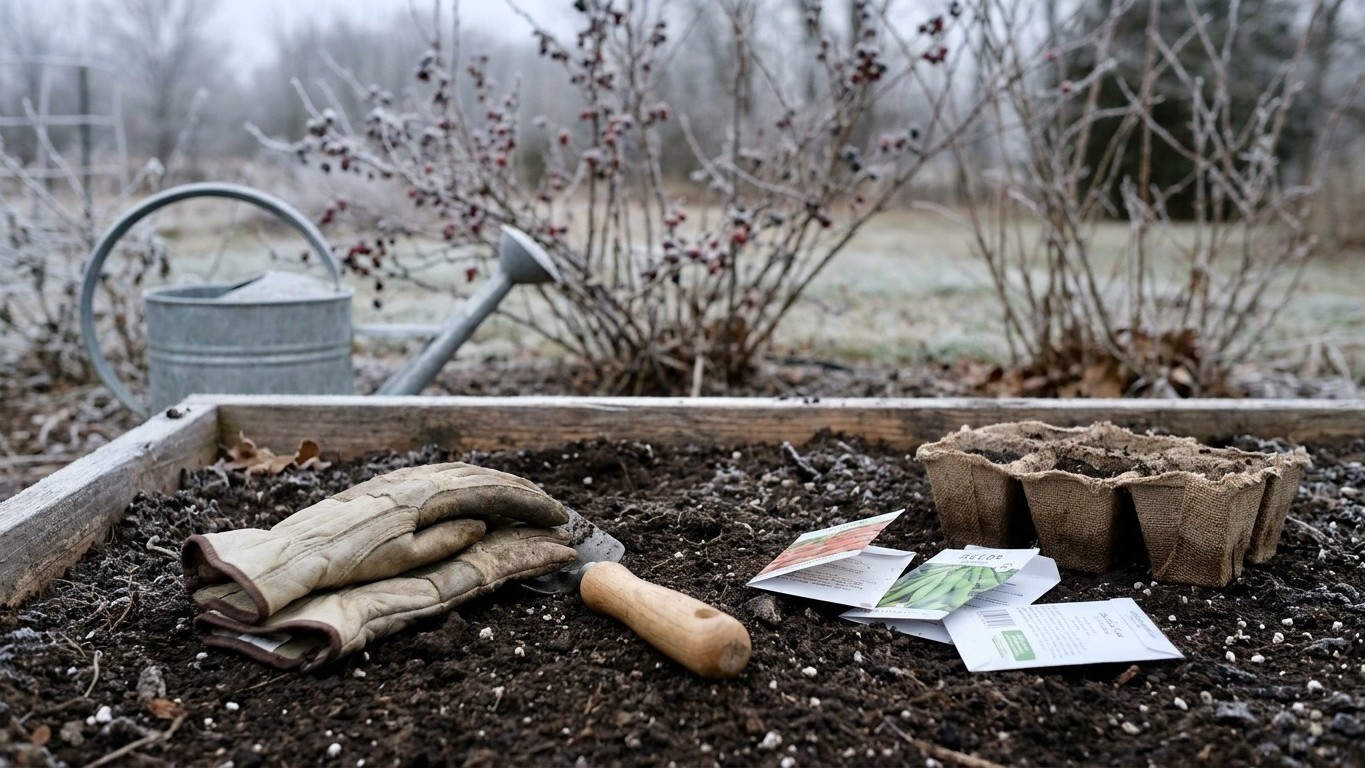

Nothing goes into open ground across most of Rhode Island in February. Frost windows here run from April 7 to April 17 for the last spring freeze, so the soil is still cold, often frozen at depth, and workable ground is the exception rather than the rule. What February is for is indoor seed starting, dormant pruning, cold-frame management, and the planning work that determines whether spring actually goes smoothly.
What goes in the ground in February

The decision here isn’t the calendar, it’s soil temperature and thaw. With the last spring frost typically landing between April 7 and April 17 at the reference weather station, February sits roughly eight to ten weeks ahead of that window, and the ground itself is the limiting factor, not the date on the wall. In much of Rhode Island the topsoil is frozen solid for stretches of the month, and even where it thaws briefly during a warm spell, it’s usually too wet to work without compacting it.
For most home gardeners the honest answer is that nothing new goes into open, bare soil this month. But that’s not the same as saying nothing happens outdoors.
What still moves outside
- Garlic and shallots: if fall planting got missed or a bed opened up during a thaw, cloves can still go in on a workable day, though a fall planting will always outperform a February one.
- Cold frames and low tunnels: these extend the season for hardy greens already established, and they can shelter a late sowing of spinach or mâche on milder days toward the end of the month.
- Bare-root and dormant plantings: fruit trees, brambles, and dormant perennials can go in if, and only if, the ground is actually workable, not just frost-free on the surface.
- Forcing indoors: rhubarb crowns and chicory roots can be brought into a dark, cool space to force tender growth well before anything happens outside.
None of this is a consolation prize. It’s the actual work that matches the season, and gardeners who skip it because “nothing’s planting” tend to lose weeks in March scrambling to catch up.
What to start under cover
Indoor seed starting in February is arithmetic, not guesswork, and it runs backward from that April 7 to April 17 frost window. Onions and leeks generally want ten to twelve weeks of indoor growth before transplanting, which puts their start date somewhere in the second half of January through early February. Peppers usually need eight to ten weeks, landing their start window in late January through mid-February depending on where in the frost range a given garden falls. Cool-season transplants like broccoli, cabbage, and other brassicas destined for an early spring bed typically need six to eight weeks, which also points to a February start for many growers.
| Crop | Typical weeks before last frost | Rough start window |
|---|---|---|
| Onions, leeks | 10 to 12 weeks | Late January to early February |
| Peppers | 8 to 10 weeks | Late January to mid-February |
| Brassicas (broccoli, cabbage) | 6 to 8 weeks | Mid to late February |
| Tomatoes | 6 to 8 weeks | Late February into March |
Two mistakes show up every year. Starting too early leaves plants sitting under lights far longer than they should, which produces rootbound, leggy seedlings that sulk for weeks after transplant instead of taking off. Starting too late compresses the growing season and can mean a plant is just hitting its stride when the first fall frost, typically October 24 to November 3 at the same reference station, cuts it short. The fix for both is the same: count back from the actual frost window for the specific piece of ground, not a fixed date pulled from a seed packet written for a different climate.
What is ready to pick
Very little comes out of an open Rhode Island garden in February, and there’s no point pretending otherwise. But a well-managed cold frame or a bed of overwintered greens still puts food on the table, and stored crops from the fall harvest are doing most of the heavy lifting right now.
What’s actually harvestable
- Overwintered kale and leeks: both can sit under snow cover and still be pulled or cut when the ground is accessible, since cold sweetens rather than ruins them.
- Cold-frame greens: spinach, mâche, and hardy lettuces started in fall often keep producing light harvests through a frame or low tunnel.
- Sprouts and microgreens: grown entirely indoors on a windowsill or under lights, these are the fastest fresh green a gardener gets this month, ready in a week to ten days from seed.
The bigger job is managing what’s already in storage. Squash, potatoes, and onions put up in fall need a check-in now: any squash going soft at the stem end, any potato sprouting eyes in the dark, and any onion turning papery and soft should be pulled and used before it takes the rest of the bin with it. A single rotting squash in a storage crate can spread mold to everything touching it within days.
The jobs that matter this month

February carries more weight than its bare garden beds suggest. This is the month where the work done, or skipped, shows up in July.
Pruning and structure
Dormant pruning of apple and pear trees, blueberry bushes, and bramble canes is best done now while the plants are fully dormant and their branch structure is easy to see without leaf cover. Cutting now, before sap starts moving, reduces stress on the plant and lowers the risk of disease entering fresh wounds compared with pruning during active growth. Grape vines also take well to a hard dormant prune in February.
Planning and prep
- Order seed early: popular varieties, especially heirloom tomatoes and specific pepper cultivars, sell out from suppliers well before spring.
- Plan crop rotation: deciding now which beds get nightshades, legumes, or brassicas prevents the same family from hitting the same soil two years running.
- Test and amend soil: a basic soil test now gives time to adjust pH or add lime before the spring planting rush.
- Turn compost: even a slow winter pile benefits from a turn to keep it breaking down rather than freezing solid.
- Clean and sharpen tools: pruners, hoes, and shovels that sat dirty all fall are easier to deal with now than in the middle of spring planting.
- Repair beds and fencing: frost heave and winter storms loosen raised bed corners and fence posts; fixing them now beats discovering the gap when deer find it first.
None of these jobs feel urgent in the moment. All of them become urgent in April if they’re skipped.
What not to do in February
The most common mistake this month is treating a warm afternoon as a green light. A 55-degree day in mid-February doesn’t mean the soil has warmed to match, and tender transplants or direct-sown warm-season seed put into ground that’s still cold at root depth will simply sit and rot rather than grow. Soil temperature lags air temperature by days to weeks, and a thermometer pushed a few inches into the bed tells the truth better than the forecast does.
A close second is pulling mulch or row cover off too early after a mild stretch. That protective layer is doing its job precisely because temperatures are still swinging, and a hard freeze after an early uncovering can undo months of overwintering work on garlic, perennials, or cold-frame crops in a single night.
Feeding nitrogen at the wrong moment is the third classic error. Applying a high-nitrogen fertilizer to dormant fruit trees or perennial beds this early pushes tender new growth right into the window where a freeze can kill it back, wasting both the fertilizer and the plant’s energy reserves. Nitrogen applications wait until active growth is underway, not before it.
The fix for all three is patience paired with actual measurement, checking soil temperature with a simple probe thermometer, watching the extended forecast rather than a single warm day, and holding fertilizer until growth has genuinely resumed.
Checking this against your own county
A state-wide frost window is a starting point, not an instruction for a specific yard. Rhode Island’s hardiness range spans 6a to 7b on the USDA Plant Hardiness Zone Map, and that spread alone signals real differences in how the season plays out depending on elevation, distance from the coast, and how open or sheltered a particular property is. Coastal areas and southern parts of the state typically see a milder, earlier spring than inland or higher-elevation pockets, sometimes by a couple of weeks.
For a planting calendar built specifically around Rhode Island conditions, and for help reading local frost and soil data for a particular county, the University of Rhode Island Cooperative Extension is the reference point worth checking before locking in a planting date.
Common questions
Can anything be direct-sown outdoors in Rhode Island in February?
For most of the state, no. The ground is typically frozen or too wet to work, and the last spring frost doesn’t arrive until April 7 to April 17 at the earliest. Garlic and shallots are the rare exception if a bed happens to thaw enough to work.
Is it too early to start tomato seeds indoors in February?
For most of the month, yes. Tomatoes generally need six to eight weeks of indoor growth before transplanting, which points to a start in late February heading into March, not earlier. Starting too soon just produces leggy, stressed seedlings.
What fruit trees should be pruned this month?
Apples, pears, blueberries, brambles, and grapes all take well to dormant pruning in February, before sap starts moving and while the branch structure is easy to see without leaf cover.
How do I know if my area’s frost dates differ from the state average?
Elevation, coastal proximity, and whether a property sits in a low frost pocket all shift the timing, sometimes by a couple of weeks compared with the reference station figures. The University of Rhode Island Cooperative Extension is the best source for county-level guidance.
Gardeners who plant by the Moon can check the February 2027 moon planting calendar, a tradition rather than a proven method.