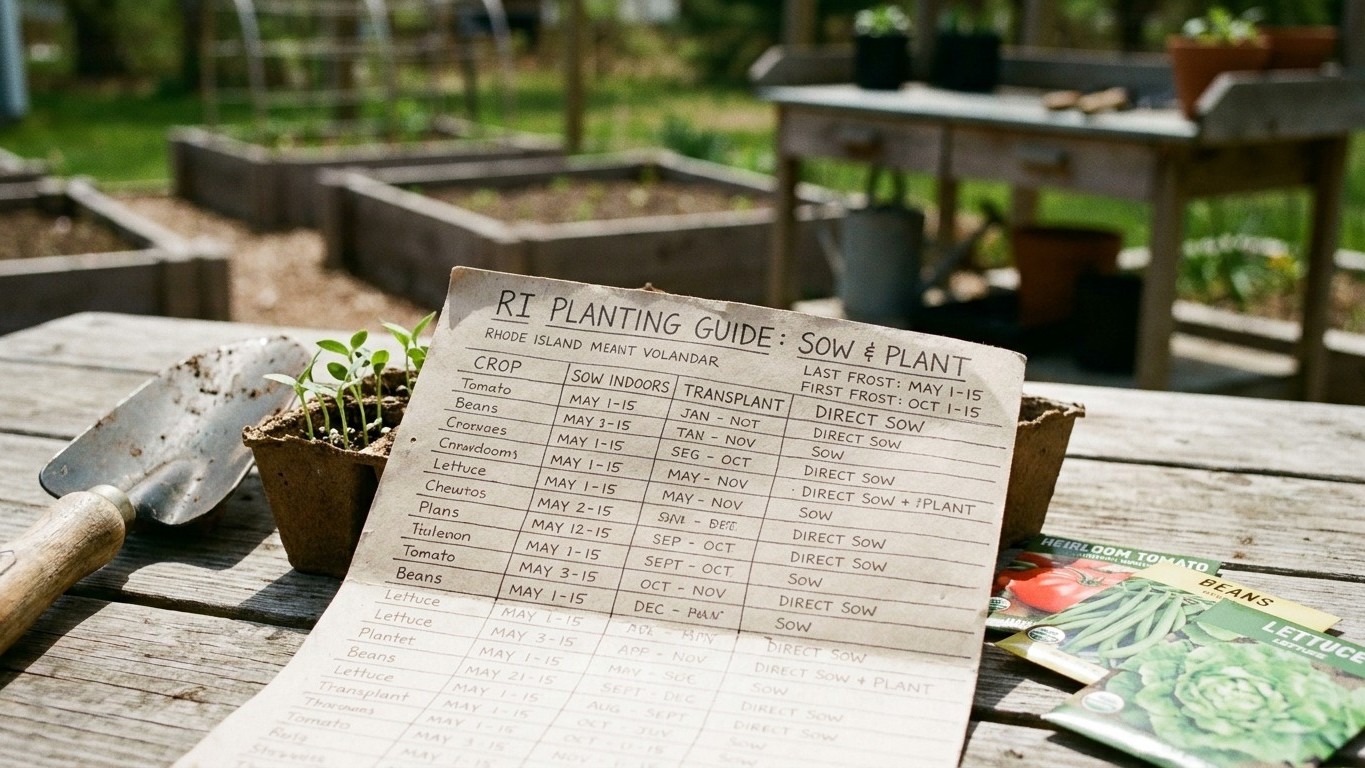

Tomato transplants set out in early April look fine for exactly one warm afternoon before a Providence-area cold snap blackens them overnight, and by then the greenhouse has sold out of replacements. That loss traces back to one number: the state’s last frost date isn’t a single day but a window, and planting off the coast without adjusting for it costs a full harvest cycle. Rhode Island’s growing season is short enough that one mistimed week rarely gets a second chance.
The frost window in Rhode Island

Every planting decision in this state starts with two dates. NOAA’s National Centers for Environmental Information, using the 1991-2020 climate normals measured at the Providence weather station, puts the last spring freeze between April 7 and April 17 and the first fall freeze between October 24 and November 3. Those are 30 to 70 percent probability windows for a 32°F freeze, not a single guaranteed day, which is why they arrive as a range rather than a fixed date.
How far Providence’s numbers travel
Providence sits close to Narragansett Bay, and that water moderates the air enough to push frost dates later in spring and earlier in fall compared with inland towns. Gardeners in Woonsocket, Chepachet, or anywhere well north or west of the bay should expect their own last frost to land later than the Providence range, and their first fall frost to arrive sooner. Add a week or two in either direction if you garden away from the coast, and more than that if your plot sits in a low frost pocket or climbs into higher ground.
Subtract the early date from the late one and you get the length of the frost-free season: somewhere between 190 and 210 days at the Providence station, depending on which end of each range a given year lands on. That is enough time to run a full succession of cool-season crops before and after a long stretch of tomatoes, peppers, and squash, but it is not a fixed number. Treat it as the outer edge of what is possible, not a promise.
Because these figures average three decades of Providence weather, an unusually cold spring can still deliver frost after April 17, and a mild fall can push the first freeze past November 3. Keep a floating row cover or an old bedsheet on hand for the two or three weeks straddling either date, since a single unexpected freeze can undo weeks of head start on tender seedlings. For guidance on the summer crops that fill the height of this frost-free stretch, see What to Plant in Rhode Island in July, and for the fall succession plantings that should go in before that first freeze, see What to Plant in Rhode Island in September and What to Plant in Rhode Island in October, and for planning ahead once the season winds down, What to Plant in Rhode Island in December, and for a full breakdown of which crops still tolerate the ground this late in the season, see What to Plant in Rhode Island in November.
Cool-season crops
Peas, spinach, lettuce, and the brassica family (broccoli, cabbage, kale, collards) all germinate in cold soil and tolerate a light frost once they are up, which is why they go into the ground well ahead of the last spring frost rather than after it. Once that window has passed and the soil has warmed further, gardeners can turn to What to Plant in Rhode Island in May for the next wave of crops. See What to Plant in Rhode Island in March to see exactly which of these crops to start earliest in the year, check out What to Plant in Rhode Island in January. For a month-by-month breakdown of exactly which of these crops to start indoors or direct-sow first, see What to Plant in Rhode Island in February. Later in the season, warm-weather crops need their own timing guide too; see What to Plant in Rhode Island in August for a full rundown of which crops fit that window, see What to Plant in Rhode Island in June, and for what comes next once the soil warms, see What to Plant in Rhode Island in April. These crops are timed off the frost date itself, not off a calendar month, because a mild March in one year and a cold one the next can shift the safe planting window considerably.
Peas and spinach can go in as soon as the soil has thawed and can be worked with a hand fork rather than a shovel, often well before the Providence frost window closes in April. Lettuce and the leafy brassicas prefer a little more warmth in the soil but still go in ahead of the last frost date, since a light freeze rarely does more than nip the outer leaves. Root crops such as carrots, beets, and radishes follow the same logic: they germinate slowly in cold soil, but the seedlings shrug off a frost that would kill a tomato outright.
Common timing mistakes
- Peas sown too late bolt and stop producing once summer heat arrives, so earlier is almost always better than later.
- Spinach bolts even faster than peas once day length and temperature climb, so treat it as an early crop and a fall crop, not a summer one.
- Brassica transplants set out too early can be stunted by a hard freeze even though mature plants tolerate cold well, so a light cover on transplant night is worth the trouble.
- Radishes are the fastest crop in this group and can be resown every couple of weeks through the cool part of spring for a steady harvest.
None of these crops need to wait on soil thermometer readings the way tomatoes do. If the ground is workable and the worst of winter has clearly passed, cool-season seed can go in, frost window or not, as long as you are prepared to throw a cover over young transplants if a hard freeze is forecast after they are up.
Warm-season crops

Tomatoes, peppers, squash, beans, and corn are killed outright by frost, but frost is not actually the limiting factor for these crops in Rhode Island. Soil temperature matters more than the calendar date: seeds and transplants set into cold, wet soil sit and rot rather than grow, even on a day with no frost risk at all. That is why the safe transplant window for tomatoes lands two to three weeks after the last frost date, once the soil itself has had time to warm through.
Matching varieties to the calculated window
Using the Providence frost range from NOAA’s 1991-2020 normals as the anchor, catalogue-listed tomato varieties give a set-out window of late April to early May for the region, once the soil has caught up with the air. The table below shows how a selection of cultivars line up against that window, using each variety’s published days-to-maturity count from transplant, the resulting first-ripe estimate, and the margin before the Providence fall frost range.
| Variety | Days to Maturity | Type | First Ripe | Margin Before Fall Frost |
|---|---|---|---|---|
| Sakura | 55 | Indeterminate | Late June | 121 days |
| Edox | 55 | Indeterminate | Late June | 121 days |
| Valentine | 55 | Indeterminate | Late June | 121 days |
| Glacier | 55 | Determinate | Late June | 121 days |
| Sun Gold | 57 | Indeterminate | Late June | 119 days |
| Supersweet 100 | 60 | Indeterminate | Late June | 116 days |
| Juliet | 60 | Indeterminate | Late June | 116 days |
| Amalfi | 68 | Determinate | Early July | 108 days |
| Cherokee Purple | 72 | Indeterminate | Mid July | 104 days |
| Big Beef Plus | 72 | Indeterminate | Mid July | 104 days |
| Tiren | 75 | Indeterminate | Mid July | 101 days |
| Granadero | 75 | Indeterminate | Mid July | 101 days |
| San Marzano II | 78 | Indeterminate | Mid July | 98 days |
| Celebrity Plus | 78 | Determinate | Mid July | 98 days |
Every margin in that table is calculated by counting forward from the set-out window to the catalogue first-ripe date, then forward again to the early end of the Providence fall frost range from NOAA. Even the longest-season variety here, at 78 days to maturity, still clears frost with about three months to spare, which tells you Rhode Island’s growing season is long enough to ripen almost any tomato on the market as long as the transplant goes in on time.
Starting seed indoors
Count backward from your intended set-out date rather than forward from a fixed calendar day. Tomato seed is commonly started six to eight weeks before transplant, so a late April to early May set-out window points to an indoor sowing date in early to mid March. Do not rush transplants outdoors just because the frost date has technically passed: peppers and squash in particular sulk in soil under 60°F, and a run of warm days in the forecast is a better cue than the date on a calendar.
The fall planting window
Working backward from the first fall frost is the same exercise as working forward from the last spring one, just run in the opposite direction. NOAA’s 1991-2020 normals put the first fall freeze at Providence between October 24 and November 3, so a fall crop needs to reach a harvestable size before the early end of that range if you want a reliable margin.
Take the days-to-maturity figure on the seed packet, count forward from your planned sowing date, and compare the result against October 24. Because growth slows as day length shortens through September, add a buffer beyond the printed days-to-maturity number rather than treating it as exact. A crop that took 50 days to mature under the long days of June can easily take longer to reach the same size under the shorter, cooler days of September.
Good candidates for a second planting in Rhode Island are the same cool-season crops that opened the spring garden: spinach, lettuce, radishes, and quick brassica greens like mustard or turnip tops all fit into the weeks between a late summer sowing and the fall frost window. Peas can go in for a fall crop too, though they need cooler nights to germinate well, which usually means waiting later into summer than gardeners expect.
Crops that improve after a light frost
Several fall crops actually taste better once temperatures drop toward freezing. Kale, Brussels sprouts, and carrots left in the ground convert stored starches into sugars as a cold-tolerance response, which is why growers often leave them through one or two light frosts before harvest rather than pulling everything at the first cold snap. Spinach behaves the same way, turning noticeably sweeter after a frost. None of this applies once a hard freeze sets in and kills the leaves outright, so a light frost is a flavor bonus, not a reason to delay harvest indefinitely.
A floating row cover or a low tunnel bought for spring transplants earns its keep again in fall, adding a few degrees of protection that can carry lettuce and spinach past the early end of the frost range and into the cooler but still productive weeks that follow. Gardeners who push their luck this way should still expect the season to end for good once a hard freeze, rather than a light one, moves through.
Reading a planting calendar properly
A state-wide planting calendar, including this one, is built from a single weather station and averaged over three decades. That makes it a reasonable starting point and a poor substitute for what actually happens in your yard. Treat every frost date as the middle of a range, not an instruction, and adjust it against what you observe outside your own back door.
What shifts the dates in your yard
Elevation is the biggest factor most gardeners overlook: a plot even a few hundred feet higher than the Providence station will run cooler and see frost both earlier in fall and later in spring. Coastal towns near Narragansett Bay benefit from the water’s moderating effect the same way Providence does, while inland valleys can trap cold air overnight and post a frost when a spot half a mile away stays clear. Urban and suburban yards surrounded by pavement and buildings often run a few degrees warmer than open countryside, so the Providence airport figures tend to run milder than what a rural garden in the same county experiences.
The same logic applies everywhere, not just in Rhode Island. A gardener working from the Vermont Planting Calendar is contending with a shorter season and colder normals than Providence sees, while someone using the Arizona Planting Calendar is working against heat rather than cold for half the year. The arithmetic of counting back from a frost date or forward from a transplant window is the same skill in every case. Only the numbers change.
The single best tool against all of this is your own record. Keep a simple log of the date you saw your last spring frost and first fall frost each year, and after two or three seasons you will have a more accurate calendar for your own plot than any state-wide average can give you.
Local help
For frost dates and soil recommendations specific to your own county, contact the University of Rhode Island Cooperative Extension, the state’s land-grant extension service. Its horticulture staff can also run a soil test, which matters more than any planting date if your yard’s pH or fertility is off. A soil test costs little compared to a season of stunted crops, and it is one of the most useful things a new Rhode Island gardener can do before the first seed goes in. For more on gardening elsewhere in the state, see our Rhode Island guides.
Common questions
Is it too late to plant tomatoes in June in Rhode Island?
Not necessarily, if you choose a fast variety. A grower who missed the late April to early May transplant window can still get tomatoes off a short-season cultivar like Sakura, Edox, Valentine, or Glacier, each rated at 55 days from transplant, since even a June set-out leaves comfortable room before the Providence area’s fall frost typically arrives between October 24 and November 3 per NOAA’s normals. A longer-season variety such as San Marzano II or Celebrity Plus, at 78 days, is a tighter fit if you are starting that late.
What USDA hardiness zone is Rhode Island in?
Frost-date normals matter more than the USDA hardiness zone map, because frost timing tells you when to plant annual vegetables, while the hardiness zone is built for choosing perennials and woody plants that need to survive winter lows. Look up your zip code on the USDA Plant Hardiness Zone Map directly, since Rhode Island spans more than one zone from the coast to its inland northern edge.
Do I need to worry about a late frost after I’ve already set out my tomatoes?
Yes, until you’re well past the late end of the local frost window. NOAA’s Providence normals put the last spring freeze between April 7 and April 17, but that is only a 30 to 70 percent probability band, not a guarantee, so a frost can still arrive after that range in a colder-than-average year. Keep a floating row cover on hand through the end of April and into early May in case a cold night is forecast after transplants are already in the ground.
Why do some planting charts give a single frost date instead of a range?
Most of those charts are simplifying a probability curve into one number, usually the midpoint, which loses the information that actually matters for planning. A single date looks more decisive, but it hides how much year-to-year variation is built into any frost prediction.
Can I trust these frost dates if I garden in northern Rhode Island?
Use them as a starting point, not the final word. The NOAA figures come from the Providence airport weather station, and towns further north and inland, away from the moderating effect of Narragansett Bay, typically see their last spring frost run later and their first fall frost arrive earlier, sometimes by a week or two. Contact the state’s cooperative extension service for guidance closer to your own county if you garden well outside the Providence area.
Some gardeners layer an older custom on top of frost dates: planting by the moon, which we explain as almanac tradition, not fact.
Related guides
- Connecticut Planting Calendar: When to Sow and Plant, Frost Dates Included
- Massachusetts Planting Calendar: When to Sow and Plant, Frost Dates Included
- Vermont Planting Calendar: When to Sow and Plant, Frost Dates Included
- When to Plant Potatoes in Rhode Island
- When to Plant Melons in Rhode Island
- When to Plant Onions in Rhode Island