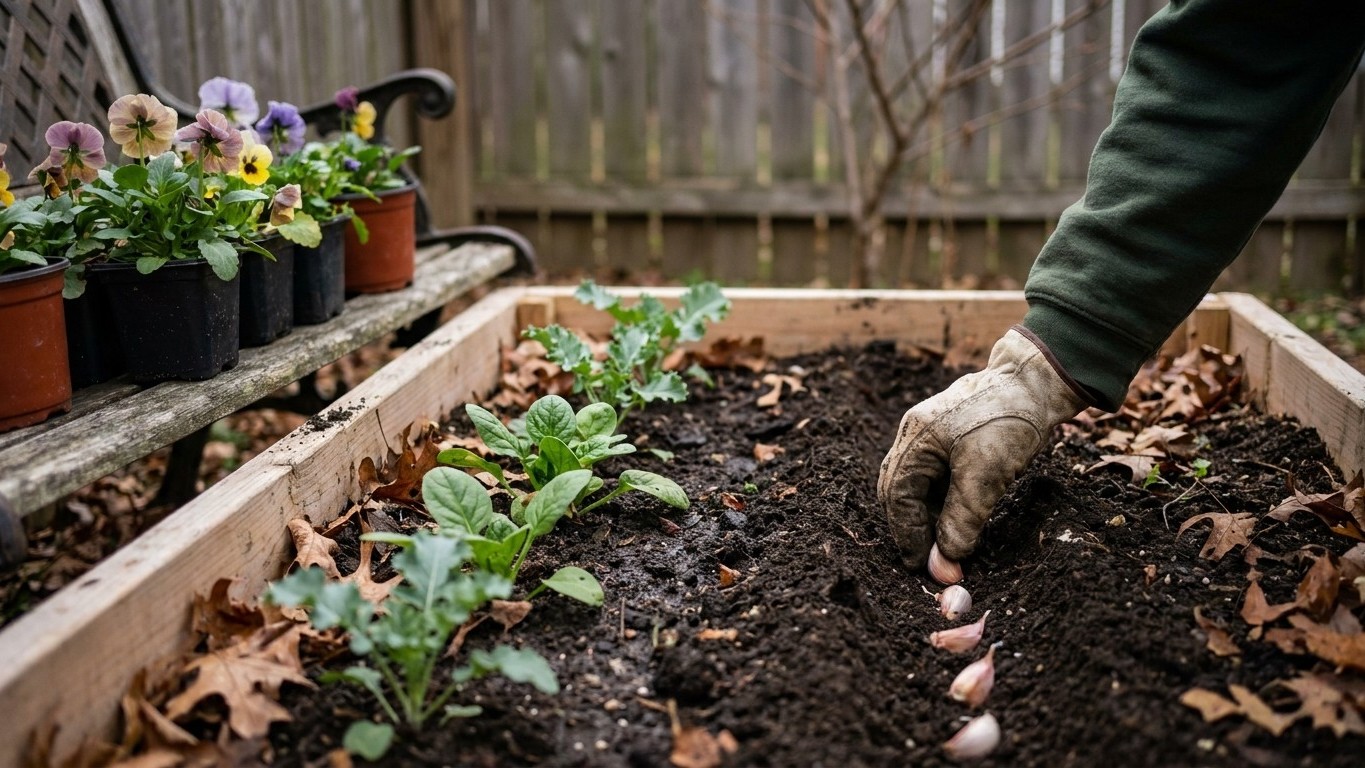

October in Tennessee splits into two very different gardening months. Early in the month, soil is still warm enough for quick-growing greens and root crops to finish before frost. By the back half, the job shifts to garlic, spring bulbs, cover crops, and getting woody plants and perennials into the ground while roots can still establish. Which one applies to you depends less on the date on the calendar and more on where your county sits.
What goes in the ground in October

The first fall frost in Tennessee lands somewhere between October 28 and November 8 (NOAA NCEI 1991-2020 Climate Normals, 30-70% freeze probability band, station USW00013897). That means for most of October, the ground is still open. The decision isn’t “can I plant,” it’s “how many weeks do I have left before that window closes.”
Early in the month, with three to four weeks of frost-free soil still ahead, fast-maturing crops can still go in directly: spinach, arugula, mizuna, radishes, and baby lettuce mixes that size up in under 30 days. These aren’t a gamble if sown in the first week or two of October, because they finish or reach a pickable size before that late-October to early-November window closes.
Once you’re past the middle of the month, the safe list narrows to things that don’t mind cold roots or actively want it. That’s garlic and shallots, both of which need six to eight weeks of root growth before a hard freeze locks the ground, and spring-flowering bulbs, tulips, daffodils, crocus, which require a cold soil period to bloom correctly and are planted precisely because the ground is cooling, not despite it.
October is also, somewhat counterintuitively, one of the better months of the year to plant trees, shrubs, and perennial divisions in Tennessee. Air temperatures are dropping, which reduces stress on top growth, while soil temperatures stay warm enough for root systems to keep establishing for several more weeks. Peonies, daylilies, hostas, and bare-root strawberries all transplant well now. Cover crop seed, winter rye, crimson clover, hairy vetch, goes down on any bed you’re not actively harvesting, protecting soil structure over winter instead of leaving it bare.
What doesn’t belong in the ground this month is anything warm-season: tomatoes, peppers, squash, beans. No stretch of mild weather changes that math once you’re within a few weeks of that frost window.
What to start under cover
Counting backward from the frost window is more reliable than counting forward from a planting date, because it forces you to work with the days-to-maturity number on the seed packet instead of guessing. If your first frost lands October 28 and a lettuce variety needs 45 days to a harvestable head, that seed needed to go in the ground by mid-September, not October. That math is the difference between a full cold frame and an empty one.
What still makes sense to start under cover this month is narrower. Cold frames and low tunnels set up now can shelter spinach, mache, and claytonia sown slightly late, extending their season by several weeks past what open ground would allow. If you’re forcing bulbs for indoor winter bloom, paperwhites need no chilling and can go in stages every couple weeks for a rolling bloom, while amaryllis and chilled hyacinth bulbs need to be started based on how many weeks out your target bloom date sits, since most spring bulbs used for forcing need roughly 12 to 15 weeks of cold treatment before they’ll flower.
The two ways this goes wrong are predictable. Start too early under cover and you get leggy, rootbound seedlings with nowhere frost-free left to plant them, since the outdoor window is closing while they’re still growing indoors. Start too late and short-day light levels combined with the approaching freeze mean the plants never size up before growth stalls for winter. Neither failure is really about skill, it’s about not doing the backward count from the actual frost range before dropping seed.
What is ready to pick
October is a harvest crunch month more than a quiet one. Warm-season crops still standing, tomatoes, peppers, winter squash, sweet potatoes, need to come out before that late-October frost window arrives, not after. Sweet potatoes in particular are damaged by even a light frost hitting the foliage, so digging them ahead of the forecast, on a dry day when soil isn’t waterlogged, protects them for curing and storage.
Winter squash and pumpkins should already be cured or coming off the vine with hardened rinds; press a thumbnail into the skin, if it doesn’t dent, it’s ready. Green tomatoes still on the vine when frost threatens can be picked and ripened indoors on a windowsill rather than left to blacken outside.
On the cool-season side, this is a genuinely good month: broccoli, cabbage, brussels sprouts, turnips, beets, and carrots are all coming into their own, and several of them, kale and brussels sprouts especially, actually sweeten once they’ve taken a light frost, since the plant converts starches to sugars as a cold defense. Tennessee’s native persimmons ripen after frost too, and are inedible before it, so patience there pays off literally.
For anything already in storage, check squash, potatoes, and onions now for soft spots or sprouting. One rotting squash in a bin will take down its neighbors if it’s not pulled and used or composted right away.
The jobs that matter this month

Several of this month’s tasks have hard deadlines tied directly to that late-October to early-November frost window, and missing them costs real yield or plants outright.
Digging sweet potatoes and cutting winter squash from the vine has to happen before frost touches the foliage or the crop underneath, since both are frost-tender in ways that surprise gardeners used to tougher root vegetables. Garlic planting belongs squarely in this window too, ideally with six to eight weeks of growing time left before the ground locks up hard.
Soil testing is worth doing now rather than in spring, because if the results call for lime, that amendment needs months to adjust pH, and a fall application has all winter to work before next season’s planting. Bare beds that have finished producing should get either a cover crop or a heavy mulch layer rather than sitting exposed, since exposed soil loses structure to fall rains and erodes faster than most gardeners expect.
Perennials and shrubs can still be divided and transplanted while soil holds some warmth, giving roots a head start before dormancy. Tender container plants and houseplants that spent the summer outside need to come in before that first frost catches them off guard, and it’s easier to do this on a mild afternoon than in a scramble the night a hard freeze is forecast.
Round out the month with cleanup: raking and composting fallen leaves, clearing spent summer plant debris that can otherwise shelter overwintering pests, draining and storing hoses and irrigation lines before a freeze splits them, and giving pruning tools a cleaning and sharpening before the dormant pruning season that follows in the coming winter months.
What not to do in October
The most common mistake this month is trusting a warm afternoon over the calendar. A run of 75-degree days in early or mid-October doesn’t mean the frost window has moved; it’s still landing somewhere between October 28 and November 8, and warm-season transplants put in during a mild stretch will still be killed when that window arrives on schedule.
A related error is uncovering cold frames, row covers, or tender potted plants after a few mild days, only to get caught unprotected when temperatures drop back down. Fall weather in Tennessee swings; treat any warm stretch in October as temporary, not as the season shifting for good.
Nitrogen-heavy fertilizer is the other trap. Feeding lawns, shrubs, or vegetable beds with high-nitrogen products this late pushes soft new growth that has no time to harden off before frost, and that new growth is exactly what gets damaged first. If anything, a low-nitrogen or potassium-focused feed supports root and cold hardiness instead.
Finally, don’t till wet soil after a heavy fall rain. Working ground while it’s saturated compacts the structure you’re trying to build for next season, undoing months of good soil work in a single afternoon. Wait for it to dry to a crumbly texture before turning beds or working in cover crop seed.
Checking this against your own county
The frost dates and hardiness range used here describe the state broadly, not any single backyard. Elevation moves frost timing by weeks: the Cumberland Plateau and the mountains of East Tennessee run cooler and see frost earlier in fall than the reference station reflects, while West Tennessee, at lower elevation, tends to stay frost-free later. The statewide hardiness range of 5b-8a (USDA Plant Hardiness Zone Map) spans that same spread, so a planting date that works in Memphis can be two or three weeks off for a garden in the Smokies.
For a planting calendar built around your specific county, the University of Tennessee Extension is the reliable next stop.
Common questions
Can I still plant tomatoes in Tennessee in October?
No. Tomatoes are warm-season and will be killed by the first fall frost, which lands between October 28 and November 8 across the state. Any tomato plant put in this month won’t have time to produce before frost ends the season.
When should I plant garlic in Tennessee?
October works well, as garlic needs roughly six to eight weeks of root growth before the ground freezes hard. Planting mid-month gives cloves time to establish before the first frost window arrives in late October to early November.
Is it too late to start a fall vegetable garden in October in Tennessee?
Not entirely, but the window is narrow. Fast crops like radishes, arugula, and baby lettuce sown in the first week or two of October can still mature before frost. Sown later in the month, they run out of time.
What USDA hardiness zone is Tennessee?
Tennessee spans zones 5b through 8a on the USDA Plant Hardiness Zone Map, based on average annual extreme minimum temperature. Since that range covers the whole state, check your specific county rather than relying on a single statewide zone number.
Gardeners who plant by the Moon can check the October 2026 moon planting calendar, a tradition rather than a proven method.
Related guides
- When to Plant Melons in Tennessee
- When to Plant Summer Squash in Tennessee
- What to Plant in Tennessee in June
- What to Plant in Tennessee in September
- What to Plant in Tennessee in November
Elsewhere? See what to plant in October in every state and province.