
By November, the frost windows tracked by NOAA for Tennessee (October 28 to November 8) have already closed across most of the state. That single fact reshapes the whole month: this is not a planting month in the traditional sense, it’s a closing-down-and-covering-up month, with garlic, cold frames, and dormant tree work carrying the workload.
What goes in the ground in November

The mechanism that matters here isn’t the calendar, it’s soil temperature and that first fall frost window. NOAA’s 1991-2020 climate normals put the average first fall freeze for the Nashville area (the reference station behind these figures) between October 28 and November 8. East Tennessee and the Cumberland Plateau run later and colder than that. Either way, by the time November is underway, soil temperatures at planting depth have usually dropped below the range where seeds germinate reliably outdoors.
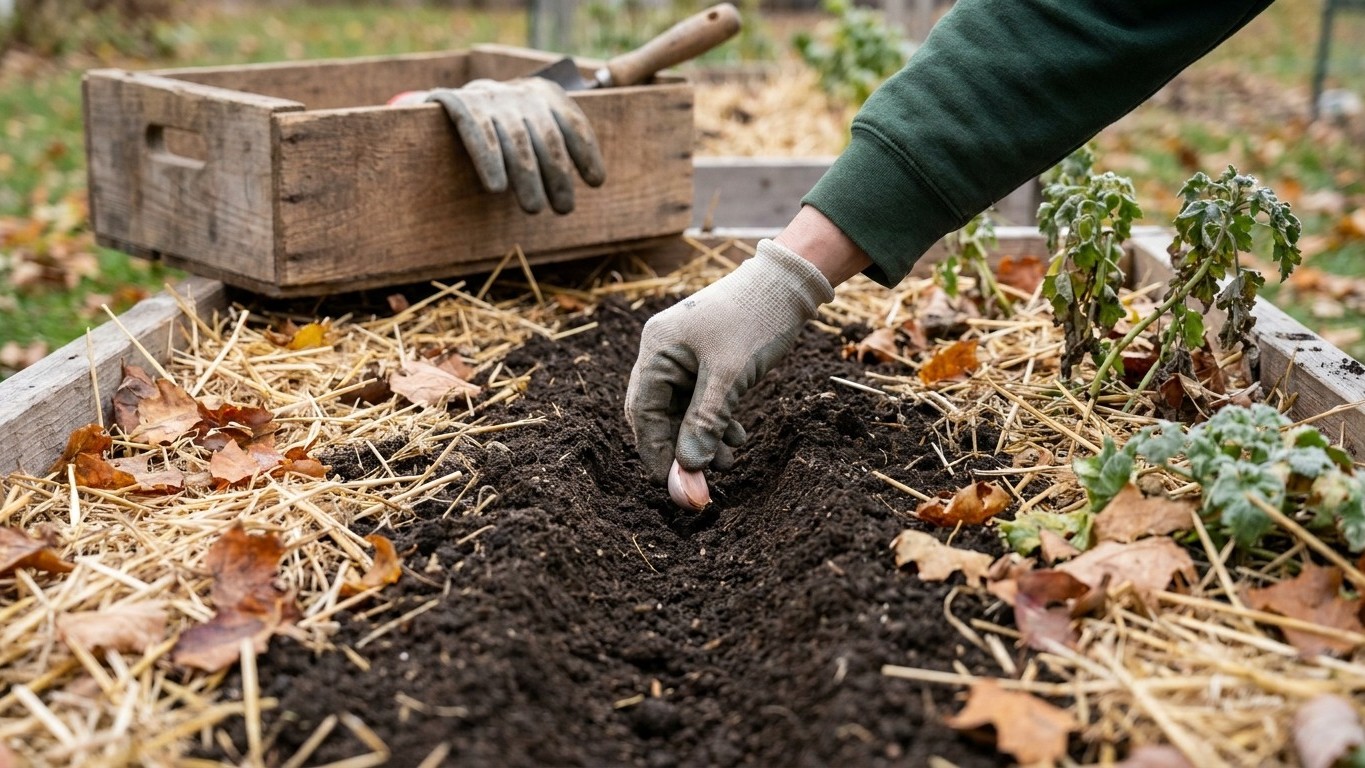
That doesn’t mean the ground sits empty. Garlic and shallots are the one true direct-sow crop of the month, and they’re better planted now than skipped: cloves want six to eight weeks of cool soil before hard freeze locks things up, so they can root without pushing top growth. Push them in wherever soil is still workable, four inches deep, pointed end up, then mulch heavily with straw once the ground begins to firm.
Bare-root fruit trees, roses, and berry canes are the other legitimate planting in November. Nurseries ship them dormant precisely because roots can establish in cool soil without the plant needing to support leaves. Get them in before the ground freezes solid, water them in well, and mulch the root zone.
Cold frames and low tunnels change the equation entirely, since they buy several zones of extra warmth. Inside one, sowing spinach, mache, or claytonia is still reasonable in early November in the milder parts of the state. And two indoor tricks worth knowing: forcing rhubarb crowns in a dark, cool spot produces tender stalks through winter, and Belgian endive (chicory) roots dug now can be forced for pale, sweet chicons indoors for weeks. Everything else, tomatoes, beans, squash, is a gamble not worth taking this month.
What to start under cover
Counting backward from a frost date matters more than counting forward from today. For cold-frame greens like spinach and mache, the target isn’t a transplant date, it’s simply “before the coldest stretch locks the frame’s soil.” Sown now, they grow slowly through the dim months and take off again as daylight lengthens, giving a late-winter harvest with almost no active care beyond venting the frame on sunny days.
Onion and leek seed is a different story, and this is where the arithmetic actually bites. Onions started from seed need roughly ten to twelve weeks under lights before they’re ready to go outside, and that transplant date is tied to the last spring frost window of March 31 to April 12. Working backward from early April puts the ideal sowing date in mid-to-late January, not November. Start onion seed now and you’ll be nursing leggy, rootbound seedlings for two extra months before they ever see outdoor soil, a stretch nobody’s windowsill setup handles gracefully.
The two failure modes are worth naming plainly. Starting too early, as with onions in November, means weak, overgrown transplants and a higher risk of damping-off before they ever get outside. Starting too late for a cold-frame crop, say waiting until December to sow those spinach seeds, means the plants never build enough root mass before growth slows to a crawl in the shortest-day weeks, and the harvest window shrinks or disappears.
Microgreens and sprouts sidestep the frost math entirely. A tray on a counter, some pea shoots or radish sprouts, ready in one to two weeks regardless of what’s happening outside, is the reliable answer for anyone who wants something green to cut this month.
What is ready to pick
Outdoors, the honest answer for most of Tennessee in November is: not much, and what’s left has usually been touched by frost already. That’s not a bad thing for several crops. Kale, collards, and brussels sprouts actually improve after a freeze or two, since the cold triggers the plant to convert starches to sugars, softening the bitterness that plagues them in warm weather. Leeks, hardy enough to sit under a blanket of mulch or even light snow, can be lifted as needed straight through the month.
Turnips, rutabagas, and any carrots left in the ground under a thick mulch layer are worth checking too; root crops mulched before the ground freezes solid often hold in place for weeks of casual harvesting.
Cold frames extend the list. Spinach, lettuce, and mache sown earlier in fall keep producing small, steady cuttings through a frame or low tunnel, especially on the mild side of a cold spell. Indoors, sprouts and microgreens fill the gap when nothing outside looks appealing.
This is also the month to go through the root cellar or pantry shelf and actually check stored crops rather than assume they’re fine. Squash with a soft spot near the stem, potatoes that have started sprouting eyes in a warm corner, onions gone soft at the neck: pull those first and use them before they take the rest of the batch down with them.
The jobs that matter this month

Dormant pruning tops the list, but timing inside the month matters. Fruit trees and berry canes should wait until they’ve fully dropped their leaves and gone truly dormant before the saw comes out; cutting into a tree that’s still partly active invites stress and slower wound healing. Once leaves are down, though, opening up the canopy on apples, pears, and stone fruit sets up stronger growth and better airflow for the following season.
Leaf drop itself is a gift most gardeners underuse. Shredded leaves make some of the best free mulch available, insulating garlic beds, perennial roots, and strawberry crowns through the coldest stretch ahead. Piling them whole, though, can mat down and smother what’s underneath, so running a mower over them first pays off.
Soil testing while the ground is still workable is worth the twenty minutes it takes to pull a sample. Amendments like lime take months to shift pH, so applying them now instead of waiting until spring means the soil is actually ready when planting season returns. Turning the compost pile one more time before it freezes solid keeps the pile breaking down instead of stalling out in a solid, frozen lump until March.
Seed ordering belongs on this month’s list too, and not as an afterthought. Popular varieties, particularly heirloom tomatoes and specialty peppers, routinely sell out of seed companies’ stock by midwinter, so getting an order in now beats scrambling in February for a substitute variety.
Tool maintenance and bed repair round things out: cleaning soil off spades and hoes before they sit idle, sharpening pruners before the big dormant-pruning push, and patching fencing or raised-bed corners while there’s nothing growing to work around.
What not to do in November
The classic mistake is trusting a warm afternoon over the calendar of averages. A run of 65-degree days in early November can feel like an invitation to tuck in a few more warm-season seedlings, but soil several inches down cools far slower than the air above it, and a single overnight freeze afterward wipes out anything tender that got planted on the strength of one nice day.
Uncovering cold frames or row covers too eagerly during a mild stretch is the flip side of the same error. Venting on a sunny afternoon to prevent cooking the plants inside is smart; pulling the covers off entirely because the week looks warm leaves everything exposed when the next freeze rolls back in, which it reliably does in Tennessee through the winter months.
Feeding nitrogen at the wrong point is a quieter mistake with real consequences. A high-nitrogen fertilizer applied to lawns, perennials, or young fruit trees this late pushes soft new growth right as the plant should be settling into dormancy, and that tender growth is exactly what a hard freeze kills first, sometimes taking winter hardiness with it. If feeding is needed at all this time of year, a low-nitrogen or phosphorus-and-potassium-leaning product supports root development instead of top growth.
Pruning fruit trees before they’ve fully dropped their leaves is the last common slip. Cutting into a tree that hasn’t gone dormant yet invites disease into fresh wounds and can trigger a flush of new growth that has zero chance of hardening off before winter’s coldest weeks arrive.
Checking this against your own county
Everything above is a statewide starting point, not a fixed instruction. Elevation swings, the difference between the Cumberland Plateau and the Mississippi River bottomlands, and simple north-south distance across Tennessee can shift these frost windows by two to three weeks in either direction. A garden in the mountains of East Tennessee is working with a noticeably later spring and earlier fall than one near Memphis.
The most reliable way to pin down local timing is the University of Tennessee Institute of Agriculture Extension, which tracks county-specific frost data and planting calendars. A quick call or visit to the local county extension office translates these statewide averages into numbers that match the actual ground being planted.
Common questions
Can garlic still be planted in late November in Tennessee?
Yes, as long as the ground remains workable and hasn’t frozen solid. Later plantings simply have less time to root before dormancy sets in, so mulching heavily right after planting matters more the later it goes in.
Is it too late to start a cover crop in November?
In most of the state, cover crops sown this late will germinate slowly and put on little growth before winter dormancy. Crimson clover or winter rye sown earlier in fall establish far better; by November, bare-root plantings and mulch are the more reliable choice for protecting open soil.
Winter rye can still germinate in cool soil into early November, but expect thin, uneven stands compared to an October planting.
Why do brussels sprouts and kale taste better after a frost?
Cold triggers these plants to convert stored starches into sugars as a natural antifreeze response, which softens their bitterness and sweetens the flavor. It’s one of the few genuine upsides of a hard freeze hitting the garden.
Should fruit trees be pruned in November?
Only once they’ve fully dropped their leaves and entered true dormancy. Pruning too early, while the tree is still partly active, raises the risk of disease entering fresh cuts and can trigger new growth that won’t have time to harden before deep winter.
Gardeners who plant by the Moon can check the November 2026 moon planting calendar, a tradition rather than a proven method.
Related guides
- the Tennessee planting calendar
- What to Plant in Tennessee in October
- What to Plant in Tennessee in December
Elsewhere? See what to plant in November in every state and province.