
The short answer: early and mid-season potato varieties suit Tennessee best, because the state’s growing window is bracketed by a late frost and an early heat ceiling. Nashville’s last spring frost falls between March 31 and April 12, per NOAA NCEI’s 1991-2020 Climate Normals, and soil above 90 F stops tuber sizing outright. That leaves a narrow middle stretch where early and mid-season varieties finish before summer heat shuts the crop down.
The short answer
Tennessee gardeners are working with two hard boundaries, not one. On the cool end, NOAA NCEI’s 1991-2020 Climate Normals put Nashville’s window for a 32 F freeze between March 31 and April 12, using station USW00013897. That’s the planting anchor for the whole season. On the hot end, Utah State University Extension’s fact sheet on potatoes in the garden states plainly that soils above 90 F inhibit tuber set and fill, and that watering does not reverse the effect once soil temperature crosses that line.
Those two boundaries squeeze the growing calendar into a shape that favors varieties which finish quickly rather than varieties bred for a long, cool season. Early and mid-season potatoes get their tubers set and filled before the soil climbs past that 90 F ceiling. Late-season varieties, the kind that keep bulking through a long cool summer in places like Maine or the Pacific Northwest, are working against Tennessee’s clock rather than with it.
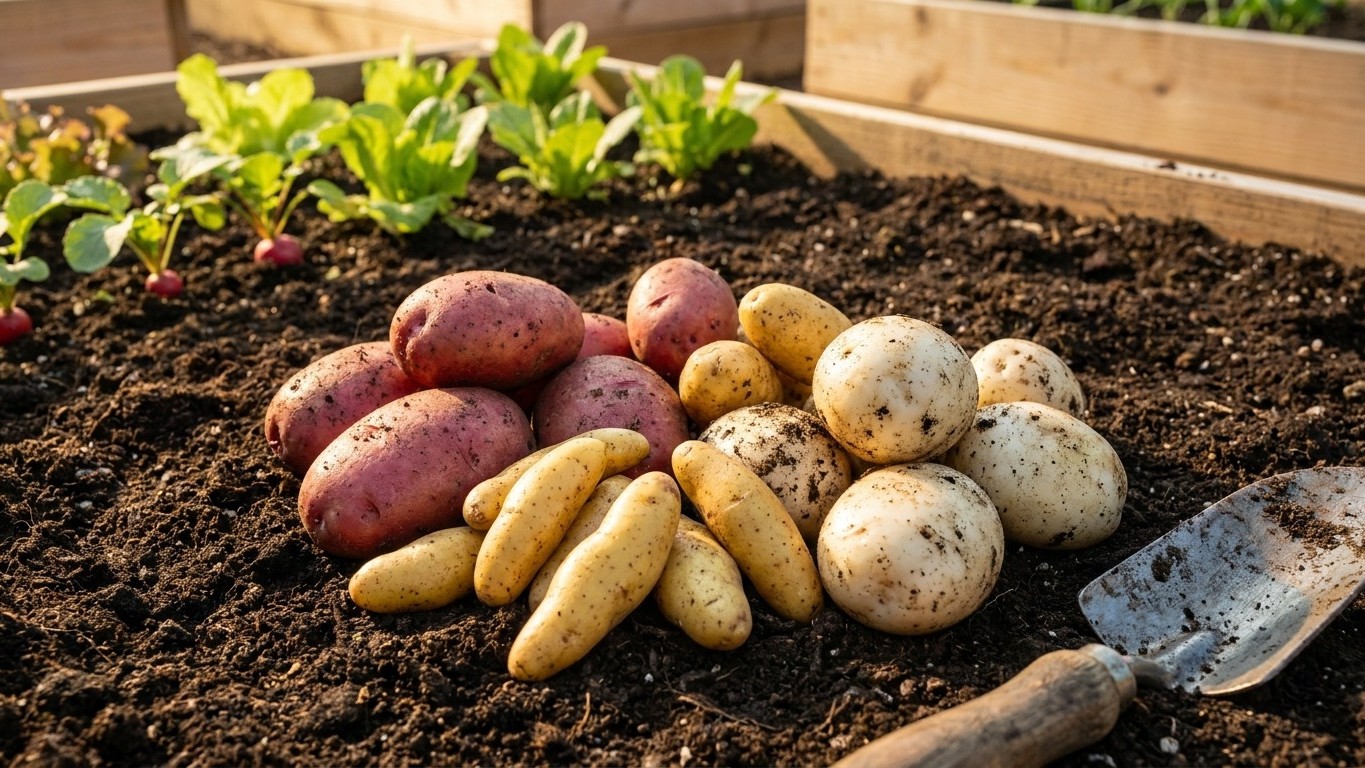
This is why the practical recommendation for most of the state is a spring-dug crop of early or mid-season potatoes, not a summer-long planting nursed through July and August. The table below groups a few widely grown varieties by the season class each falls into and by what they’re generally used for, baking or boiling, since that’s the distinction the extension sources actually publish. Neither Utah State nor the University of Maine publishes a days-to-maturity count for any variety, so none appears here.
| Variety | Season class | Best use |
|---|---|---|
| Red Pontiac | Early to mid-season | Boiling |
| Yukon Gold | Mid-season | Baking and boiling |
| Kennebec | Mid-season | Baking |
| Katahdin | Mid-season | Boiling |
East Tennessee and the Cumberland Plateau run cooler and later than Nashville in spring, which pushes the safe planting window back and, if anything, strengthens the case for early and mid-season varieties there too, since the growing stretch before summer heat arrives is no more generous.
What actually decides it
Two mechanisms decide which potato varieties belong in a Tennessee garden, and neither one is about taste or soil type. They’re about temperature, at two different points in the plant’s life.
Soil temperature at planting
Potatoes go in the ground as soon as soil reaches 50 F, according to the University of Maine Cooperative Extension’s Bulletin #2077, and that point typically falls 14 to 21 days before the last frost date. That timing detail matters more than gardeners usually credit it: it means the calendar date on a seed packet is close to useless in Tennessee. What matters is soil temperature, tracked with an actual soil thermometer a few inches down, cross-referenced against the March 31 to April 12 window NOAA NCEI documents for Nashville. A gardener in a colder microclimate, a shaded hollow or a north-facing slope, will hit 50 F soil later than a neighbor three miles away on open, south-facing ground. The mechanism generalizes: wherever you garden, count backward from your own last frost date, not from Nashville’s, and confirm with a thermometer instead of a calendar.
The heat ceiling in soil
The second mechanism is the one that decides whether the crop succeeds at all, and it’s the one most home gardeners never learn until a summer planting fails. Utah State University Extension is explicit that soil above 90 F inhibits tuber set and fill, and that this isn’t a stress the plant can be watered through. Mulch, shade cloth, and irrigation can lower soil temperature by a few degrees, but none of it reverses tuber inhibition once the threshold is crossed for a sustained stretch. This is the mechanism that should govern variety choice for any reader outside Tennessee too: count the number of 90 F days a given territory typically logs during the tuber-bulking window, and if that count is high, the answer is always to plant early enough that bulking finishes before the heat arrives, not to select a variety that can supposedly “handle heat.” No potato variety escapes the ceiling; the season class just determines how much runway it needs before hitting it.
How to do it
- Check certified seed potatoes from a garden center or seed supplier rather than grocery-store tubers; uncertified seed carries virus that will follow the crop through the whole season.
- Track soil temperature at planting depth with a soil thermometer rather than relying on the calendar alone.
- Plant once soil reaches 50 F, which lands 14 to 21 days before the local last frost date, per the University of Maine Cooperative Extension.
- For Nashville-area gardens, use NOAA NCEI’s March 31 to April 12 window as the anchor point and count backward from it; East Tennessee and Cumberland Plateau gardeners should expect that window to fall later and adjust accordingly.
- Choose an early or mid-season variety so tuber set and fill complete before soil temperatures climb toward the 90 F ceiling Utah State University Extension documents.
- Hill soil around the developing plants as they grow, which helps buffer soil temperature swings at the root zone.
- Dig the crop once foliage dies back, rather than leaving tubers in soil that’s climbing toward the heat ceiling.
What goes wrong
- Planting by calendar date instead of soil temperature. A fixed date ignores yearly swings in spring warm-up; check soil temperature directly and plant at 50 F regardless of what the calendar says.
- Using uncertified seed potatoes from the grocery store. These frequently carry latent virus that stunts the crop invisibly; buy certified seed potatoes instead, every season.
- Choosing a late-season variety because it’s what’s available locally. A late-season potato needs a longer cool stretch than Tennessee’s frost-to-heat window offers; swap to an early or mid-season variety and dig sooner.
- Trying to water through a heat wave to save the tubers. Utah State University Extension is clear that watering does not reverse tuber inhibition once soil exceeds 90 F; the fix is timing the crop earlier next season, not irrigating harder this one.
- Assuming the whole state shares one frost date. NOAA NCEI’s window is specific to the Nashville-area station; East Tennessee and the Cumberland Plateau run cooler and later, so gardeners there need their own local reading, not a statewide assumption.
- Planting too deep in cold, wet spring soil. Deep planting in soil that hasn’t warmed delays emergence and invites rot; wait for the 50 F mark at planting depth before setting seed pieces.
Common questions
Can late-season potato varieties grow in Tennessee at all?
They can be planted, but the mechanism working against them is the same heat ceiling that governs every variety: soil above 90 F inhibits tuber set and fill, according to Utah State University Extension. A late-season variety needs more time to bulk than Tennessee’s frost-to-heat window typically allows, so most gardeners get better, more predictable results from early or mid-season choices.
How do I know when my soil has actually hit 50 F?
Use a soil thermometer at planting depth rather than air temperature or the calendar. The University of Maine Cooperative Extension’s guidance ties planting directly to that 50 F soil reading, occurring 14 to 21 days before the local last frost date, which is the only reliable trigger the sources publish.
Is the Nashville frost date the same for the whole state?
No. The March 31 to April 12 window comes from a specific NOAA NCEI station near Nashville. East Tennessee and the Cumberland Plateau are cooler and run later in spring, so gardeners in those regions should expect their own safe planting window to shift later than Nashville’s.
Does mulching lower soil temperature enough to grow a summer crop?
Mulch and shade can lower soil temperature somewhat, but neither source used here claims it prevents tuber inhibition once soil sustains temperatures above 90 F. The more reliable approach is planting early enough that bulking finishes before soil reaches that point, rather than trying to engineer around the heat once it arrives.