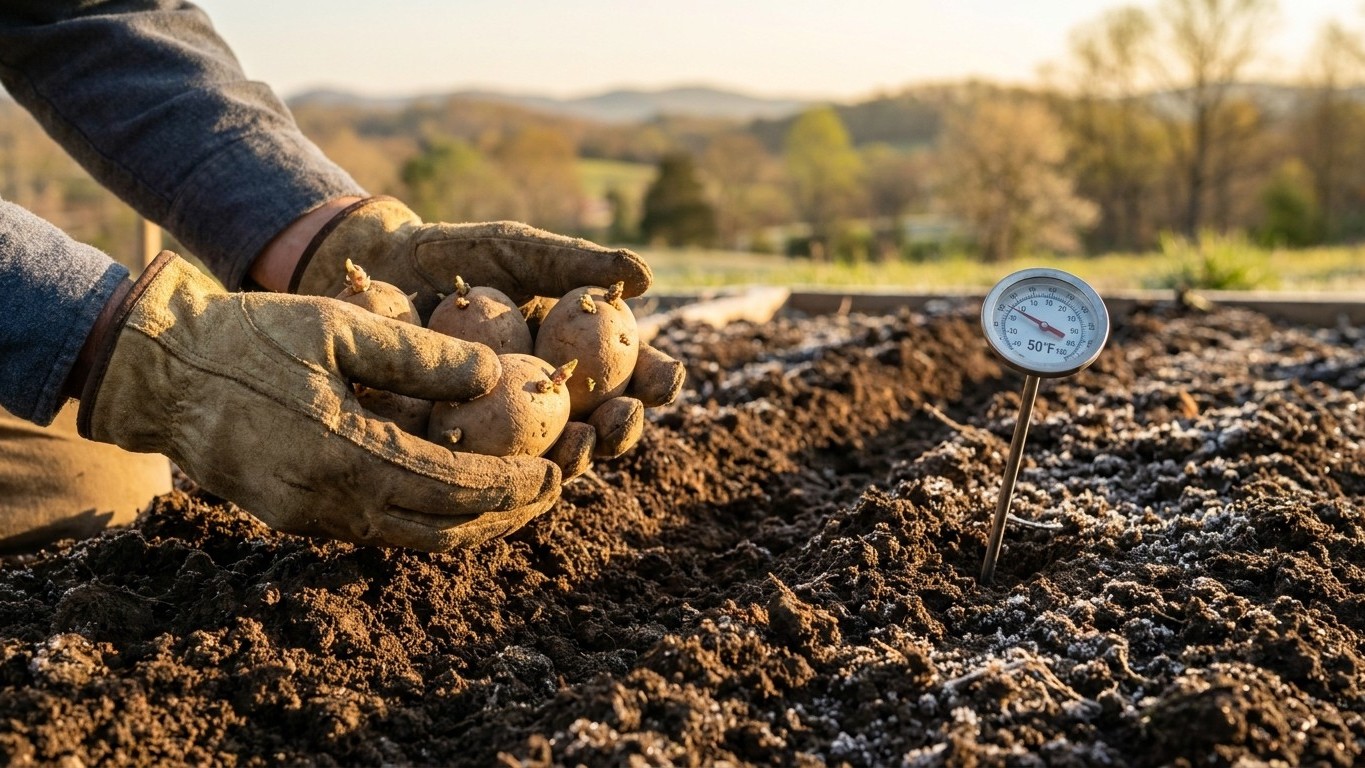

Plant potatoes in Tennessee when the soil hits 50°F, not on a fixed calendar date. Around Nashville, that means roughly 14 to 21 days before the last spring frost, which falls between March 31 and April 12 according to NOAA’s 1991-2020 Climate Normals. Everywhere else in the state, that window shifts with elevation.
The short answer
The last spring frost date for the Nashville reference station, tracked by NOAA’s National Centers for Environmental Information under the 30-70% freeze probability band, falls between March 31 and April 12. That’s the number to work backward from, and it comes from actual station data, not a guess or a folk rule.
Utah State University Extension and the University of Maine Cooperative Extension both point to the same mechanism for timing a potato planting: get seed pieces into the ground once soil temperature reaches 50°F, which lands 14 to 21 days ahead of the last frost date. Run that math against the Nashville window and the planting stretch lands somewhere between March 10 and March 29. Early counters who hit the 21-day mark against the earliest frost date (March 31) land near March 10. Gardeners waiting closer to the later frost date (April 12) and counting only 14 days back land near March 29.
That’s not a hard rule to circle on a calendar, though. It’s a range built from two moving pieces: how early or late your local last frost tends to fall, and how quickly your particular patch of ground warms in early spring. A south-facing raised bed with sandy loam can hit 50°F a week before a heavy clay garden ten miles away. The frost date gives you the outer boundary. Soil temperature gives you the green light.
What throws people off is treating “last frost date” as the planting date itself. Potato foliage that emerges before the last frost can take a light freeze and often pushes new growth back up from the seed piece. That’s part of why the recommended window sits ahead of, not after, the frost date. Waiting until the calendar says “safe” usually means the soil has already been workable for two or three weeks, and that’s lost growing time in a state where early summer heat becomes the next problem.
None of this changes east of Nashville. The Cumberland Plateau and East Tennessee run cooler and later in spring, so the same 50°F soil threshold arrives later there too, sometimes by several weeks depending on elevation. The mechanism doesn’t change. The date it points to does.
What actually decides it
Soil temperature, not the calendar
Potato seed pieces planted into cold, wet soil don’t sit and wait patiently for warmer weather. They rot. Utah State University Extension frames the planting trigger as soil temperature reaching 50°F, because that’s the point where the seed piece can push a sprout before disease organisms in cold soil get the upper hand. A frost date is a regional average pulled from decades of weather station readings. Soil temperature is a local, physical condition you can actually test with a thermometer pushed a few inches into your own bed. The frost date tells you roughly when to start checking. The soil tells you when to actually plant.
The heat ceiling that caps the season on the other end
The planting window matters because of what happens months later, not just what happens at planting. Both Utah State University Extension and the University of Maine Cooperative Extension (Bulletin #2077) note that tuber set and fill stall out once soil temperatures climb above 90°F. This isn’t a wilting problem you can water your way out of. Once the soil crosses that line, the plant stops adding size to the tubers underground, regardless of how green the foliage looks up top. In a state where soil routinely crosses 90°F by mid-summer, that ceiling effectively sets a hard deadline on the back end of the season. Planting early enough to size up tubers before the ground overheats matters more than squeezing out a few extra weeks of foliage growth.
Elevation and region shift the whole window
The Nashville station data is one point on a map, not a statewide constant. Middle Tennessee’s frost dates don’t hold for the Cumberland Plateau or the mountains further east, where spring arrives later and soil warms more slowly under the same March sun. A gardener in a higher, cooler pocket of the state who plants on a Nashville-derived date is planting into ground that hasn’t caught up yet. The fix isn’t a different formula. It’s using the same 50°F soil check locally, and expecting the calendar date that check lands on to run later than it would in Middle Tennessee.
How to do it
- Push a soil thermometer four to six inches deep into the planting bed and check it over several consecutive days rather than relying on a single reading, since a warm afternoon can give a misleading spike.
- Once readings hold near 50°F, count back from your local last frost date as a sanity check. For the Nashville reference area, that lands the window between roughly March 10 and March 29, adjusted earlier or later depending on which end of the NOAA frost range (March 31 to April 12) your particular spring is running.
- Source certified seed potatoes rather than potatoes pulled from a grocery bin. Certified seed has been inspected for the viruses that build up in uncertified stock and quietly cut yields season after season.
- Cut larger seed potatoes into pieces with at least one or two eyes each, then let the cut surfaces air-dry and callus for a day or two before planting, which reduces rot risk in cool soil.
- Work the bed to a loose, well-drained texture. Potatoes forming in heavy, compacted soil size unevenly regardless of how well the timing was handled.
- Plant seed pieces at the recommended depth for your bed style, whether that’s a trench, a raised row, or a container, once soil temperature and the frost-date count agree.
- Choose an early season class if your area logs a long stretch of soil above 90°F in summer, since Utah State and University of Maine extension guidance both point to early varieties finishing tuber fill before that heat ceiling shuts growth down.
What goes wrong
- Planting strictly by the last-frost calendar date instead of checking soil temperature. A frost date is a regional average, not a guarantee about your specific bed. Test the soil at four to six inches instead of trusting the date alone.
- Using uncertified seed potatoes, including grocery store stock. Uncertified seed carries viruses that don’t show up as obvious symptoms right away but drag down yield over the season. Buy certified seed potatoes from a nursery or extension-recommended supplier.
- Applying a Middle Tennessee planting window to East Tennessee or the Cumberland Plateau. Those areas run cooler and later in spring, so a date that works near Nashville can mean planting into soil that hasn’t reached 50°F yet further east. Re-check soil temperature locally rather than importing a date from elsewhere in the state.
- Planting a late-season variety in a region with a long stretch above 90°F soil. Tuber fill stalls once that heat ceiling is crossed, so a long-season crop can lose its sizing window before it’s finished. Favor an early season class where summer heat arrives hard and stays.
- Skipping the callus step after cutting seed pieces. Fresh-cut pieces planted immediately into cool, damp soil are far more prone to rot before they sprout. Let cut surfaces dry for a day or two first.
Common questions
Can I plant potatoes before the last frost date in Tennessee?
Yes, and the guidance from Utah State University Extension and the University of Maine Cooperative Extension points that direction on purpose. The 50°F soil threshold typically arrives 14 to 21 days before the last frost, so waiting for frost-free weather usually means planting later than necessary.
Does the Nashville frost date apply to my part of Tennessee?
Only as a reference point. The March 31 to April 12 window comes from NOAA NCEI data tied to a specific station, and East Tennessee and the Cumberland Plateau run cooler and later. Use the same soil-temperature check locally rather than assuming the Nashville dates transfer directly.
What happens if soil gets too hot after planting?
Once soil temperature climbs above 90°F, tuber set and fill are inhibited, per Utah State University Extension and University of Maine Cooperative Extension guidance. Watering doesn’t reverse that. It’s why choosing an early season class matters in regions with long hot summers.
Is it worth paying more for certified seed potatoes?
Yes. Certified seed has been checked for the viruses that accumulate in uncertified stock, including potatoes saved from a previous harvest or bought at a grocery store. That single choice affects yield more than most other decisions made at planting time.