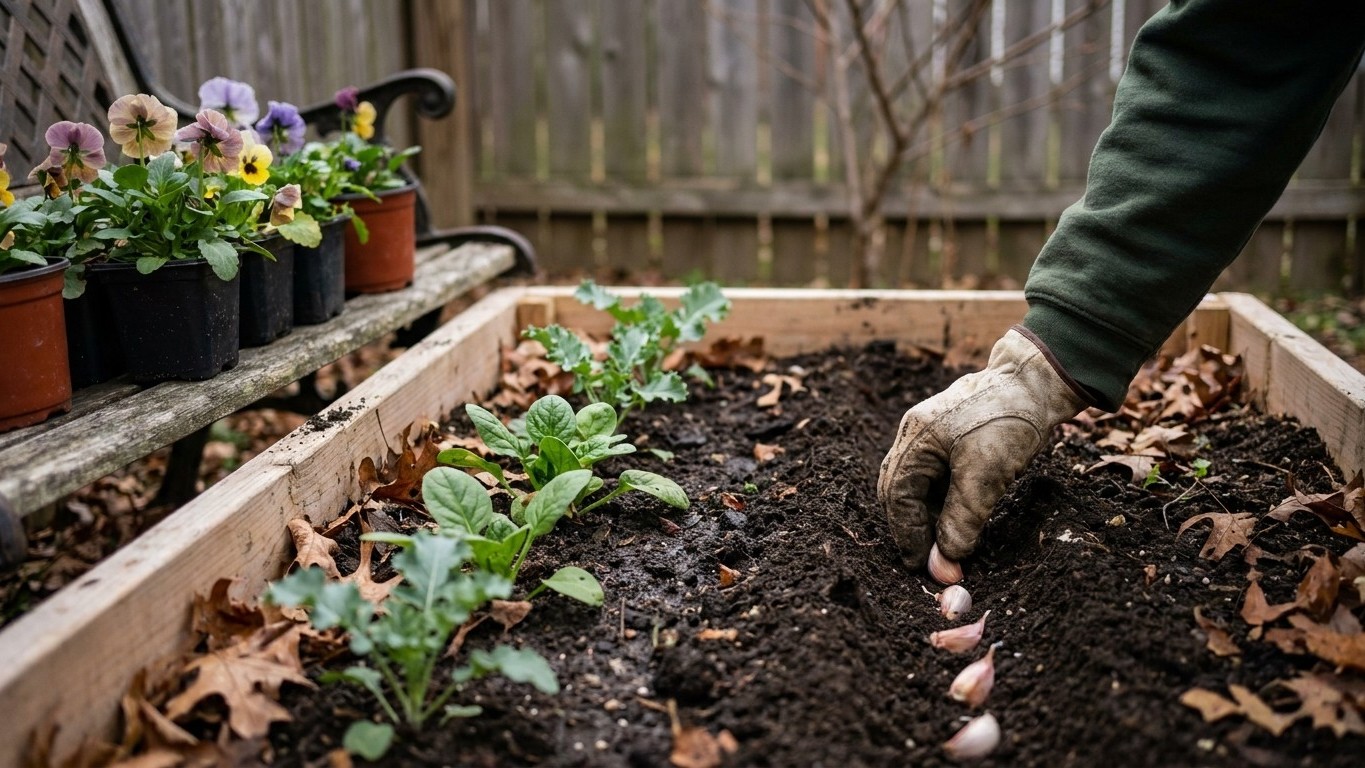

Garlic goes in the ground, spring bulbs get tucked into cooling soil, and the last winter squash comes off the vine before frost claims it. In the Salt Lake valley, that first hard frost typically lands between October 18 and October 29. Higher elevations and northern counties see it sooner; the south often gets a longer reprieve.
What goes in the ground in October
Soil temperature, not the date on the calendar, decides what survives this month. Utah spans USDA Hardiness Zones 4a through 9a, with Salt Lake City sitting in the milder middle of that range. A backyard at 7,000 feet in Summit County is working a completely different clock than one in St. George.
Garlic and shallots are the headline crop right now. Both need four to six weeks of root growth before the ground freezes solid, so the goal is to get cloves in while soil still works easily with a trowel, ideally before that first fall frost window closes. Break bulbs into individual cloves, plant them root-side down about two inches deep, and space them roughly six inches apart. A layer of straw mulch after planting helps buffer the freeze-thaw cycles that can heave cloves out of loose soil over winter.
Spring-flowering bulbs also belong in October ground: tulips, daffodils, crocus, and alliums grown for the flower rather than the kitchen. These want soil that has cooled below roughly 60°F, which for most of Utah means early to mid-October is often too warm and late October is closer to right, depending on elevation.
Hardy greens still have a shot in the first half of the month in valley locations. Spinach, mache (corn salad), and arugula can be direct-sown outdoors where soil is workable and some protection, even just a floating row cover, is available for the nights that dip toward freezing. These crops tolerate light frost and, in mild years, will overwinter under cover for an early spring harvest.
What does not belong outdoors: any warm-season transplant. Tomatoes, peppers, squash, and beans are done contributing new growth by October across virtually all of Utah. Planting them now is not a gamble, it is a guaranteed loss.
What to start under cover
Count backward from the first fall frost window (October 18 to October 29 in the Salt Lake area) rather than from a fixed date. Hardy greens sown into a cold frame or under a low tunnel generally need four to six weeks to reach a sturdy rosette stage strong enough to coast through winter and resume growth in early spring. That arithmetic pushes the ideal sowing window for most of Utah into September for anyone above the valley floor, and to the very first days of October for milder, lower-elevation gardens.
The two failure modes run in opposite directions. Sow too early, while soil is still warm from summer, and tender greens like lettuce can bolt or succumb to damping-off in the lingering heat and humidity trapped under cover. Sow too late, after soil temperatures have already dropped hard, and seedlings never build the root mass or leaf structure needed to survive a real freeze. They just sit there, thin and vulnerable, until a cold snap finishes them.
Cold frames and unheated low tunnels are the workhorses here. A simple frame built from scrap lumber and an old window sash can hold soil temperature several degrees above open ground, which is often the difference between a spinach bed that limps through winter and one that doesn’t. Vent the frame on sunny afternoons even in cold weather; trapped heat under glass or plastic can cook seedlings faster than frost kills them.
This is also a reasonable month to start bulbs indoors for forcing, paperwhites and amaryllis chief among them, giving households indoor color while the garden outside winds down.
What is ready to pick
October carries the last big harvest push of the growing season across most of Utah. Winter squash and pumpkins need to come off the vine before a hard freeze damages the rind; a fingernail test works well here, pressing into the skin near the stem, if it resists denting, the squash is ready. Cure them in a warm, dry spot for one to two weeks afterward to toughen the skin further for storage.
Apples are finishing in most Utah orchards and home trees this month, with timing shifting by variety and elevation. Main-crop potatoes come out once the tops have died back, and root vegetables like carrots, beets, and parsnips actually improve in flavor after a light frost converts stored starches to sugar, so there is no rush to pull them the moment temperatures dip.
Tomatoes and peppers still hanging on the vine deserve a decision before frost arrives: pick green tomatoes to ripen indoors on a windowsill, or accept that the season is closing. Once frost blackens the foliage, whatever is left on the plant is done.
Anyone storing squash, potatoes, or onions from earlier in the season should check the pile now. A single soft or moldy specimen tucked among sound ones will spread rot through the whole batch within days; pull it before that happens.
The jobs that matter this month
Garlic bed preparation and planting sit at the top of the list, since missing the window means waiting a full year for another shot. Work compost into the bed before planting, since garlic sits in place for eight months and won’t get another feeding opportunity until active spring growth resumes.
Winterizing irrigation is a distinctly Utah concern. Drip lines, hose bibs, and sprinkler systems left full of water when a hard freeze arrives can crack fittings and split pipe, an expensive mistake that shows up as a spring surprise. Draining and blowing out irrigation lines before the first sustained freeze saves real money.
Mulching pays off twice this month: a thick layer over newly planted garlic and bulbs buffers freeze-thaw cycles, while mulch spread over perennial beds and exposed soil protects roots and cuts down on spring weed pressure. Fallen leaves, shredded if possible, work as well as bought mulch and cost nothing.
Tender perennials and container plants need a decision now, not after the first frost warning. Potted rosemary, citrus, and other marginally hardy plants should move indoors or into an unheated garage before nighttime temperatures threaten them.
Beyond the beds, this is a good month to order seed for next season before popular varieties sell out, test soil pH while the ground is still workable, turn the compost pile one last time before cold slows the microbes, and clean and sharpen tools before they sit idle over winter. None of these feel urgent in the moment, but each one saves a scramble come spring.
What not to do in October
The most common mistake is treating a warm afternoon as permission to keep tender crops uncovered. A 70-degree day in early October can be followed by a 25-degree night once a cold front moves through; Utah’s continental climate swings hard and fast, and a single unprotected night can undo a season’s work on tomatoes, peppers, and basil.
Pruning fruit trees now is another frequent error. Cuts made before trees are fully dormant can push out tender new growth right as cold weather arrives, and that new growth is far more vulnerable to freeze damage than mature wood. Dormant pruning belongs later in the winter, not in October.
Applying a high-nitrogen fertilizer this month works against the plant rather than for it. Nitrogen encourages soft, leafy growth exactly when perennials and shrubs should be shutting down and hardening off for winter. If feeding is needed at all in fall, a low-nitrogen, phosphorus-and-potassium-leaning product supports root development instead of top growth.
Leaving winter squash or pumpkins in the field past a hard freeze is a quiet way to lose stored value. Frost-damaged rinds break down fast in storage, turning a squash that should have lasted months into one that rots within weeks.
Checking this against your own county
A statewide October forecast is a starting point, not an instruction. Elevation alone can shift a frost date by two or three weeks between a valley floor and a nearby bench or canyon. Southern Utah runs noticeably warmer than the mountain valleys and high desert of the north and center of the state, and local terrain, cold-air drainage, and even proximity to the Great Salt Lake all nudge the numbers further.
For a planting calendar built around a specific county rather than a statewide average, the Utah State University Extension office is the reliable next stop.
Common questions
Is it too late to plant garlic in October in Utah?
Not for most of the state. Garlic needs four to six weeks of root development before the ground freezes hard, and with the first fall frost window running October 18 to October 29 in the Salt Lake valley, planting through the first half of the month still leaves enough time in milder locations. Higher elevations should aim for the earlier end of that window or plant in late September instead.
Can I still start a fall vegetable garden in October in Utah?
Only in a limited form. Hardy greens like spinach and mache can still go into a cold frame or under a low tunnel in the first part of the month in lower-elevation areas, but there is no time left for anything that needs a full growing cycle before winter sets in.
What temperature kills tomato plants in Utah?
A specific kill-temperature threshold for tomatoes isn’t published in the sources behind this guide. What is documented is the first fall frost window itself, October 18 to October 29 for the Salt Lake area, and any frost reaching 32°F is enough to damage or kill unprotected tomato foliage and fruit.
Does frost actually improve the flavor of root vegetables?
Gardeners widely report that carrots, beets, and parsnips taste sweeter after a light frost, since cold temperatures trigger the plant to convert stored starches into sugars as a natural antifreeze response. This is a well-established gardening observation rather than a figure tracked in the climate data cited here.