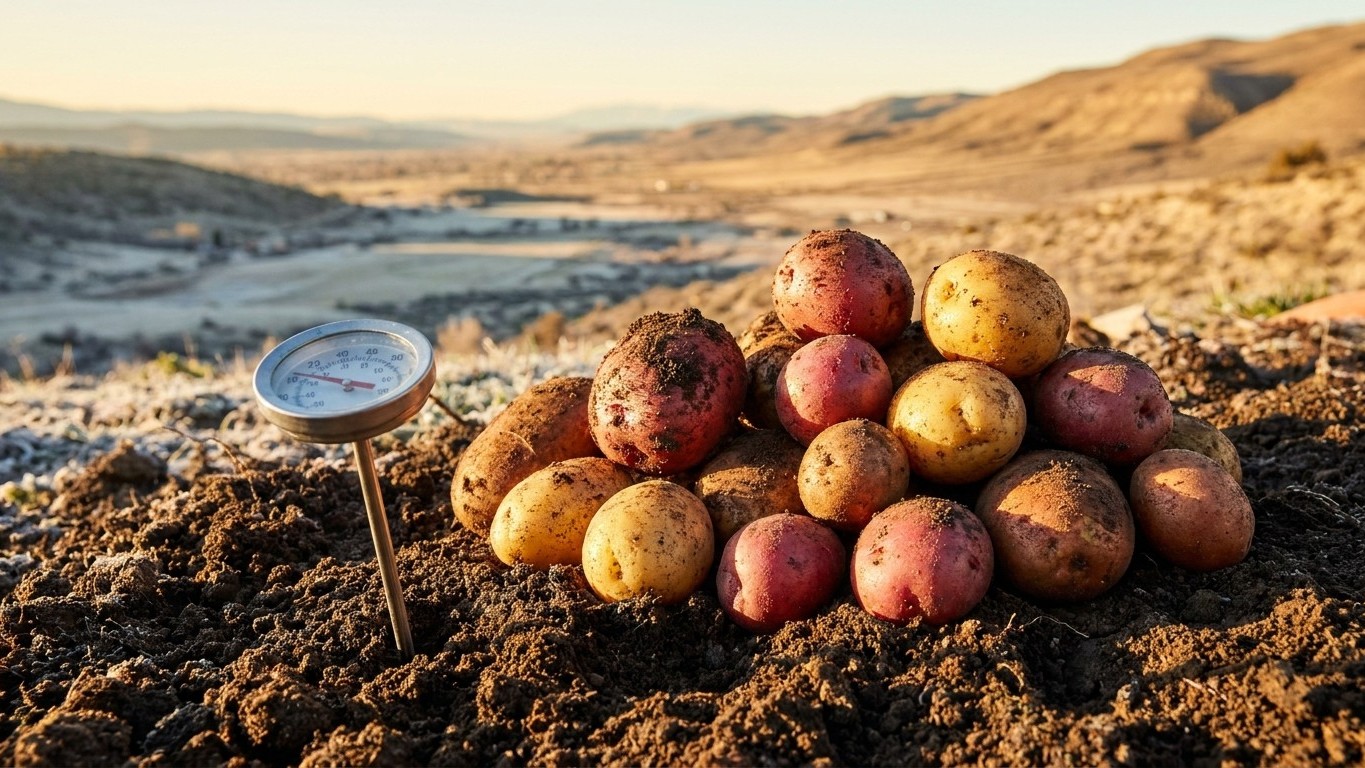

Early and mid-season varieties are the ones that actually finish in Utah, because the state’s growing window is short and its summer soil runs hot. The last spring frost in the Salt Lake City valley falls between April 12 and April 29, and once soil temperatures climb past 90°F, tubers stop sizing no matter how much you water. That combination, not personal preference, is what decides which potato belongs in a Utah garden.
The short answer
The frost-free window for the Salt Lake City valley runs from April 12 to April 29, based on NOAA NCEI’s 1991-2020 Climate Normals for station USW00024127. That’s the only frost figure this page can stand behind, and it’s specific to that valley station, not to the whole state. Mountain valleys across Utah sit higher and colder, so their frost-free stretch starts later and ends earlier. Southern Utah runs warmer, so growers there get more room on both ends of the calendar.
The second number matters more than the frost date. Utah State University Extension’s potato fact sheet and the University of Maine Cooperative Extension’s Bulletin #2077 both describe the same mechanism: potato tubers are planted as soon as soil reaches 50°F, which lands 14 to 21 days before the last frost date, and tuber set and fill shut down once soil climbs above 90°F. Watering doesn’t reverse that shutdown. The plant keeps growing green top, but the tubers underground stop bulking.
Put those two facts together and the answer writes itself. A gardener working from the Salt Lake City frost dates has roughly a three-week head start on planting, then a race against a summer soil ceiling that hits hard in a low desert valley. Varieties described as early or mid-season, the classifications both Utah State and University of Maine actually publish, fit inside that window. Late-season types need a stretch of moderate soil temperature that much of Utah simply doesn’t offer once June and July arrive.
Neither source publishes a days-to-maturity count for named varieties, and this page won’t invent one. What they do publish is the season class, and that class is the planning tool that matters here. An early variety reaches harvestable size before the soil crosses into the danger zone. A late variety is still trying to size tubers when that same soil has already shut the process down. That’s the entire logic of variety choice in this climate, and it holds whether you’re gardening in a Salt Lake City backyard, a high mountain valley, or a warmer plot in the state’s south.
What actually decides it
Two mechanisms run this whole decision, and once you understand them you can size up a potato variety this page never mentions.
The frost window sets your start line
Soil, not air, is what a seed potato responds to. Extension guidance from Utah State and Maine both anchor planting to soil temperature reaching 50°F, and that point typically falls 14 to 21 days ahead of the last frost date for a given location. For the Salt Lake City valley, where NOAA NCEI records the last frost between April 12 and April 29, that pushes the earliest planting window into late March or early April for many years. Move to a higher, colder Utah valley and that whole window shifts later, because soil warms slower at elevation. Move south into warmer ground and it shifts earlier. The frost date isn’t a fixed rule for the state; it’s a local reading that changes with elevation and latitude, and any gardener has to find their own version of it rather than borrow Salt Lake City’s.
The heat ceiling sets your finish line
This is the mechanism that decides the whole crop, and it’s the one gardeners tend to miss because it doesn’t look like a problem from above ground. Once soil temperature crosses 90°F, tuber set and fill stop. The plant can still look healthy, still flower, still push leaves, but the tubers below aren’t gaining size. There’s no rescue at that point. Extra irrigation cools the surface briefly but doesn’t change the underlying soil temperature enough to restart bulking. That’s why the practical answer in a hot Utah valley is to plant early and harvest as a spring crop, not to try to nurse a potato patch through the peak of summer. A location with a long stretch of days above that threshold simply doesn’t give a late-season variety enough safe time to finish, regardless of how the seed packet describes it.
How to do it
- Check your own soil temperature with a soil thermometer rather than relying on the calendar; wait until it reads 50°F before planting seed potatoes.
- Count backward from your local last-frost date. Since soil hits 50°F roughly 14 to 21 days before that date, use that math to set your target planting window instead of a fixed date pulled from another region.
- Buy certified seed potatoes. Uncertified seed carries virus that spreads silently through a crop, and there is no in-season fix once it’s in the plant.
- Choose an early or mid-season variety for most Utah locations, since these are the season classes Utah State University Extension and the University of Maine Cooperative Extension actually publish, and they fit inside the state’s shortened window better than late-season types.
- Plant as soon as soil reaches that 50°F mark, giving the crop the maximum runway before summer soil temperatures climb.
- Track soil temperature through late spring and into summer. Once readings start approaching 90°F, treat that as your harvest signal for early types rather than waiting on a fixed date.
- Harvest before soil holds consistently above 90°F. Waiting past that point doesn’t add size to the tubers; it only risks fewer usable potatoes in the same amount of ground.
- Cure and store the crop promptly once dug, since a heat-stressed harvest doesn’t hold as well as one pulled at the right stage.
What goes wrong
- Planting by a calendar date instead of soil temperature. A date that works for the Salt Lake City valley can be weeks off for a higher mountain valley or a warmer southern plot. Fix it by testing soil directly and planting off the 50°F mark, not off someone else’s date.
- Choosing a late-season variety because it sounds like it produces more. In a valley where soil crosses 90°F for a long stretch of summer, a late-season type simply doesn’t get the safe window it needs to size up. Switch to an early or mid-season class and treat the crop as a spring harvest instead.
- Trying to water through the heat ceiling. Extra irrigation once soil passes 90°F doesn’t restart tuber fill; the mechanism that stops sizing isn’t drought, it’s temperature. Plan the harvest date around the heat threshold instead of trying to outlast it with the hose.
- Saving seed potatoes from a previous crop instead of buying certified seed. Home-saved tubers can carry virus invisibly, and an infected plant won’t show it clearly until yield drops. Buy certified seed each time and treat that cost as part of the planting budget, not an optional upgrade.
- Assuming one frost date works for the whole state. The April 12 to April 29 range is specific to the Salt Lake City station. A gardener in a colder mountain valley who uses that date risks planting into ground that hasn’t warmed, while a gardener in a warmer southern location who waits that long loses weeks of usable season.
Common questions
What season class of potato is safest for a typical Utah backyard?
Early and mid-season classes fit best, because they’re built to finish inside the shorter window that Utah’s frost dates and summer heat ceiling create together. Neither Utah State University Extension nor the University of Maine Cooperative Extension publishes a days-to-maturity figure for named varieties, so season class is the planning tool to use.
Does the April 12 to April 29 frost date apply everywhere in Utah?
No. That range comes from NOAA NCEI’s Climate Normals for station USW00024127 in the Salt Lake City valley. Higher mountain valleys across the state run colder and see frost later into spring, while southern Utah runs warmer and clears frost earlier.
Can I still grow potatoes if my area gets a lot of days above 90°F?
Yes, by treating the crop as a spring harvest. Plant as soon as soil reaches 50°F, well ahead of the last frost date, and dig before soil holds consistently above 90°F, since that’s the point where tuber set and fill stop for good.
Why does certified seed matter so much for potatoes specifically?
Uncertified seed potatoes can carry virus that isn’t visible until yield already suffers, and there’s no way to treat it once the plant is growing. Certified seed is the one input in the whole process that removes that risk before it starts.