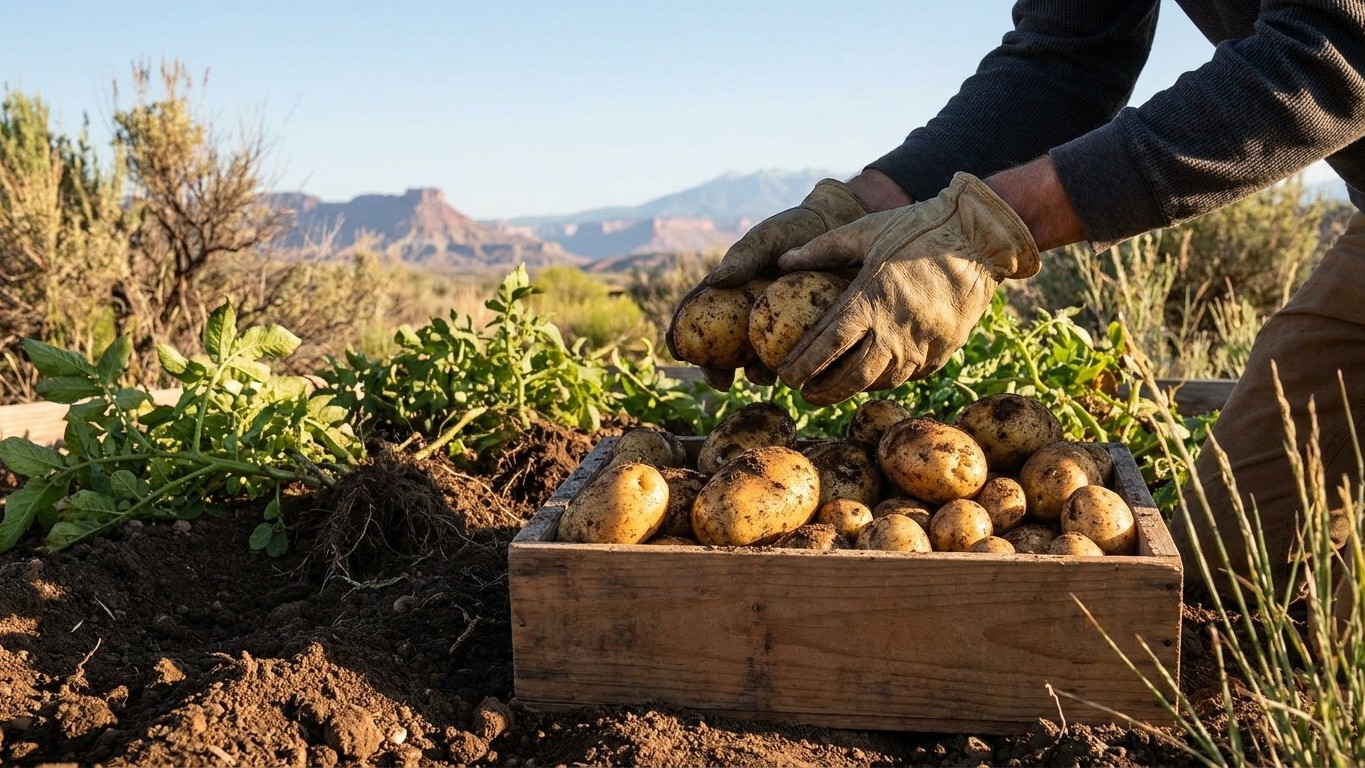

Yes, potatoes grow well in Utah gardens, but summer heat sets the calendar. Plant early enough that tubers form before soil temperatures climb too high, choose early or mid-season varieties, and expect to dig the crop before the hottest weeks of summer rather than after. The state’s mild valleys and high heat load both push toward one answer: get in early.
The short answer

Two numbers decide how this crop behaves in Utah. At the reference station in Salt Lake City, the year averages 52.1 days at or above 90 F, according to NOAA NCEI Climate Normals for 1991-2020. That’s a meaningful heat load, roughly a day and a half a week across the warm months, concentrated in July and August. The second number is the last spring frost window for that same station: April 12 to April 29, drawn from NOAA NCEI’s 1991-2020 freeze probability data for station USW00024127.
Put those two together and the picture is clear. Utah doesn’t sit in the mildest zone of the country, but it also isn’t the hottest. With 52 days a year above 90 F, the heat arrives late enough in the season that a gardener who plants early can grow a full crop and dig it before the worst stretch of summer hits. This isn’t a state where potatoes are impossible, it’s a state where When to Plant Potatoes in Utah matters more than shade cloth and extra watering ever could.
Utah State University Extension, in its fact sheet on garden potatoes, is direct about the mechanism that makes this timing matter: tuber set and fill are inhibited once soil temperatures climb above 90 F. That threshold is about soil, not air, but the two track closely in an exposed garden bed with no mulch. A count of 52 days a year with 90 F air temperatures at the reference station is a reasonable signal that soil in an unshaded row can cross that line more than once most summers, especially in the second half of July.
The Salt Lake City station sits in a mild valley, and that matters for how a reader should use these figures. Most of Utah sits higher and colder than the valley floor, which pushes both the frost dates and the hot-day count in a cooler direction. Southern Utah runs the opposite way, warmer and with an earlier, longer hot season. Neither of those adjustments changes the underlying strategy: plant as soon as the soil allows, and treat the crop as one that finishes before peak heat rather than one that pushes through it.
On variety choice, Utah State University Extension sorts garden potatoes by what they’re used for rather than by a maturity date, a starting point covered in more depth in Potato Varieties That Suit Utah. Russet types are suited to baking and long storage. Red-skinned types are suited to boiling and salads. Yellow-fleshed types serve as an all-purpose choice for either use. All three season classes, early, mid-season and late, show up across those groups, and in a state with a defined heat window, an early or mid-season class gives the most room to finish sizing before the soil gets too warm.
When to plant here
Work backward from the local last frost date instead of forward from the calendar. The arithmetic is the same no matter which county a reader gardens in, only the starting date changes.
- Start with your county’s last spring frost date. The statewide reference window from NOAA NCEI is April 12 to April 29 for the Salt Lake City station, but this is a starting point, not a fixed date for every county.
- Count back 14 to 21 days from that date. If a county’s last frost falls on April 20, counting back two to three weeks lands the planting target between March 30 and April 6.
- Confirm soil temperature separately. Utah State University Extension and the University of Maine Cooperative Extension both tie planting to soil reaching 50 F, not to the calendar date alone. A soil thermometer pushed a few inches into the row tells this directly, and it’s a more reliable signal than the date on its own in a spring with a late cold snap.
- Plant once both conditions line up. Soil at 50 F, inside the 14-to-21-day window before the last frost, is the target. Planting earlier into colder soil risks rot before sprouting; planting later shortens the stretch of cool weather the crop gets before summer heat arrives.
What the heat does to the crop
The mechanism is the whole story here. Once soil temperature climbs above 90 F, tuber set and fill stop, according to Utah State University Extension and the University of Maine Cooperative Extension. The plant doesn’t die and the foliage can look fine, but the underground work of sizing tubers pauses. This isn’t a stress the plant grows through with more water; it’s a temperature ceiling, and no amount of irrigation lowers soil temperature enough to matter once the sun has been on that row all afternoon.
Utah’s air temperature record gives a sense of how often that ceiling gets tested. With 52.1 days a year at or above 90 F at the Salt Lake City reference station, a garden without heavy mulch or afternoon shade is likely to see soil cross into that range on multiple days most summers, particularly from mid-July into August. That’s exactly the stretch when a late-planted or late-season crop would still be trying to fill tubers.
The practical answer for a gardener here is a spring-to-early-summer crop rather than a season that runs deep into August. Plant at the earliest safe window described above, let the plant do its bulking during the cooler weeks of late spring and early summer, and plan to dig before the heaviest run of 90-degree days sets in. A gardener who plants late and hopes to keep the crop going through the hot stretch with extra watering is fighting a mechanism that water doesn’t reach. The fix is scheduling, not irrigation.
What goes wrong here
- Planting uncertified seed potatoes. Seed saved from a grocery-store potato or an unlabeled source can carry viruses that stunt the plant and reduce yield without any obvious symptom until the season is already lost. Buy certified seed potatoes from a garden center or seed supplier, which is the only way to know the seed is virus-free.
- Planting into cold, wet soil. Seed pieces set into soil colder than 50 F sit in ground that promotes rot before the eyes sprout. Wait for the soil thermometer to confirm 50 F rather than planting on a fixed calendar date, especially in a spring that’s running cool.
- Skipping the hilling. Tubers that form near the surface and get exposed to sunlight turn green and develop solanine, which makes them unsafe to eat. Hill soil up over the base of the plants as they grow, adding a few inches of cover each time the foliage gets tall enough, so developing tubers stay buried.
- Digging too early. Pulling the crop while the foliage is still green and growing means the tubers haven’t finished sizing, and the harvest comes in light. Wait until the foliage yellows and begins to die back on its own before digging, which is the plant’s own signal that it has stopped bulking rather than a fixed date on a calendar.
Checking this against your own county
Everything above is anchored to one reference station in a mild valley, and that’s a starting point, not an instruction for every backyard in the state. A garden a few thousand feet higher in elevation can run its last frost date weeks later than the Salt Lake City window, while a garden in the warmer south can run weeks earlier. Those shifts move both the planting date and how many 90-degree days the crop has to dodge.
The fix is simple: check the local numbers before planting by date alone. Utah State University Extension is the resource to use for county-level frost dates and planting guidance specific to a given elevation and region, and it’s worth a call or a visit to their site before locking in a planting day based on a statewide figure.
Common questions
Can potatoes handle Utah’s summer heat?
The plants tolerate the season, but tuber growth stops once soil temperatures climb above 90 F, according to Utah State University Extension. With 52.1 days a year at or above 90 F at the Salt Lake City reference station, the practical answer is to plant early and harvest before the heaviest heat rather than expecting the crop to keep sizing through August.
When should I plant potatoes in Utah?
Target soil at 50 F, roughly 14 to 21 days before your county’s last spring frost date. For the Salt Lake City reference window of April 12 to April 29, that puts a typical planting target in late March to mid-April, adjusted for each county’s own frost date.
Which potato varieties work best here?
Utah State University Extension groups garden varieties by use rather than by days to maturity: russet types for baking and storage, red-skinned types for boiling and salads, yellow-fleshed types as an all-purpose choice. Early or mid-season classes give the most margin to finish before peak summer heat in a state with this heat load.
How do I know when to dig?
Wait for the foliage to yellow and die back on its own. That’s the plant signaling it has stopped bulking, and it’s a more reliable marker than counting a fixed number of weeks since planting.