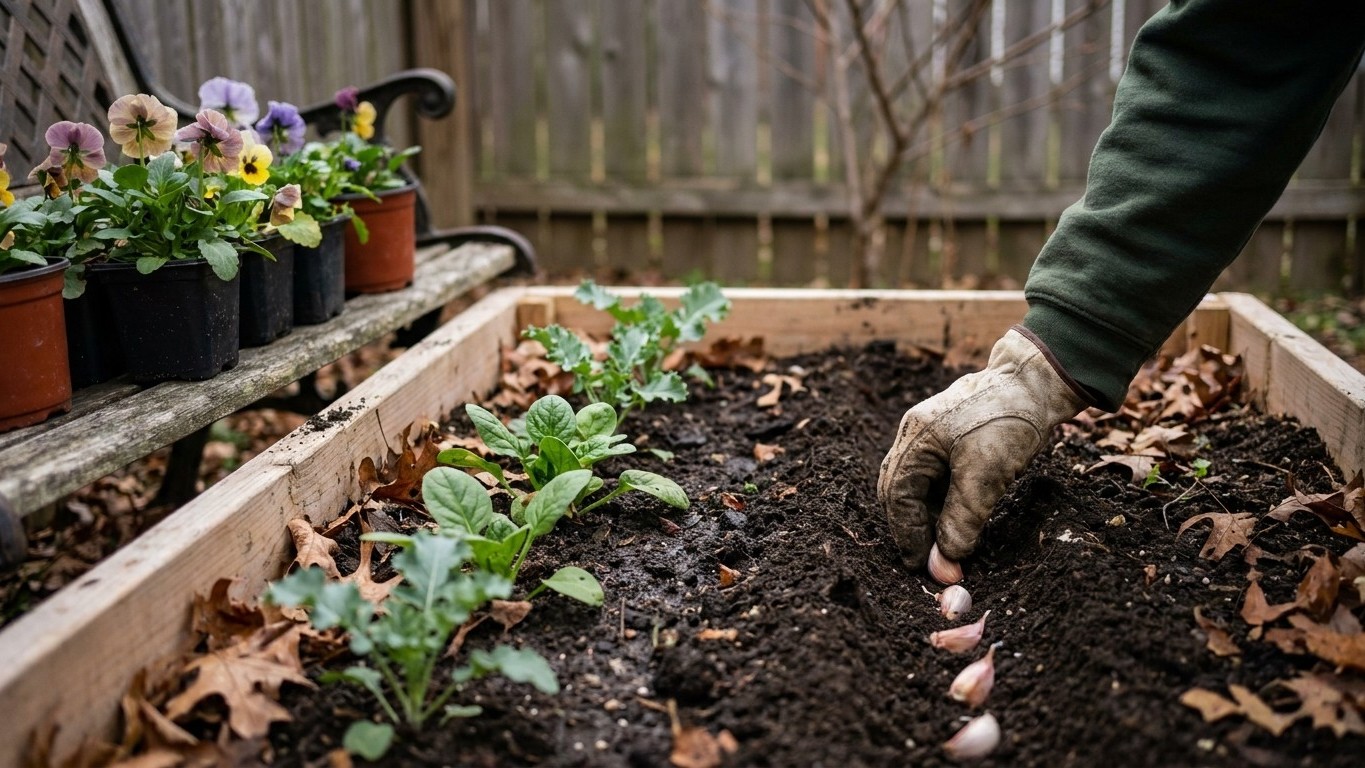

October is a planting month in Virginia, not a waiting month. Garlic and shallots go into the ground, along with spinach, kale, and spring bulbs like daffodils and tulips. Cover crops go down on beds that emptied out after summer. Trees and shrubs still root well while soil holds its warmth. The first fall frost hasn’t landed yet across most of the state, but it’s close enough that tender crops are already off the table.
What goes in the ground in October

The number that decides everything this month is the frost window, not the date on the calendar. At the coastal reference station near Virginia Beach, NOAA’s 1991-2020 climate normals put the first fall freeze between November 10 and November 24. That means October sits ahead of that window across the coastal plain and central Virginia, with soil still warm enough at root depth to support new plantings. The Blue Ridge and southwest Virginia run weeks earlier, so a gardener in those elevations should treat late October as already borderline for anything tender.
That gap between now and the freeze is exactly why garlic and shallots go in this month. Cloves need four to six weeks of root growth before the ground locks up, and with five or more weeks left before the earliest frost date in most of the state, October timing lines up almost perfectly. Spring bulbs follow the same logic from the other direction: daffodils, tulips, and crocus root best once soil temperature at planting depth drops below 60F, which typically happens by mid to late October across the state’s lower elevations.
Cool-season greens still have a runway too. Spinach, kale, lettuce, and mache sown now can reach baby-leaf size before the frost window arrives, and with a cold frame or row cover, several of them keep producing well past it. Cover crops like winter rye and crimson clover go down on any bed sitting empty, holding soil through winter rather than leaving it bare.
| Crop or planting | October outdoor planting | Why |
|---|---|---|
| Garlic, shallots | Yes | Needs weeks to root before the ground freezes |
| Spinach, kale, lettuce | Yes, with cover | Fast-growing, tolerates cool soil, benefits from row cover past frost |
| Spring bulbs | Yes, mid-late month | Roots best once soil drops below 60F |
| Trees, shrubs, perennials | Yes | Warm soil, cool air favors root establishment |
| Tomatoes, beans, squash | No | Frost weeks away, not enough season left |
What to start under cover
Counting backward from the frost window works better than picking a date off a seed packet. A 45-day baby-leaf crop like spinach or arugula sown in early October reaches harvest size right around the earliest edge of that Nov 10-24 window, which leaves almost no buffer without protection. Sow the same crop under a cold frame or low tunnel and that buffer stretches by several weeks, since the cover holds several degrees of extra warmth and blocks wind that would otherwise stall growth.
Two mistakes show up every year. Sowing too early, while soil and air are still warm under the cover, traps heat and humidity that push seedlings to stretch and go leggy before they ever face real cold. Sowing too late runs into the other problem: day length below roughly ten hours slows almost everything down regardless of how well it’s protected, so a crop started in late October under cover may simply sit there, barely growing, until day length increases again.
October is also the month to start forcing bulbs indoors. Paperwhite narcissus and amaryllis potted now, kept in a cool dark spot until shoots appear, time out to bloom in the dead of winter, when almost nothing else in the house is flowering. It’s a small job, but it’s one that has to happen weeks ahead of the payoff, which makes it easy to forget until the window has already closed.
Microgreens indoors don’t care about frost at all. A tray on a windowsill turns around in seven to fourteen days no matter what the outdoor thermometer reads, which makes them the one crop worth starting on impulse rather than by the calendar.
What is ready to pick
Winter squash and pumpkins are the headline harvest this month, and the test for readiness is simple: press a thumbnail into the rind. If it doesn’t dent, and the stem has gone dry and hard, it’s ready to cut and cure. Sweet potatoes need to come out of the ground before the first frost damages the vines, which puts real pressure on the calendar given how close that Nov 10-24 window sits. Once dug, they need a short curing period in a warm spot before storage, not straight into a cold basement.
Late tomatoes and peppers still on the vine can be picked green ahead of frost and ripened indoors, which is worth doing rather than gambling on a few more warm days. Fall brassicas actually improve this month: broccoli side shoots, cabbage, and Brussels sprouts all sweeten as nights cool, since the cold pushes the plant to convert starches to sugars. Apples and late pears are still coming off the tree in orchard regions of the state.
It’s also the month to check what’s already in storage. Garlic and onions held since summer should get a hand-check for soft spots or sprouting, since one bad bulb in a mesh bag can spread rot to its neighbors faster than most gardeners expect.
The jobs that matter this month

Sweet potatoes need to come out before frost touches the vines, and that alone puts a hard deadline on the first half of the month in the coldest pockets of the state. Strawberry beds and newly planted garlic both benefit from a layer of mulch now, laid down before the first hard freeze rather than after, since mulch applied too late does nothing to protect roots that have already been shocked by cold.
Sanitation matters more in October than almost any other month. Pulling and destroying diseased plant debris, rather than composting it, cuts down on the fungal spores and insect eggs that would otherwise overwinter in the bed and reinfect next season’s crop from day one.
October is also the prime window for cool-season lawn work in Virginia. Aerating and overseeding tall fescue now, while soil is still warm enough for germination and nights are cool enough to favor cool-season grass over crabgrass, gives turf months of head start before summer heat stress returns.
A few more jobs earn their place on the list this month: pulling a soil sample while extension labs still have turnaround time before the spring rush, turning the compost pile now that fall leaves are adding carbon to the mix, cleaning and sharpening tools before they sit unused through winter, and bringing tender potted plants indoors before a cold night catches them outside. None of these feel urgent in isolation, but each one has a deadline that’s easy to miss until it’s already passed.
What not to do in October
The most common mistake is planting tomatoes, peppers, or basil in hopes of squeezing out one more harvest. With the frost window sitting at Nov 10-24 across most of the state, that gamble rarely pays off, and the effort is better spent on crops that actually have season left to use.
Pruning trees and shrubs now is another trap. Cuts made this month stimulate new growth right as the plant should be shutting down for winter, and that new growth won’t have time to harden off before cold arrives, leaving it vulnerable to dieback. Save pruning for dormancy, once leaves have dropped and growth has stopped for the year.
Nitrogen fertilizer follows the same logic. Feeding beds or lawns with a high-nitrogen product this late pushes soft, leafy growth exactly when the plant should be storing energy in its roots, and that soft growth is the first thing frost damages.
Cold frames and row covers cause their own version of the mistake. A warm October afternoon tempts a gardener to prop the cover open, and it’s easy to forget to close it back up before a cold night undoes weeks of protection in a few hours. And planting spring bulbs too early, while soil is still above 60F, can trigger premature top growth or invite rot instead of clean dormancy through winter.
Checking this against your own county
A statewide month is a starting point, not an instruction. The frost dates above come from one coastal reference station, and elevation moves them considerably: the Blue Ridge and southwest Virginia see their first freeze weeks earlier than the coastal plain, while the mildest pockets near Virginia Beach run later than almost anywhere else in the state. A garden a few hundred feet higher in elevation, or thirty miles inland, can be operating on a different calendar entirely.
The most reliable way to close that gap is to check locally. Virginia Cooperative Extension publishes county-level guidance and planting calendars that account for these regional swings, and it’s worth checking before committing a bed to anything time-sensitive this month.
Common questions
Can I still plant tomatoes in Virginia in October?
No. With the first fall frost falling between November 10 and 24 across most of the state, there isn’t enough season left for tomatoes to produce a meaningful harvest, and a cold night can kill the plant outright.
When should garlic be planted in Virginia?
Garlic needs roughly four to six weeks of root growth before the ground freezes hard. With the frost window landing in mid to late November across much of the state, October planting gives cloves enough time to establish before winter dormancy.
What USDA hardiness zone is Virginia in?
Virginia spans USDA zones 5a to 8b, based on the average annual extreme minimum temperature under the USDA Plant Hardiness Zone Map. That’s a single-variable measurement and a statewide range, so a gardener’s actual zone depends heavily on elevation and region rather than the state average.
Where can I find planting dates specific to my county?
Virginia Cooperative Extension (ext.vt.edu) publishes regional planting calendars and local frost data that adjust for elevation and geography, which is more precise than any statewide guide.
Gardeners who plant by the Moon can check the October 2026 moon planting calendar, a tradition rather than a proven method.
Related guides
Elsewhere? See what to plant in October in every state and province.