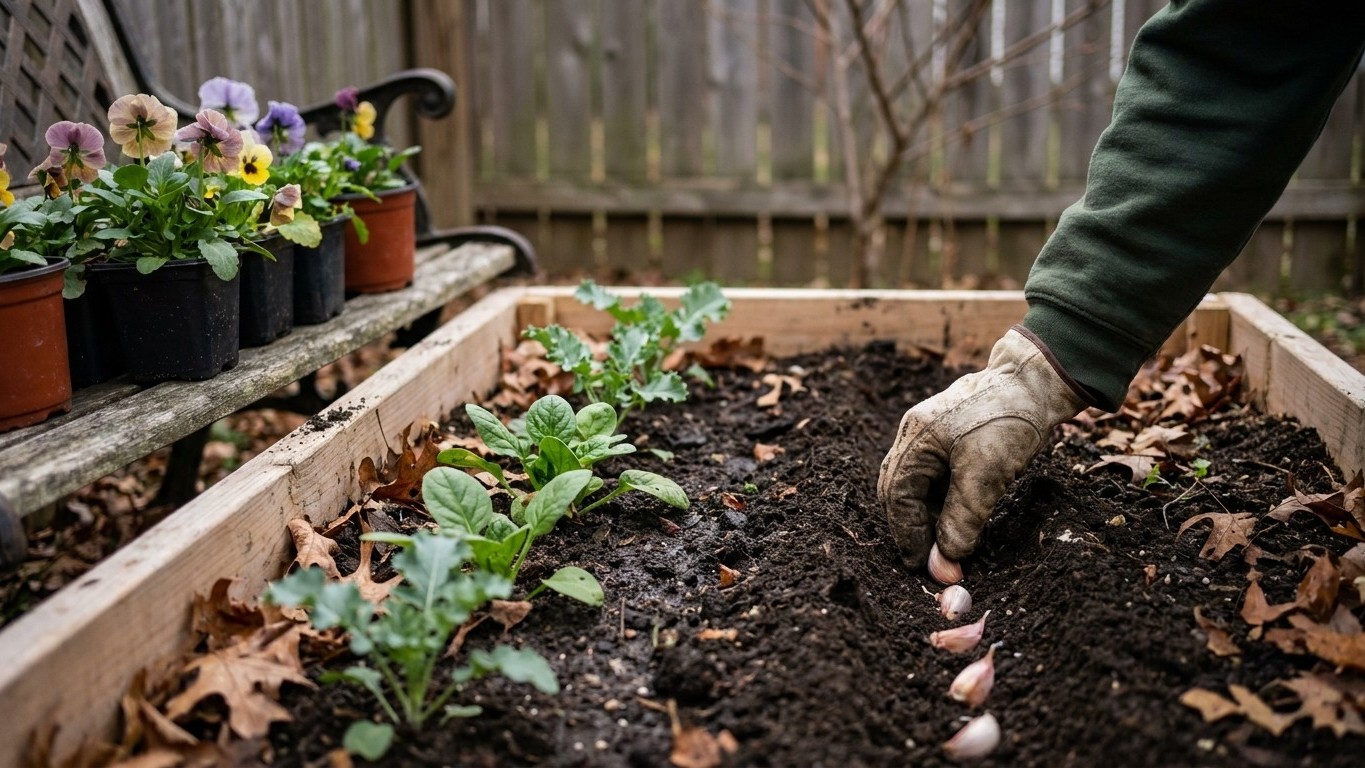

October is planting month for garlic, shallots, and spring bulbs across Wisconsin, and it’s the last real window for cover crops before the ground locks up. The first fall frost lands somewhere between October 17 and October 29 depending on where you live, so the early weeks still allow outdoor work while the back half of the month asks you to shift toward cleanup and protection.
What goes in the ground in October
The frost window, not the date on the wall, decides what’s safe this month. NOAA’s 1991-2020 climate normals put the first fall freeze for the reference station at 32°F somewhere between October 17 and October 29, and that ten-day spread already tells you the calendar alone won’t do the job. A Lake Michigan-area station sits behind that figure, which matters because the lake itself delays the first freeze at the shoreline. Inland southern Wisconsin often sees frost in early October, and the state’s far north can freeze weeks ahead of that.
Garlic and shallots are the safest bet in the ground this month. Push cloves into loosened, well-drained soil about 4 to 6 weeks before you expect the ground to lock up, root-side down, then mulch heavily once the soil starts to cool. Spring-flowering bulbs (tulips, daffodils, crocus) go in on the same logic: they need soil that’s cooled below roughly 60°F to root without pushing top growth that frost would just kill. Cover crops like winter rye or hairy vetch can still be broadcast in early October to hold soil through winter and feed it come spring.
Hardy greens are workable only with protection. Spinach, arugula, and young kale transplants can go into a cold frame or under a low tunnel and keep growing slowly even after air temperatures dip. Left uncovered, the same transplants are a gamble the frost window will win.
| Crop or planting | Outdoors, unprotected | Notes |
|---|---|---|
| Garlic, shallots | Yes | Plant 4-6 weeks before ground freeze, mulch after |
| Spring bulbs | Yes | Wait for soil below about 60°F |
| Winter rye, hairy vetch | Yes | Broadcast early in the month |
| Spinach, kale, arugula | Cold frame or tunnel only | Uncovered plants risk frost damage |
| Tomatoes, peppers, basil | No | Harvest before the frost window, don’t replant |
What to start under cover
Counting backward from the frost window, rather than forward from today’s date, is what keeps cold-frame plantings on schedule. Most quick greens (spinach, mâche, arugula) mature in 30 to 45 days. Sown in the first days of October, they can size up before the deep cold that follows the October 17-29 window really settles in. Sown a week or two later, they’re racing shortening daylight as much as temperature, and growth slows to a crawl even under cover.
Start too early, back in late summer heat, and transplants sit around getting leggy and rootbound before the cold frame is even ready for them. Start too late, past mid-month, and there isn’t enough daylight left for the plants to size up before winter dormancy sets in regardless of how well they’re insulated. The narrow, useful window sits in the first half of October for anything meant to feed you from under glass or plastic through the following weeks.
This is also the month to force spring-flowering bulbs indoors for winter bloom. Paperwhites and amaryllis potted up now, kept cool and dark for the first few weeks, will be coming into flower well before the outdoor garden wakes up. It’s a low-effort payoff for a month that otherwise runs heavy on cleanup work, and it uses windowsill space that would otherwise sit empty until spring seed-starting begins.
What is ready to pick
October is peak harvest for anything that took all summer to bulk up. Winter squash and pumpkins are ready when the stem has gone dry and corky and the skin resists a thumbnail press; pull them before a hard freeze damages the skin, since a soft spot at harvest becomes a rot problem in storage within weeks. Potatoes signal readiness when the vines have died back on their own, not when you decide it’s convenient to dig.
Brussels sprouts, kale, and other brassicas actually improve with a light frost touching the leaves, converting starches to sugars and taking the bitter edge off. That’s one case where waiting a little past the first cold snap pays off rather than costing you the crop. Carrots and beets left in the ground through a light frost do the same thing.
Anything tender needs to come off the plant before the frost window closes. Green tomatoes, peppers, and basil have no frost tolerance at all, so the last week before the expected freeze date is the deadline, not a suggestion. Basil in particular blackens at the first real touch of cold and is done for the season.
Onions and garlic from earlier in the season should already be curing; check them now for any bulb going soft at the neck, since one rotting onion in storage spreads moisture to its neighbors fast.
The jobs that matter this month
Soil testing belongs on this month’s list, not next spring’s. Fall-applied lime needs the winter months to react with the soil before planting season, so a test now, followed by amendment while the ground is still workable, actually has time to work. Waiting until spring means the correction lags behind the crop.
Cleanup and protection
Pulling and destroying diseased plant material (blighted tomato vines, powdery-mildewed squash leaves) now keeps those spores from overwintering in the bed and reinfecting next year’s plants. Healthy plant debris can go straight to the compost pile, but anything visibly diseased should leave the garden entirely. Drain and store hoses and irrigation lines before the first hard freeze cracks a fitting, and bring in any tender potted plants, tropicals, and rooted cuttings that have been living outdoors all summer.
Ordering and planning ahead
Seed catalogs for the following spring often go to press with limited quantities of popular varieties, so ordering garlic sets and spring seed early avoids the disappointment of a sold-out variety come January. This is also a natural point to sketch next season’s crop rotation while this year’s bed layout is still fresh in memory, rather than trying to reconstruct it from a photo in March.
Dormant pruning of fruit trees and canes is better held off until later in winter, once the wood is fully dormant; cutting now, while some sap may still be moving, can leave wounds slower to heal. Turning the compost pile one more time before it freezes solid, and sharpening and oiling tools before they sit unused, are both small jobs that save time come spring.
What not to do in October
A warm afternoon in early October convinces a lot of gardeners the frost risk has passed. It hasn’t. The first fall freeze can land anywhere in the October 17-29 range, and a string of mild days beforehand says nothing about the night that follows. Tender crops left out on the strength of good weather are the single most common loss this month.
Feeding lawns or perennials a high-nitrogen fertilizer now pushes soft new growth right when the plant should be hardening off for winter. That new growth is exactly what frost damages first, so any fall feeding should lean toward lower-nitrogen formulas that support root development instead of top growth.
Uncovering a cold frame or low tunnel during a mild spell and forgetting to close it back up before nightfall undoes weeks of protection in one cold night. The same goes for tender bulbs like dahlias and cannas left in the ground too long, hoping for a few more days of bloom; once a hard freeze hits the foliage, the tubers underneath are at risk within days if not lifted promptly.
Planting spring bulbs into soil that’s still warm from summer is its own mistake. Bulbs planted too early can push top growth before winter, using up energy that should go into root establishment instead. Waiting until soil temperature has actually dropped, rather than going by the date, gets better spring blooms.
Checking this against your own county
A statewide frost window is a starting point, not a forecast for any one backyard. Wisconsin’s elevation changes, the moderating effect of Lake Michigan along the shoreline, and the sharp difference between the state’s northern and southern counties can shift these dates by weeks in either direction. A garden two counties north of another can be working with a completely different calendar despite sharing a state hardiness range of 3b to 6a.
For a planting calendar built around local conditions rather than a single statewide station, the University of Wisconsin-Madison Division of Extension is the right next stop, along with county-level extension offices that track local frost data more closely than any statewide average can.
Common questions
Can I still plant vegetables in Wisconsin in October?
Garlic, shallots, and cover crops go in the ground this month, along with spring bulbs once soil has cooled. Tender vegetables are done for the season by the time the frost window arrives, and quick greens only make sense under cold-frame or low-tunnel protection.
When should I plant garlic in Wisconsin?
Aim for roughly 4 to 6 weeks before the ground is expected to freeze solid, which for most of the state falls within October. Mulch heavily right after planting to protect cloves through winter.
What USDA hardiness zone is Wisconsin in?
The USDA Plant Hardiness Zone Map places Wisconsin across zones 3b to 6a, based on average annual extreme minimum temperature. That’s a wide range across one state, so a zone number alone shouldn’t replace local frost data when timing plantings.
Do I need to cover plants before the first frost?
Anything you want to keep growing past the first freeze, mainly hardy greens, needs a cold frame or row cover in place before that first cold night, not after. Tender crops like tomatoes and basil have no frost tolerance regardless of covering, so harvesting before the frost window is the only real protection for those.