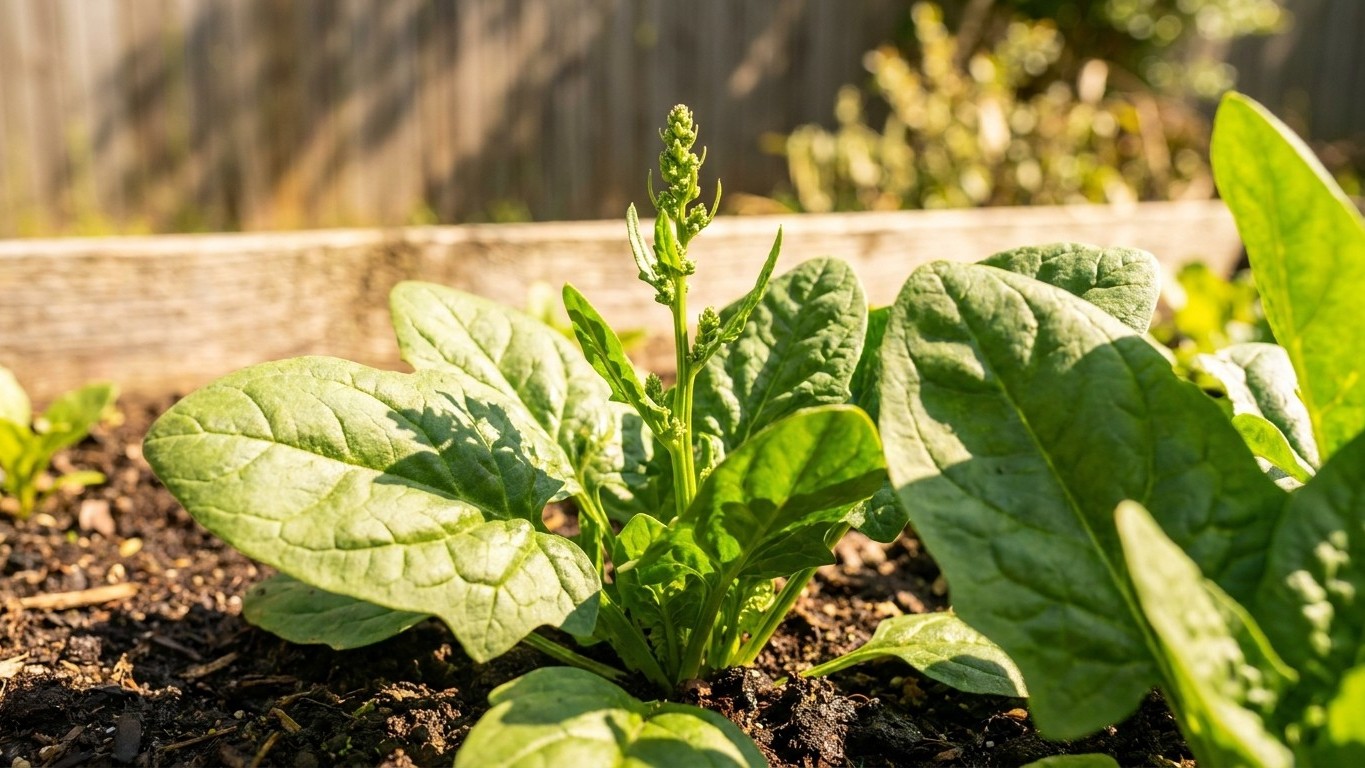

Cut spinach while the leaves are a good eating size and the center of the plant is still a flat rosette. Cutting early, in the cool part of the season, matters more than any date on the calendar. After the cut, spinach keeps for two weeks at the very most, and only in near-freezing, very humid air. A home fridge usually gives you less.
When spinach is ready in Wisconsin
The signal is a rosette of full-size leaves with the center still low and flat. Once a stalk starts rising from the middle, the good cutting is nearly over. As a rough window, spring sowings reach that stage in late spring around Milwaukee, and fall sowings until the freezes turn hard.
NOAA NCEI’s 30-year climate normals put the last 32°F freeze at Milwaukee between April 16 and April 29, and the first fall freeze between October 17 and October 29. Lake Michigan holds warmth and pushes the first freeze later along the lakeshore. Inland southern Wisconsin typically freezes in early October, and the north far earlier. Your own backyard may sit a week or two off these dates, so your county extension office can tell you how far.
How do you know spinach is ready to cut?
Look at the leaves first. They should be broad enough to wash and use, with a rosette that still sits close to the ground. Check them for chewing damage too, because ragged holes tell you something is feeding on the row (What Eats Spinach in Wisconsin, and When covers who and when). Cut in the morning while the leaves are cool and full of water. You can take the outer leaves and leave the center to keep growing, or cut the whole plant just above the soil once it starts to stretch.
Heat and day length set the deadline. Utah State University Extension says spinach grows best where temperatures do not exceed 75°F, and above that the leaves turn bitter. Milwaukee averages only 7.0 days a year at 90°F or higher, so summers are mild by national standards. That does not rescue spinach, because long days trigger flowering as well as warmth does. The longest day of the year brings 15 h 10 of daylight, so even a cool summer does not buy extra weeks. For more on that, see Will Spinach Bolt Early in Wisconsin? The spring crop has to be cut before the afternoons settle above 75°F and the days stretch toward June.
When should you sow spinach for a fall cutting?
Utah State University Extension tells fall gardeners to plant early enough before the date they want to harvest. Counting back from the October freeze dates points to sowing in late summer. Cold is not what holds the fall crop back. Warm soil is: germination drops once the soil is above 80°F, and an early August bed can still be that warm. If seed sown then fails to come up, the soil was probably too hot, so wait for it to cool and sow again. Utah State names several varieties to try, and any of them follows the same signal. For the full season plan, start with Growing Spinach in Wisconsin.
Keeping it, and for how long
The UC Davis Postharvest Technology Center gives the optimum for spinach as 0°C (32°F) with an optimum relative humidity of 95 to 98%. Its fact sheet calls spinach highly perishable and says it will not maintain good quality for more than 2 weeks. That is a ceiling reached only when conditions are close to perfect, so treat it as the longest case and not a plan.
How long does cut spinach last in the fridge?
UC Davis says wilting, yellowing of leaves and decay are likely to increase once storage runs past 10 to 14 days. At 5 to 10°C (41 to 50°F), the conditions of common distribution, the decline comes faster. A refrigerator door sits in that warmer range, and spinach left there starts yellowing within days. A good rule is to cook or eat the bunch while it is still crisp and deep green. Whatever you will not use soon can be cooked down and frozen.
Garden spinach has one advantage over a bag from the store. You know exactly when it was cut, and it has not spent days in a truck or on a shelf. Its clock starts when you take the knife to it. Cool it quickly after cutting and do not leave a full basket sitting in the sun, since every hour in warm air uses up part of that two-week ceiling.
Why does humidity matter as much as temperature?
A spinach leaf is thin and broad, and it gives up water fast into dry air. Air at 95 to 98% humidity is close to saturated, so the leaf loses very little. The ordinary fridge is much drier than that, which is why unwrapped spinach goes limp in a day or two even when it is cold enough. Cold and moisture have to work together. Cold air in a dry compartment wilts leaves, and humid air at room temperature rots them.
Spinach that has already wilted, yellowed or turned slimy will not recover in storage. Sort the bunch when you bring it in and pull out any leaf that is damaged. A single decaying leaf can spoil the ones around it, and that is often what ends a bag early.
Where in the house that actually is
A domestic fridge runs warmer than 32°F, and the door runs warmer still because it swings open all day. The closest match to the ideal is the back of the lower shelves, where the coldest air settles. The crisper drawer, kept closed, adds some humidity. A cheap fridge thermometer set on the shelf where the spinach will sit tells you more than the dial does. The door shelves are the worst place for a bunch of greens.
How do you store spinach in a home fridge?
The goal is to copy that near-saturated air with a bag, a damp wrap or water under the cut ends. Loosely wrap the dry, unwashed leaves in a slightly damp towel and slide the bundle into a bag that is not sealed tight. Or stand the bunch with its cut ends in an inch of water, as you would hold flowers, and set a loose bag over the leaves. Either way the leaves stay moist without sitting in a puddle. Standing water around the leaves invites decay, so drain or change it if it turns cloudy.
Put the bag at the back of the bottom shelf, away from the door, because spinach left in the door will be yellowing in days. If a leaf touches the back wall and freezes, move the bag forward a little. Check the bunch every couple of days and pull any leaf that has gone slick or yellow.
Common questions
Can you cut spinach more than once?
Yes, until the plant bolts. Take the outer leaves and leave the center growing, and the plant keeps producing new ones. Once a stalk rises from the middle, the leaves turn bitter and the plant is done. Pull it and use the space for something else.
Is bolted spinach safe to eat?
It is safe, but it is rarely pleasant. Heat above 75°F and long days push the plant to flower, and the leaves taste bitter by then. Cooking softens that a little. Most gardeners pull bolted plants and plant a fall crop instead.
Why won’t August-sown spinach come up?
Warm soil is the usual cause. Germination drops when soil temperature is above 80°F, and early August beds can stay that warm even after nights start cooling. Water the bed, wait for the soil to cool, and sow again. Counting back from the freeze dates still leaves room for a second try.
Can you cut spinach after the first fall frost?
Yes, if the leaves look healthy. The first 32°F freeze at Milwaukee lands between October 17 and October 29, later at the lakeshore and much earlier in the north. Leave frozen leaves alone until they thaw, because they bruise easily when stiff. Once thawed and still green and firm, they are fine to cut, though the plants will grow slowly through late fall.