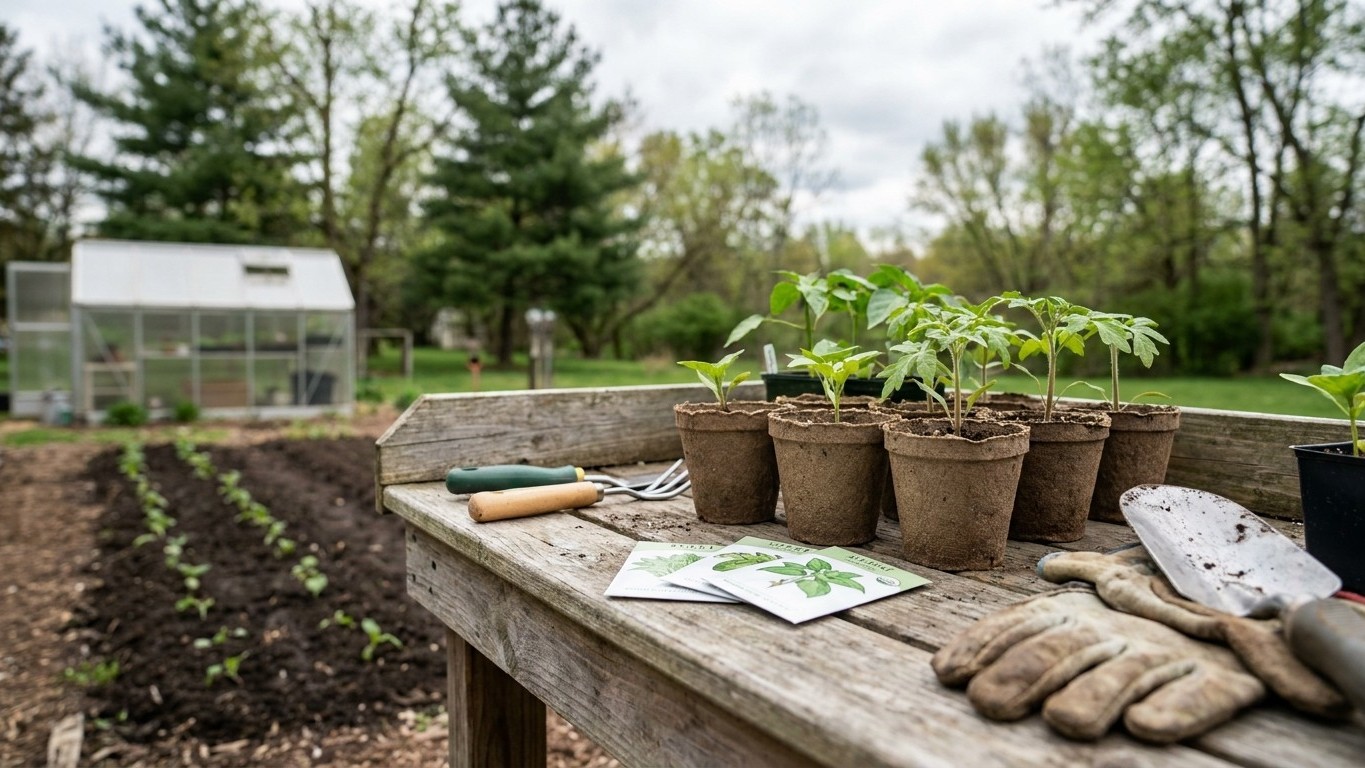

In Yukon, April sits roughly two months ahead of the average last spring frost, so the honest answer is that almost nothing goes into open ground yet. The work that matters this month happens indoors and under cover: starting seedlings on a schedule counted back from frost, prepping soil and tools, and getting a jump on the short season before it arrives.
What goes in the ground in April
The average last spring frost for the Whitehorse area is June 5, according to Environment and Climate Change Canada’s 1981-2010 climate normals for the WHITEHORSE A station. That date is a mean, not a guarantee: in roughly half of all years, frost arrives later than June 5, so treat it as the midpoint of a window rather than a safe planting cutoff. April sits a full six to eight weeks ahead of that midpoint, and in most of Yukon the ground is still frozen solid or locked under snow cover through much of the month.
That makes the direct answer for open-ground planting in April simple: nothing. No seed, bulb, or transplant belongs in unprotected soil yet, no matter how mild a warm afternoon feels. Soil temperature, not air temperature, decides when planting is safe, and frozen or waterlogged ground in early spring will rot seed and stall roots long before frost is even the main risk.
What is possible is anything that works with cover or dormancy rather than against it. A cold frame or low tunnel set over a raised bed can warm soil enough to start hardy greens like spinach or arugula a few weeks ahead of open-ground timing, provided the bed itself has thawed and drains. Gardeners who missed a fall garlic planting can sometimes still tuck cloves in once the ground is workable, though a spring-planted crop will size up smaller than a fall-planted one. Forcing rhubarb crowns or chicory roots indoors, in a dark, cool space, gives an early harvest without touching the garden at all. None of this replaces direct sowing, but it keeps hands busy and gives something to show for the month while the ground itself stays off limits.
What to start under cover
Seed-starting math works backward from the frost window, not forward from the calendar. Using the June 5 average last frost as the reference point, slow growers like onions and leeks want roughly ten to twelve weeks under lights before they go outside, which puts their start date in mid-March. Tomatoes and other warm-season crops that need six to eight weeks of indoor growth land their start squarely in April. Brassicas such as cabbage and broccoli, also on a six-to-eight-week clock, fit the same window.
Because the June 5 date is a mean and not a promise, it pays to build in slack rather than race to the earliest possible start. Two mistakes show up every season. The first is starting too early: a tomato seedling begun in February or early March, with June 5 sitting weeks away and no clear end to a cold spring in sight, ends up rootbound and leggy on a windowsill long before it is safe to move outside. The second is starting too late, sowing warm-season seed in May and expecting a full harvest before the average first fall frost on August 25, which leaves barely eleven to twelve weeks of growing season even in a normal year.
April splits the difference for most warm-season crops and brassicas. Pot up anything started in March that has outgrown its cell, keep lights close to prevent stretching, and hold off hardening off outdoors until daytime temperatures are reliably above freezing, not just on a single mild afternoon.
What is ready to pick
Outdoors, April in Yukon offers little to nothing fresh. Snow cover and frozen ground rule out any garden harvest, and even a mild stretch of weather does not change the calculus while soil sits weeks from thaw. That is the honest picture, and no amount of covering or coaxing turns it into a harvest month.
What still feeds a household this time of year comes from indoors and from storage. Sprouts and microgreens grown on a countertop, from mung beans, broccoli, or sunflower seed, take a week or less from seed to plate and give fresh greens with zero garden dependency. A cold frame that was seeded in late winter may be yielding its first thinnings of spinach or mesclun by late April in a mild spring, though this depends heavily on how much sun the frame gets and how well it is insulated.
Storage crops need a check-in now more than almost any other month. Squash, potatoes, and onions put by in fall have been sitting for months, and April is when soft spots, sprouting, and mold start to show up in earnest. Go through the bins: pull anything with a soft or sunken patch before it spreads, separate sprouting potatoes for immediate use, and toss onions that have gone soft at the neck. A single rotting squash left in a box of good ones will take the others down with it faster than most gardeners expect.
The jobs that matter this month
April is a working month even though the garden itself stays closed. Dormant pruning of fruit trees and berry canes should wrap up before buds swell, since cuts made once new growth starts cost the plant more energy and heal more slowly. Currants, haskap, and any hardy fruiting shrub grown in Yukon gardens benefit from this last pruning window while branches are still bare and easy to see.
Seed ordering has a real deadline too, even if it feels informal. Popular short-season varieties bred for northern gardens sell out earlier every year, and a gardener who waits until May to order is choosing from what is left, not what is best. Pairing that order with a written plan for crop rotation, so the same bed does not grow the same family two years running, takes an hour now and prevents disease buildup later.
Soil work belongs in April as well. Once beds are workable, testing pH and nutrient levels gives time to amend before planting rather than reacting mid-season. Turning a compost pile that has sat frozen all winter kickstarts the breakdown that will produce usable compost by the time beds are ready. Tools deserve the same attention: a dull hoe or pruner does more damage to plants than a sharp one, and cleaning rust and sap off blades now beats doing it in a rush later.
Raised beds, cold frames, and fencing all take a beating over a northern winter. Walk the garden and check for frost heave, warped boards, and gaps in fencing that let deer or hares in once green growth appears. Small repairs done now, while there is nothing growing to work around, are far easier than patching a bed that already has seedlings in it.
What not to do in April
The most common mistake this month is trusting air temperature over soil temperature. A string of 50-degree days can feel like spring, but soil that is still frozen a few inches down, or saturated from snowmelt, will rot seed and stunt roots regardless of how warm the air feels on a given afternoon. Wait for the ground itself to thaw and drain, not for a comfortable jacket-weather forecast.
A related error is uncovering cold frames, mulch, or protected beds too early after a mild spell, only to have them exposed when a cold snap returns. Yukon springs are uneven, and a week of thaw does not mean winter is finished. Keep protective covers in place and vent them on warm days rather than removing them outright.
Fertilizing at the wrong point in the season causes its own damage. Applying a heavy dose of nitrogen to dormant perennials or bare beds in April pushes soft, premature growth that has nowhere safe to go if a hard frost follows. Hold nitrogen-heavy feeding until plants are actively growing and the frost risk has genuinely dropped, and lean on soil testing rather than guesswork to decide what a bed actually needs.
Finally, resist moving tender seedlings outside for a “test day” in the sun without a proper hardening-off period. A few hours of direct wind and cold-radiating soil can set back or kill a seedling that looked strong indoors.
Checking this against your own county
A territory-wide average hides a lot of local variation. The June 5 and August 25 frost averages come from the WHITEHORSE A station, and Yukon’s elevation changes, valley cold pockets, and the difference between southern lakeside communities and northern or upland districts can shift real planting windows by weeks in either direction. The Canadian hardiness zone for Whitehorse, 1b under Natural Resources Canada’s system, reflects seven climate variables specific to that location and does not translate to a USDA zone or apply evenly across the territory.
For local nuance, consult Agriculture and Agri-Food Canada and cross-check against community-specific frost records where available.
Common questions
Is it too early to plant a vegetable garden in Yukon in April?
Yes, for open ground. The average last frost is June 5, and April sits weeks ahead of that midpoint with soil still frozen or thawing in most areas. Indoor seed starting and cold-frame work are the realistic options this month.
Can I plant garlic in Yukon in April?
Only once the ground has thawed and is workable, and only if fall planting was missed. Spring-planted garlic generally produces smaller bulbs than garlic planted the previous fall, since it misses the root development that happens over winter.
What Canadian hardiness zone is Whitehorse?
Whitehorse sits in Canadian hardiness zone 1b, based on Natural Resources Canada’s seven-variable system using 1991-2020 normals. This is not a USDA zone and cannot be directly converted to one.
When should I start tomato seeds indoors for a Yukon garden?
Counting back six to eight weeks from the average last frost of June 5 puts the start date in April. Because that frost date is a mean, not a guarantee, hardening off should wait until soil and air conditions are reliably warm rather than following the calendar alone.