
What eats garlic in Yukon depends on where the damage starts: down in the soil on roots and cloves, up on the leaves, or on the bulb late in the cycle. Garlic goes in the ground in autumn and comes out the following summer, so a pest gets two chances at it, once before the ground freezes and once while the shoots grow. At Whitehorse the average first fall frost, August 25, closes the second chance.
Which pests attack garlic in Yukon
Agriculture and Agri-Food Canada, the federal department that stands behind Yukon growers’ questions, is the service to ask for a species-by-species list. A short season and long, cold winters tend to keep that list shorter in the far north than in the Lower 48. Rather than memorizing insect names, sort by where on the plant the trouble starts, because that is what you can see from the garden path.
Set aside what does not belong. Pests of trees, shrubs, orchard fruit and field grain turn up in plant-health lists for the territory, but they feed on tissue that garlic does not offer. If a description mentions bark, buds or fruit, it is about something else.
Which pests feed in the soil?
Soil feeders work on the cloves and roots after planting and again when growth restarts under thawing ground. They are the hardest group to catch, since the first sign is often a missing plant. A clove that never sent up a shoot, or a shoot that tips over and pulls out easily, points you down there. Autumn-planted cloves sit in the soil for months, which gives anything that tunnels or chews time to find them.
Which pests feed on the leaves?
Leaf feeders act only while the plant is green. In Yukon that window opens when shoots break through in spring and shuts as summer ends. Whitehorse’s average first fall frost is August 25, a midpoint: in one year out of two the first frost arrives earlier. The reading comes from the Whitehorse A station (1981-2010 normals from Environment and Climate Change Canada), and districts farther north or at higher elevation can run weeks behind it. Leaf damage therefore has a short season to happen in.
What about animals that dig?
Animals that dig up beds belong on the list too, even though they are not insects. They go after freshly planted cloves in fall, when the soil is loose and smells of turned earth. Torn-open soil with cloves scattered or gone is the usual giveaway.
When each one shows up, and what it does first
The calendar for garlic runs backward from the freeze. Cloves go in during autumn, early enough for roots to start before the ground locks up. The symptom you notice first depends on the season you are standing in.
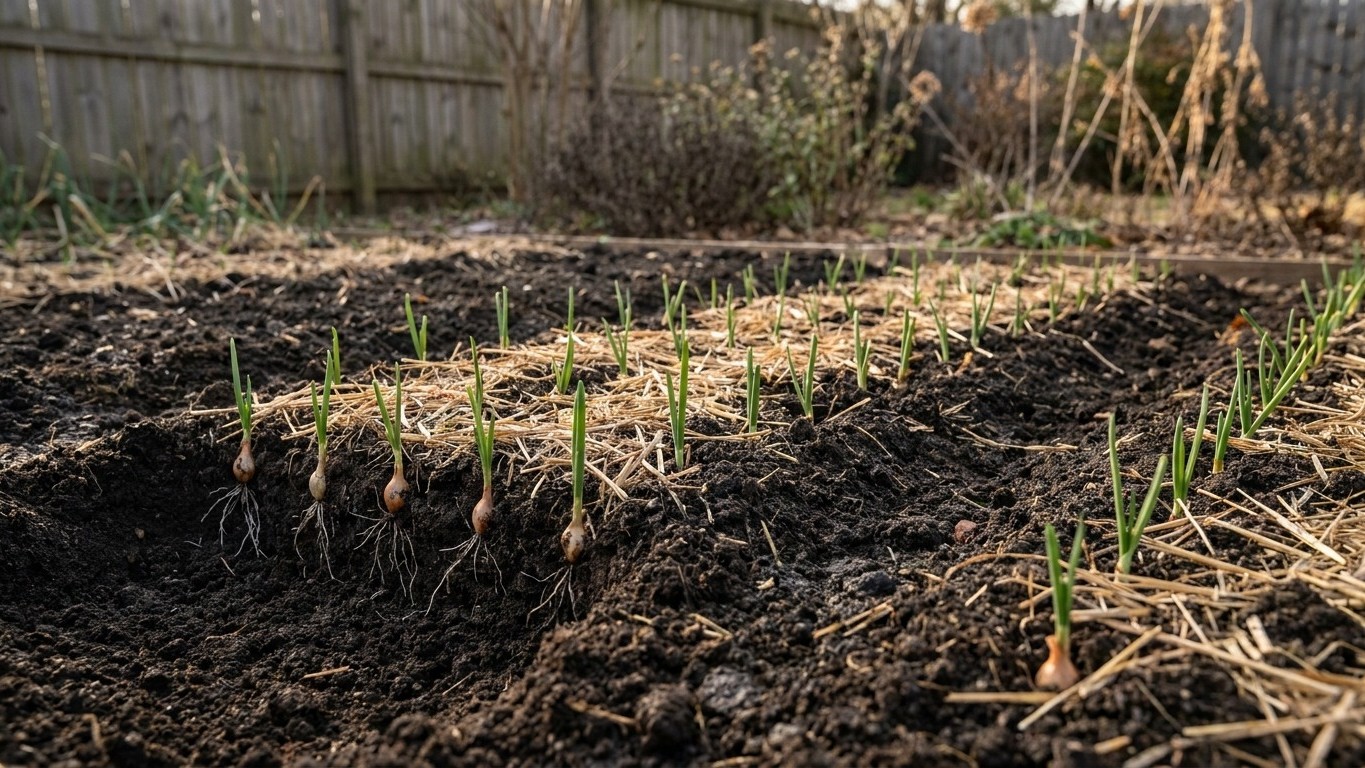
Right after planting, the soil feeders and diggers get their first chance. What you see is disturbance: cloves pushed up to the surface, small holes, or a patch of earth that looks raked over. Bare cloves are also exposed to frost heaving, so check the bed after the first hard freeze and again after the first thaws. Push anything that has surfaced back to its proper depth and cover it.
Spring is the second window. As the snow leaves and the soil warms, soil feeders show up as gaps in the row. A clove that never came up can be winter damage, rot or something feeding underground. Dig one and look before you decide. A gnawed or hollowed clove tells a different story than a soft, discolored one.
Once the leaves are up, leaf feeders take over. What you see first is a leaf with ragged edges, small holes, silvery scrapes or twisted new growth, and often the culprit is hiding at the base of the plant. Look under leaves and down in the crown at dusk or early morning, when many chewing and sucking pests are active. Leaf damage matters most in the early weeks, while the plant is building the leaves that feed the bulb.
Late in the cycle, as garlic nears lifting the following summer, the bulb itself becomes the concern. Pests that work underground show up as tunnels or rough, scarred areas on the bulb wrapper. Leaving bulbs in wet ground past maturity gives anything feeding or rotting down there more time, and a short northern season does not leave much slack. Our When to Plant Garlic in Yukon: Counting Back From the First Frost lays out how to time autumn planting so roots are set before the freeze.
Telling the damage apart from everything else
Plenty of garlic problems that look like insect damage turn out to be weather, water or soil. A yellow tip in spring can come from cold snaps, saturated ground or hungry soil. The quickest habit to build is to check the plant below the surface before blaming anything above it.
| What you see | Possible causes | What settles it |
|---|---|---|
| Gaps in the row in spring | Winter kill, frost heaving, rot, feeding in the soil, digging animals | Dig one clove. Gnaw marks or tunnels point to feeding; a soft, discolored clove points to rot; a clove lifted to the surface points to heaving |
| Yellow leaf tips after emergence | Cold injury, waterlogged soil, nutrient shortage, pests on the roots | Check whether the pattern follows low spots in the bed, and look at the roots. Healthy roots are firm and pale |
| Ragged edges, holes or scraped patches on leaves | Chewing or scraping pests, wind or hail damage | Look for the pest at the base of the plant at dawn or dusk. Wind and hail damage cuts across many leaves at one height |
| Soft bulbs, fuzzy growth or bad smell at lifting | Disease, with or without a pest entry point | Cut the bulb open. Tunnels point to a pest; uniform softness and mold point to disease |
The rule that does the most work is simple. Dig up one affected plant before you treat or replace anything, and look at the roots, the base of the bulb and the cloves. A symptom above ground can have five causes, and the underside usually narrows it to one or two. If still unsure, take one plant and a few clear photos to the agriculture contacts listed in the last section.
What actually works here, and what is a waste of time
In a short northern season, timing and physical barriers do more than any product. The most dependable step is getting cloves in early enough that roots establish before the freeze. A plant that goes into winter with roots already working is stronger in spring, when feeders are most likely to find it. The Yukon planting calendar covers how to count back from the frost; keep in mind that the August 25 average is a midpoint.
Physical barriers come next. A layer of mulch over the bed after the ground freezes limits heaving and keeps the soil from swinging between thaw and refreeze. Fine wire mesh laid over the bed in fall stops animals from digging, and it can come off as shoots push up in spring. Floating row cover over young leaves keeps flying and crawling pests off, but only if it goes on before damage starts and its edges are buried or weighted down.
Clean planting stock matters just as much. Start with cloves from a reliable local or regional grower and choose a variety suited to northern winters; the Garlic Varieties That Suit Yukon Winters guide helps with that. Rotate the bed so garlic or other alliums do not return to the same soil year after year, and clear old leaves and bulb scraps at lifting, since leftovers give pests and disease a place to wait out the winter.
Several common habits do little. Spraying at the first yellow tip wastes effort when the cause is cold or wet soil, and it can harm useful insects. Homemade mixtures and folk remedies have no reliable track record on garlic. Planting grocery-store bulbs of unknown origin brings in whatever they carry. What is approved for use on garlic is set by regulation, so ask the agriculture office before reaching for any treatment.
Where to check this for your own county
Agriculture and Agri-Food Canada is the place to start. Yukon is organized by communities and districts rather than counties, so there is no county office to visit. The department can point you to the territorial agriculture contacts who handle plant-health questions from growers.
What is documented for the whole territory does not tell you what is in your garden. Pest presence can vary from one valley to the next, and with elevation, soil type, snow cover and how close you are to wild ground where animals den. The Whitehorse frost reading describes one station, and a garden in a colder pocket may see frost weeks earlier.
When you contact them, bring a photo of the damage, a description of when it started, and whether the planting went in during autumn. For a good sample, dig up the whole plant with roots and soil attached, and keep it in a bag out of the sun. For a broader look at the crop, Growing Garlic in Yukon covers the full cycle from planting to lifting.
Common questions
Do pests bother garlic less in Yukon than in warmer places?
Cold winters and a short growing season usually limit how many pest generations can build up, so problems tend to be milder than in the Lower 48. That is a general pattern, not a promise for any one garden, so check with the agriculture contacts for your district.
When is garlic most at risk from pests?
Two windows matter: right after autumn planting, when cloves are exposed in loose soil, and spring emergence, when shoots are tender. Leaf damage is possible only while the plant is green, which ends around the first fall frost, August 25 on average at Whitehorse.
How can I tell insect damage from cold damage?
Cold injury tends to show as yellow or browned tips across many plants at once, often after a hard freeze. Pest damage is usually uneven, with holes, scrapes or tunnels on some plants and not others. Digging up one plant to check the roots and cloves is the most reliable test.
Should I spray garlic when I see damage?
Not before you know the cause. Many symptoms come from weather, water or soil, and spraying does nothing for those. What may be used on garlic depends on what is approved where you live, so ask Agriculture and Agri-Food Canada or the territorial agriculture contacts first.