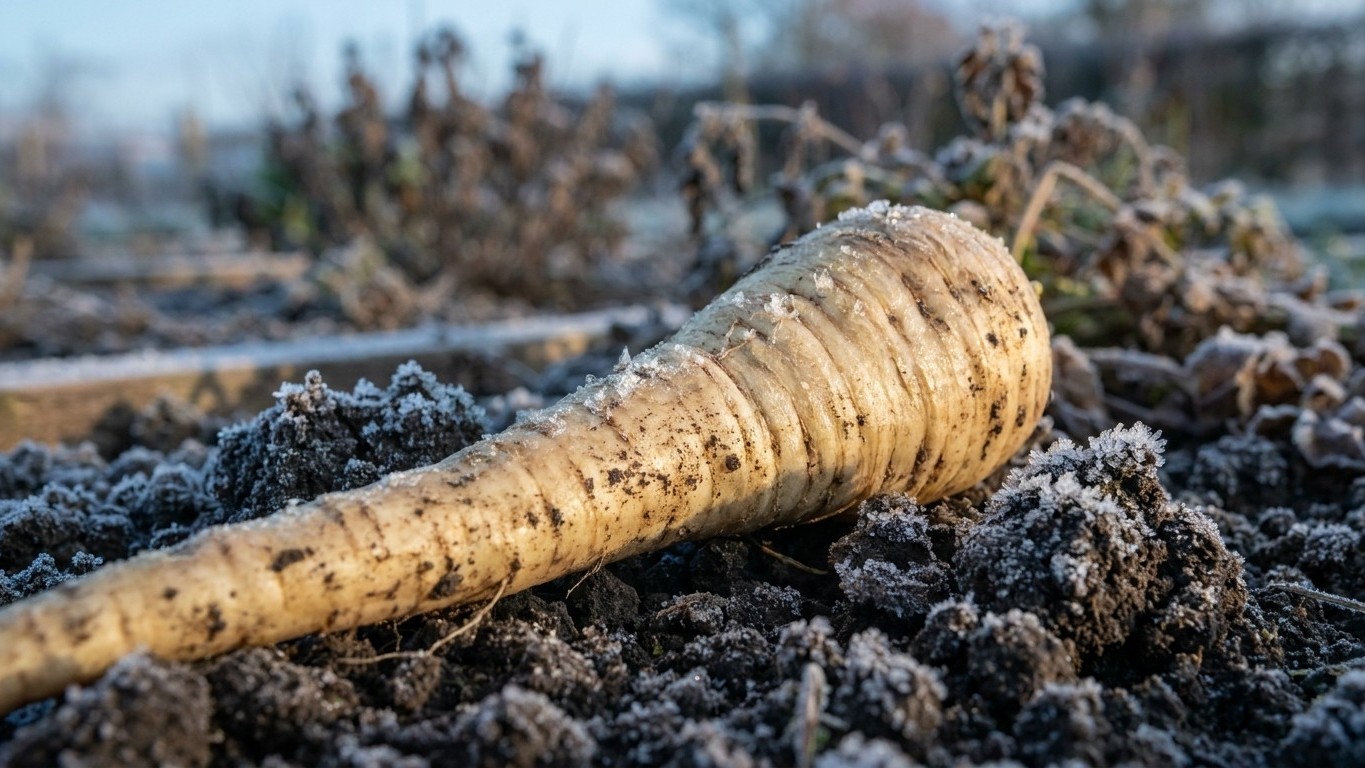

Lift Yukon parsnips in fall, after several weeks of frost and before the ground locks up. The cold is what turns stored starch into sugar, and the territory supplies plenty of it. Held at 0 to 1 °C and 98% humidity, away from apples and other ripening fruit, the roots keep for four to six months. Few kitchens or cellars hold those conditions steady, so expect somewhat less. The sections below cover what spoils a stored root first.
The short answer
The question that decides everything for this crop is whether the territory delivers several frosty weeks. It does. The mean daily minimum of the coldest month at the Whitehorse reference station is -19.2 °C (Environment and Climate Change Canada). A parsnip grown here will sweeten as well as grow, provided it reaches a decent size before the ground freezes.
Utah State University Extension puts it plainly: parsnips taste best after several weeks of cool, frosty weather, which converts stored starch to sugar. What counts is frost exposure, the number of cold weeks the root sits through before you dig it. A hardiness zone number describes how cold winters get. It does not tell you how many frosty weeks a root has had by the time you lift it. A root pulled in a warm early September is starchy and bland wherever it grew. The full mechanism is covered in Will Parsnips Sweeten in Yukon?
When should you lift parsnips in Yukon?
Wait until the tops have been knocked back by frost and the roots have sat through several weeks of cold. In most years that means late September into October. Then dig before the soil freezes hard enough to fight the fork. The reference station’s mean first fall frost is August 25, which is a midpoint. In one year out of two, the first frost arrives earlier. Northern and upland districts run weeks behind Whitehorse, so watch your own garden. Pull one root, wash it, and taste it. If it is still starchy, leave the rest another week or two.
How long do parsnips keep after lifting?
USDA Agricultural Handbook 66 gives four to six months at 0 to 1 °C (32 to 34 °F) with 98% relative humidity (USDA Agricultural Handbook 66). That is a long keeper by any standard. It assumes the temperature and humidity stay steady the whole time, which almost no house manages. A cold cellar or an unheated room that stays just above freezing gets closest.
Cold does not hurt a parsnip, because the root is not chilling sensitive. The failure is ethylene. Parsnips give off almost none themselves, but the handbook reports that low levels of ethylene in cold storage cause bitterness, likely through a buildup of xanthotoxin. Store them away from apples, pears and any ripening fruit, even when the temperature is right. Top the roots after harvest, but do not trim into the crown.
Does the season fit?
Parsnips are sown in place, so the 100 to 120 days to maturity run from seeding. The reference station’s mean last spring frost is June 5 and its mean first fall frost is August 25, so the crop does not finish inside the frost-free window. It finishes inside the cool fall. The steps below show how that plays out. They are written for the main guide, Growing Parsnips in Yukon, and for anyone deciding whether to bother.
- Sow two to three weeks before the mean last spring frost. With June 5 as the midpoint, that means about mid-May to the end of the month, as soon as the soil can be worked. June 5 is the middle of a window. In one year out of two the last frost falls later, and colder districts sit weeks behind Whitehorse.
- Expect bare soil for two to three weeks. Germination takes time, so check the seedbed before assuming failure. A row that shows nothing by the end of May is normal, and digging it up to re-sow wastes the best weeks of the season. Mark the row so you can find it.
- Count 100 to 120 days from seeding. A mid-May sowing reaches maturity around late August. A late-May sowing at the slow end runs to roughly the third week of September.
- Compare that with the first fall frost. The mean first fall frost, August 25, lands at or before the finish line. The season fits tightly. Mature roots arrive just as the frost begins, and the cold that sweetens them starts while they are still sizing up.
A tight fit is workable for this crop because the root tolerates the cold. Early sowing is the one lever you control. Every week lost to a cold spring or a late seedbed shortens the time the roots have to size up before the ground freezes.
What goes wrong here
Most failures come from soil, water and timing. Pests can also scar roots, which is covered in What Eats Parsnip in Yukon, and When. Here is what the soil and climate cause, with the remedy for each.
- Forked roots from heavy or stony ground. A root that meets a stone or a layer of clay splits or twists around it. Parsnips want deep, sandy soil, and Utah State University Extension says heavy soil must be double dug. Dig the bed deep, take out stones, and break up compaction before you sow.
- Forked roots from overwatering. This is a separate cause and a separate fix. Keep the seedbed evenly moist until the seedlings are up, then water only when the soil a finger-depth down is dry. Constant soaking in good soil can still produce forked, misshapen roots.
- A season that runs out. A late sowing or a cold spring leaves little time before the ground freezes. Sow as early as the soil allows, and do not mistake the slow start of bare soil for failure. If roots are small in fall, leave them in for more frost. Small, sweet roots are still worth eating.
- Roots lifted too early. With a coldest-month mean minimum of -19.2 °C, Yukon winters are cold enough to sweeten a parsnip. The risk is digging before the roots have had several frosty weeks. Early lifting gives starchy roots, so taste a test root first.
- Ground frozen before the dig. Once the soil locks up, lifting damages roots and tools. Lift before that point, or mulch deeply so you can dig later.
- Bitter roots in storage. Ethylene from nearby apples or ripening fruit turns stored parsnips bitter even at the right temperature. Keep them apart, and leave the crown intact when you top them.
Common questions
How can I tell when parsnips are ready to lift?
Look for tops that frost has blackened or flattened, and give the roots several weeks of cold after that. Then pull one root, wash it, and taste it. A sweet, nutty flavor means the sugars have built up. A starchy one means wait.
Can parsnips stay in the ground over winter?
The root tolerates the cold. The trouble is that frozen ground makes it hard to lift them. If you want to leave some in, mulch heavily so the bed stays diggable, and lift them as soon as the soil thaws in spring, before new top growth starts.
Is the four-to-six-month storage figure realistic at home?
It is the figure for 0 to 1 °C at 98% humidity, held steady. A cold cellar, an unheated room just above freezing, or a fridge gets part of the way. Plan on a shorter keeping time and check the roots now and then. Remove any that go soft, and keep them away from fruit.
Do I need a certain hardiness zone for sweet parsnips?
No. Sweetness depends on how many frosty weeks the root sits through before you dig it. Whitehorse averages -19.2 °C for the daily minimum of its coldest month, which delivers frost in quantity. The practical limit in Yukon is whether the roots reach size before the ground freezes.