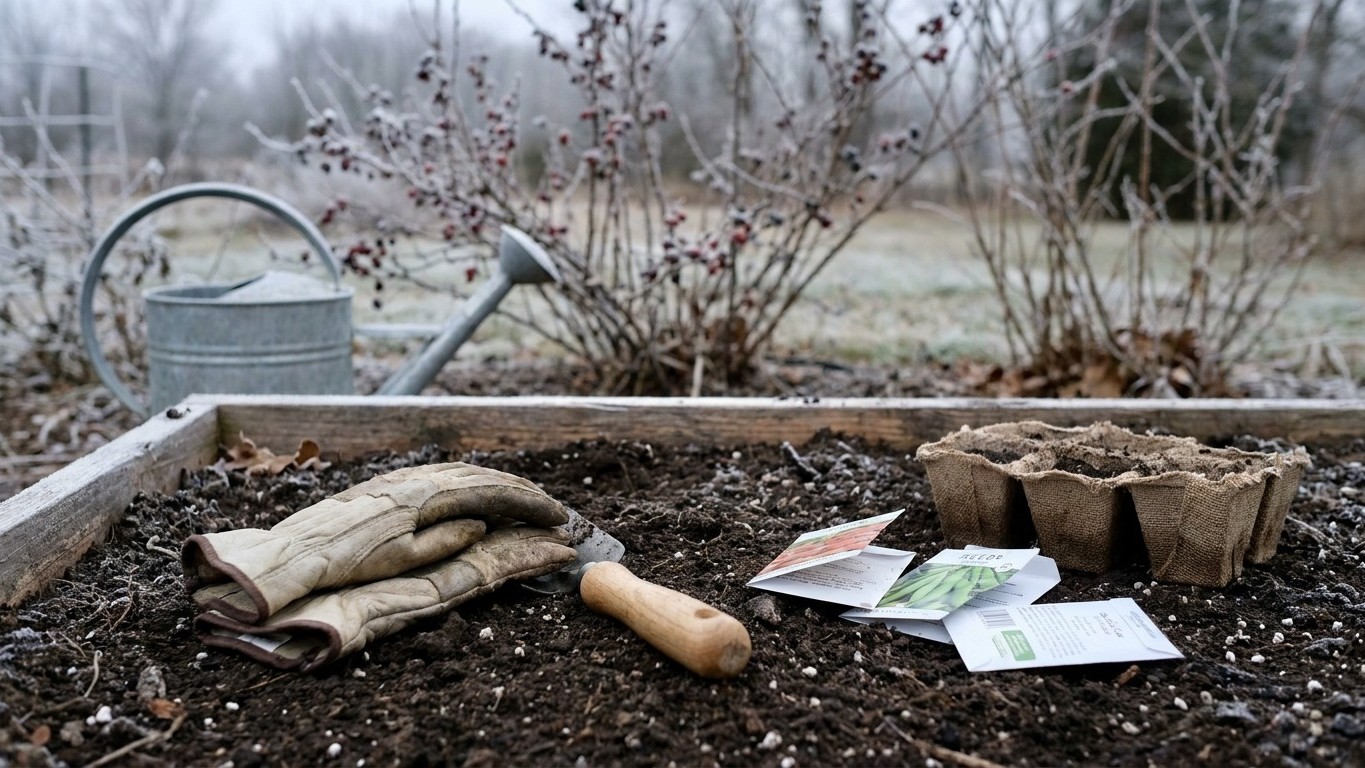

February in Yukon means frozen ground, short daylight, and a growing season that hasn’t started yet. Nothing goes into open soil this month. What you can do: start slow-growing alliums indoors under lights, order seed before short-season varieties sell out, prune dormant hardy shrubs, and get a jump on the planning that a growing season this compressed demands.
What goes in the ground in February
The honest answer is nothing. Whitehorse sits in Canadian hardiness zone 1b, and February is deep winter across the territory: soil is frozen solid, often under a foot or more of snow, and air temperatures stay well below anything a seed or transplant could survive. There is no cold-frame trick or row-cover workaround that changes frozen ground into workable ground. Garlic and shallots, which in milder climates might still go in during a late-winter thaw, are already in the soil from the previous fall here, or they are waiting in storage for spring.
The frost data underlines how tight the window really is. The average last spring frost at the Whitehorse A station is June 5, and the average first fall frost is August 25, a frost-free stretch of roughly eleven weeks. Those are means, not guarantees: in one year out of two, the last frost actually lands later than June 5. Treat that date as the midpoint of a range, never as a line you can plan around with confidence, and remember that a single station reading doesn’t speak for the whole territory. Elevation, valley cold pockets, and distance from the Whitehorse basin all push real dates around.
So what actually happens in a Yukon garden this month? Indoors: forcing rhubarb crowns or chicory roots in a dark, cool spot is one of the few “harvests” available before spring, and it works because those plants are dormant and store enough energy to push new growth without soil warmth. Bare-root fruit stock and dormant perennials, if you’re planning to plant them once the ground opens, get ordered now rather than planted now, nurseries serving zone 1b growers move fast on their short-season stock, and by the time the ground thaws the best bare-root selections are often gone. Anyone tempted to uncover a cold frame on a mild afternoon should resist: the soil underneath is still frozen, and opening it just lets more cold in.
What to start under cover
The arithmetic here starts from the frost window, not from the date on the calendar. Onions and leeks are slow growers that typically need 10 to 12 weeks indoors before they’re ready to go outside. Counting back from the average last frost of June 5, that puts the ideal start window somewhere in mid-to-late March for most growers. Starting in February, then, is running 5 to 6 weeks ahead of that math for most gardeners, which mostly makes sense for celery and the slowest allium varieties, or for anyone growing in a heated greenhouse where extra weeks under lights, with potting up along the way, don’t turn into a liability the way they would on a windowsill.
Peppers and tomatoes are a different story. They need roughly 8 to 10 weeks indoors before transplanting, which lines up with a start date closer to early April for a June transplant target. Starting them now, in February, sets up the first classic failure of the season: four extra weeks on a windowsill turns a healthy seedling into a leggy, rootbound plant that struggles to recover once it finally goes into the garden or a greenhouse bed.
The second failure mode runs the other way. Given an eleven-week average frost-free stretch between June 5 and August 25, anything started too late simply runs out of season before it can mature, there’s no cushion to make up lost time. That’s the balance every Yukon seed-starting schedule has to hold: early enough to use the short season fully, late enough that transplants aren’t already exhausted before they ever see garden soil. Slow-growing alliums and celery are reasonable February starts under lights; tomatoes, peppers, and other warm-season crops are not, no matter how tempting the empty windowsill looks.
What is ready to pick
Outdoors, nothing. The ground is frozen and buried under snow, and there is no cold-frame green or overwintered kale leaf to pull in a Yukon February the way a milder province might manage. Anyone growing in an unheated structure should not expect fresh growth this month; the honest picture is that outdoor and cold-frame harvests wait for spring.
What still feeds the household comes from two places: the root cellar and the kitchen counter. Stored potatoes, carrots, squash, and onions need a check this month, because February is often when the first soft spots and sprouting show up after months in storage. Squash in particular develops sunken, discolored patches near the stem end as it starts to turn, pull those out and use them before the spot spreads to the rest of the harvest. Onions that have started sprouting green shoots are still edible but won’t keep much longer and are worth moving to the front of the meal plan.
Indoors, sprouts and microgreens are the closest thing to a fresh harvest available this month. A tray of pea shoots or radish microgreens on a windowsill takes one to two weeks from seed to harvest, and it’s a reliable way to get something green on the table while the garden itself stays dormant. It’s a small habit, but for a territory where fresh outdoor produce is still months away, it matters more than it would somewhere with a longer season.
The jobs that matter this month
Dormant pruning tops the list for anyone growing hardy fruiting shrubs like currants, haskap, or saskatoons. Pruning while the plant is fully dormant, before any sap movement begins, reduces stress on the plant and makes it far easier to see the branch structure without leaves in the way. Wait until active growth starts and every cut costs the plant energy it should be spending on new shoots instead of healing wounds.
Seed ordering has a real deadline attached to it, even if it doesn’t feel that way in February. Short-season varieties bred to mature within a Yukon-length growing window are a narrow category, and the seed companies that carry them tend to sell out of the best-performing options well before spring. Ordering now, rather than waiting for a warm afternoon to remind you, is the difference between getting the variety that actually finishes before the average August 25 frost and settling for whatever’s left.
Soil testing and amending can happen now too, at least in the planning sense: pull a sample where the ground is workable near a building foundation or send off a bagged sample, and use the results to plan what goes where once planting starts. Turning a compost pile is worth doing wherever there are still thawed pockets, since a completely frozen pile isn’t decomposing anyway and doesn’t need attention until it softens. Tool maintenance, meanwhile, is pure upside: cleaning rust off blades and sharpening pruners now means no delay once the ground opens and every week of the short season counts.
Bed and fence repairs are easier now than they’ll ever be later. With no crops in the ground and everything frozen or dormant, a garden without live plants is far easier to walk through and fix than the same space once it’s full of growth. Checking stored crops for rot, covered above, doubles as a job here too: a rotten potato left in a bin can spread to its neighbors within weeks.
What not to do in February
The most common mistake is starting warm-season crops, especially tomatoes and peppers, too early simply because the seed packets are sitting on the counter and the urge to get going is strong. As covered above, that head start turns into a liability: by the time the ground or greenhouse bed is actually ready, those seedlings are leggy and stressed rather than vigorous.
A second mistake follows a mild stretch of weather. Because the average last frost of June 5 is a mean rather than a guarantee, and frost realistically lingers past that date in half of all years, treating any warm afternoon as proof the cold is over is a gamble. Uncovering cold frames, pulling mulch off perennial beds, or moving seedlings outside on the strength of one comfortable day risks losing weeks of protected growth to a freeze that arrives right on schedule for this climate.
Feeding nitrogen at the wrong moment is the third trap. Dormant fruiting shrubs and any overwintering perennials aren’t actively growing yet, and a nitrogen feed applied now pushes soft new growth right when a hard freeze is still entirely possible. That tender growth is the first thing damaged when temperatures drop again, and the plant pays for a feeding that should have waited until real spring growth was underway. The fix in all three cases is the same: let the calendar arithmetic from the frost window guide timing, not the feel of the air on a given afternoon.
Checking this against your own county
A territory-wide month is a starting point, not an instruction. Yukon’s climate varies enormously between the lake-moderated basin around Whitehorse and the colder, more continental districts to the north, and elevation alone can shift a frost window by weeks in either direction. The June 5 and August 25 averages used throughout this page come from a single station and won’t match every valley or hillside garden.
For a planting calendar tuned to a specific district, the federal extension resource at agriculture.canada.ca is the most reliable public starting point, since the territorial department’s own site does not accept the kind of automated verification this page relies on. Local garden clubs and greenhouse growers are also worth checking with directly for on-the-ground frost timing.
Common questions
Can anything be planted outside in Yukon in February?
No. The ground is frozen and typically snow-covered across the territory in February, and hardiness zone 1b conditions rule out direct-sown or transplanted crops of any kind until the ground thaws well into spring.
When is it safe to start tomato and pepper seeds indoors for a Yukon garden?
Counting back 8 to 10 weeks from the average last frost of June 5 points to early April as a more reasonable start than February, since starting these crops too early leads to leggy, rootbound seedlings by transplant time.
How short is the Yukon growing season, really?
Based on the average last spring frost of June 5 and average first fall frost of August 25 at the Whitehorse A station, the frost-free window runs roughly eleven weeks, one of the shortest growing seasons anywhere in North America.
Is Yukon’s hardiness zone the same as a USDA zone number?
No. Yukon uses the Canadian system, and Whitehorse is rated zone 1b under that system, which is built from seven climate variables rather than the single minimum-temperature measure USDA zones use. The two scales don’t convert directly, and a single Canadian zone can span multiple USDA zones, so the number shouldn’t be read against USDA zone maps from other states.