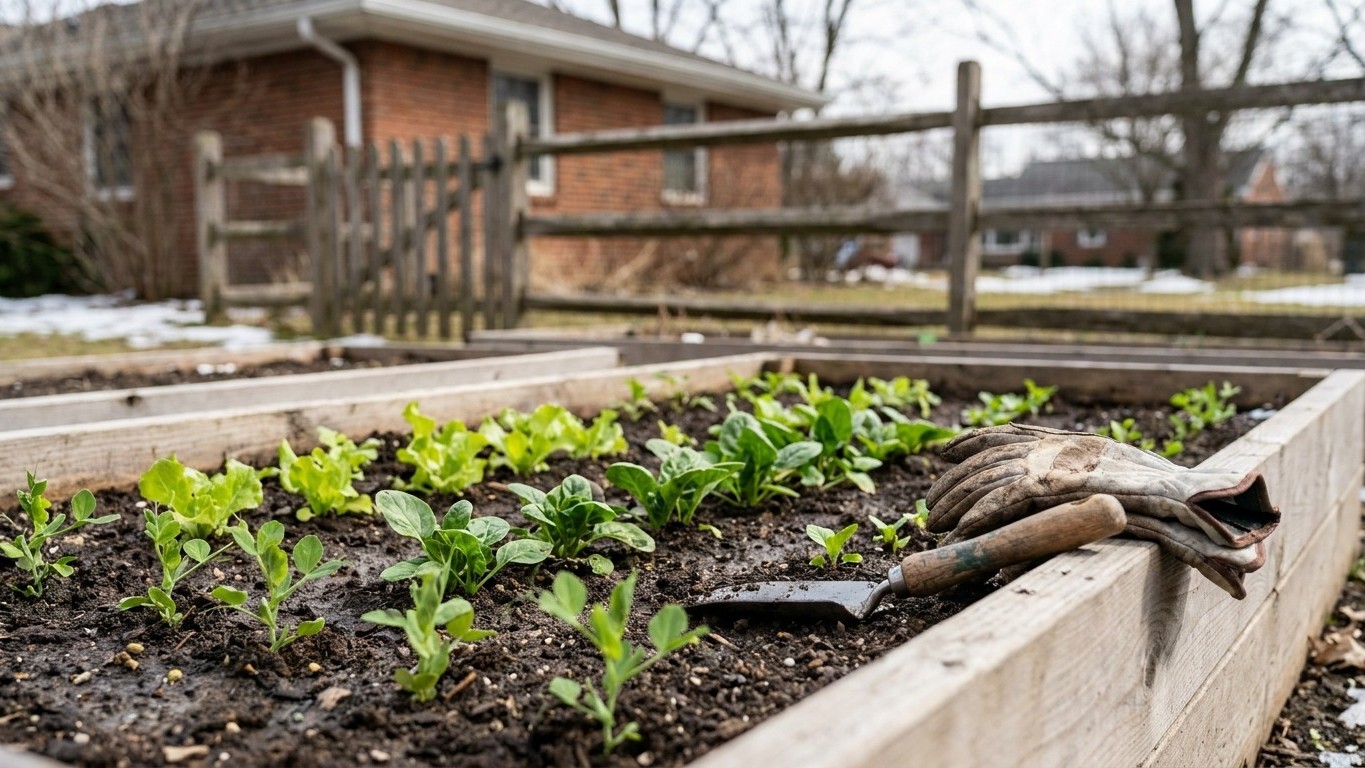

In Whitehorse and across the territory, March sits roughly ten to eleven weeks ahead of the average last spring frost, which lands around June 5. Nothing goes into open ground this month. The soil is still frozen solid under snow cover in most districts. What March actually offers is indoor seed starting for the earliest transplants, dormant-season pruning, garlic checks under mulch where it was planted the previous fall, and the planning work that decides how the whole season runs once the ground finally opens.
What goes in the ground in March
The honest answer for Yukon: nothing goes into open, unprotected soil this month. Ground temperature, not the calendar, decides planting dates, and in a territory rated Canadian hardiness zone 1b, March soil is still frozen or waterlogged with meltwater in most valleys. Whitehorse’s own frost record backs this up bluntly. The average last spring frost falls around June 5, and that’s a mean date, not a guarantee. In roughly half of all years frost arrives even later than that. Treat June 5 as the midpoint of a window, not a green light, and March is nowhere near it.
That said, a few narrow exceptions exist for gardeners with protected structures. If garlic or shallots went into a bed the previous fall, they’re already in the ground and need nothing more than a check that mulch hasn’t blown off or washed thin. A cold frame or low tunnel with a south-facing exposure can sometimes hold enough residual soil warmth to let a gardener direct-sow the toughest hardy greens, spinach and mâche among them, toward the very end of the month, but this is a gamble tied to how much sun a particular site gets, not a rule that applies territory-wide.
Bare-root and dormant work
Bare-root fruit trees, currants and raspberry canes can sometimes be heeled into a trench of loose soil or sand in an unheated garage or root cellar if they arrive by mail before the ground is workable outside. This isn’t planting in the finished sense. It’s holding dormant stock alive until real planting season arrives, usually well into late spring here. Forcing rhubarb crowns or chicory roots indoors in a dark, cool space is another legitimate March project, and it delivers a fresh vegetable harvest while the outdoor garden is still locked under snow.
What to start under cover
Seed starting indoors is where March earns its keep in Yukon. The math works backward from that June 5 average last frost, not forward from the date on the wall. Onions and leeks, which need ten to twelve weeks indoors before transplant, should already be started or go in now to be ready by early June. Peppers, which are notoriously slow, also want roughly eight to ten weeks under lights, putting a March start squarely in the right window given how late the ground opens here.
Tomatoes are the classic trap. Started too early, in say January, they turn into leggy, rootbound plants stretching for a window that can’t give them enough light, and they sulk for weeks after transplant instead of taking off. Started in March, six to eight weeks ahead of a projected outdoor move in early-to-mid June, they arrive at transplant time compact and vigorous. Brassicas for transplanting, cabbage, broccoli, kale started indoors rather than direct-sown, fit a similar six-week countdown from March into a late-spring move outside, though hardened-off transplants can go into cold frames earlier than bare soil allows.
The two failure modes worth naming plainly: starting too early leaves a gardener babysitting overgrown seedlings for weeks with no outdoor destination ready, while starting too late in a season this short means slow growers like peppers or celery never catch up before the first fall frost, which averages around August 25. That’s a frost-to-frost growing window of roughly eleven weeks outdoors once transplants finally go out, so every week gained indoors under lights in March matters more here than almost anywhere else covered on this site.
What is ready to pick
Outdoors, the honest answer is nothing. No crop is being harvested from open ground in Yukon in March, and any suggestion otherwise would be fiction. What still feeds a household this month comes from storage and from indoor growing, not from the garden bed.
Root cellars and cold storage rooms are the main larder right now. Potatoes, carrots, beets, and stored onions need a hands-on check: potatoes that have sprouted eyes or gone soft at one end, onions with a wet neck or a sour smell, and winter squash with a soft spot forming near the stem end should all be pulled and used or composted before they take neighboring produce down with them. A single rotting potato in a bin can spread moisture and mold to a dozen others within a couple of weeks.
Indoors, sprouts and microgreens are the fastest fresh food a Yukon gardener can produce this month, ready in as little as five to ten days from seed on a windowsill or under a small grow light. A rhubarb crown forced in a dark basement corner can also yield tender stalks within three to four weeks, giving something genuinely fresh from the garden’s own stock while the outdoor beds remain buried.
The jobs that matter this month
This is where March in Yukon does real work, even with the ground frozen shut. Dormant pruning of fruit trees, currants, and raspberry canes is best done now, while plants are still fully dormant and the structure of bare branches is easy to read. Cutting later, once sap is rising, stresses the plant and invites disease into fresh wounds at exactly the wrong moment.
Seed ordering has a real deadline too, even if it isn’t written on any label. Popular short-season varieties bred for a short frost-free window, which in Whitehorse averages only about eleven weeks between the last spring frost near June 5 and the first fall frost near August 25, sell out from northern seed suppliers well before spring. Ordering in March instead of April means actually getting the fast-maturing tomato or pepper variety a short season demands, rather than settling for whatever’s left.
Soil, tools, and planning
Where the ground is workable, or where garden soil was bagged and brought indoors for testing, March is the month to send a sample off or run an at-home pH test so amendments can be ordered and ready the moment the thaw allows digging. Turning an outdoor compost pile is often still impossible under snow, but an indoor worm bin or a covered bin can be turned and checked for balance now. Tools benefit too: cleaning rust off blades, sharpening pruners and hoes, and repairing a raised bed frame or a section of fencing are all jobs that take an afternoon now and save a delay once the ground opens and every week of the short growing season counts.
Crop rotation planning, sketched out on paper this month, prevents the same soil-borne problems from recurring bed to bed once planting finally starts.
What not to do in March
The classic Yukon mistake is reading a mild, sunny afternoon as a sign that spring has arrived and pushing seedlings or bare soil work outside too soon. A week of pleasant daytime temperatures in March means very little when the average last frost doesn’t arrive until around June 5, and night temperatures can still swing hard below freezing even after a warm-feeling day.
Another common error is starting warm-season seeds, tomatoes, peppers, cucumbers, far too early because a gardener is eager to see green after a long winter. Started in January or early February instead of March, these plants become leggy and rootbound long before there’s anywhere outdoors to put them, and a stressed, overgrown seedling rarely outproduces one started on schedule and transplanted compact and healthy.
Feeding heavy nitrogen to anything at this point, whether it’s a houseplant coming out of winter dormancy or a forced rhubarb crown, tends to push soft, weak growth rather than the sturdy structure a plant needs before it faces real outdoor conditions months from now. Hold off on heavy feeding until there’s actual daylight and root activity to support it. And if fall-planted garlic mulch was pulled back too early after a mild spell, it should go right back on. A late cold snap on exposed soil can still damage shoots that started pushing up during a warm stretch.
Checking this against your own county
Everything above is a territory-wide starting point built from the Whitehorse A weather station, not a fixed instruction for every Yukon garden. Elevation, exposure, and simple distance from Whitehorse can shift these frost windows by two weeks or more in either direction. A sheltered valley garden near the Yukon River may see workable soil sooner than a higher, more exposed homestead just a short drive away.
For local advice, planting calendars, and current conditions specific to a given district, consult Agriculture and Agri-Food Canada, the federal department covering agricultural guidance for the territory.
Common questions
Can anything be direct-sown outdoors in Yukon in March?
No. Soil is frozen or saturated with snowmelt across virtually all of the territory in March, and the average last spring frost doesn’t arrive until around June 5. Direct-sown seed outdoors this month would sit in cold, dead soil rather than germinate.
Is it too early to start tomato and pepper seeds indoors in March?
It’s close to the right window, not too early. Peppers need roughly eight to ten weeks indoors before transplant and tomatoes six to eight weeks, and with transplanting typically happening once frost risk clears well after June 5, a March start lines up reasonably well without producing overgrown, rootbound seedlings.
What Canadian hardiness zone is Yukon rated?
The Whitehorse area is rated Canadian hardiness zone 1b under Natural Resources Canada’s system, which uses seven climate variables rather than the single winter-minimum-temperature measure the USDA system relies on. It does not convert directly to a USDA zone number.
How short is the Yukon growing season, and why does that matter in March?
Based on the average last spring frost near June 5 and the average first fall frost near August 25, the frost-free window runs roughly eleven weeks. That’s tight enough that seed-starting decisions made in March, and how far ahead of frost-free dates a gardener counts backward, directly determine whether slower crops have any chance of maturing before fall frost returns.