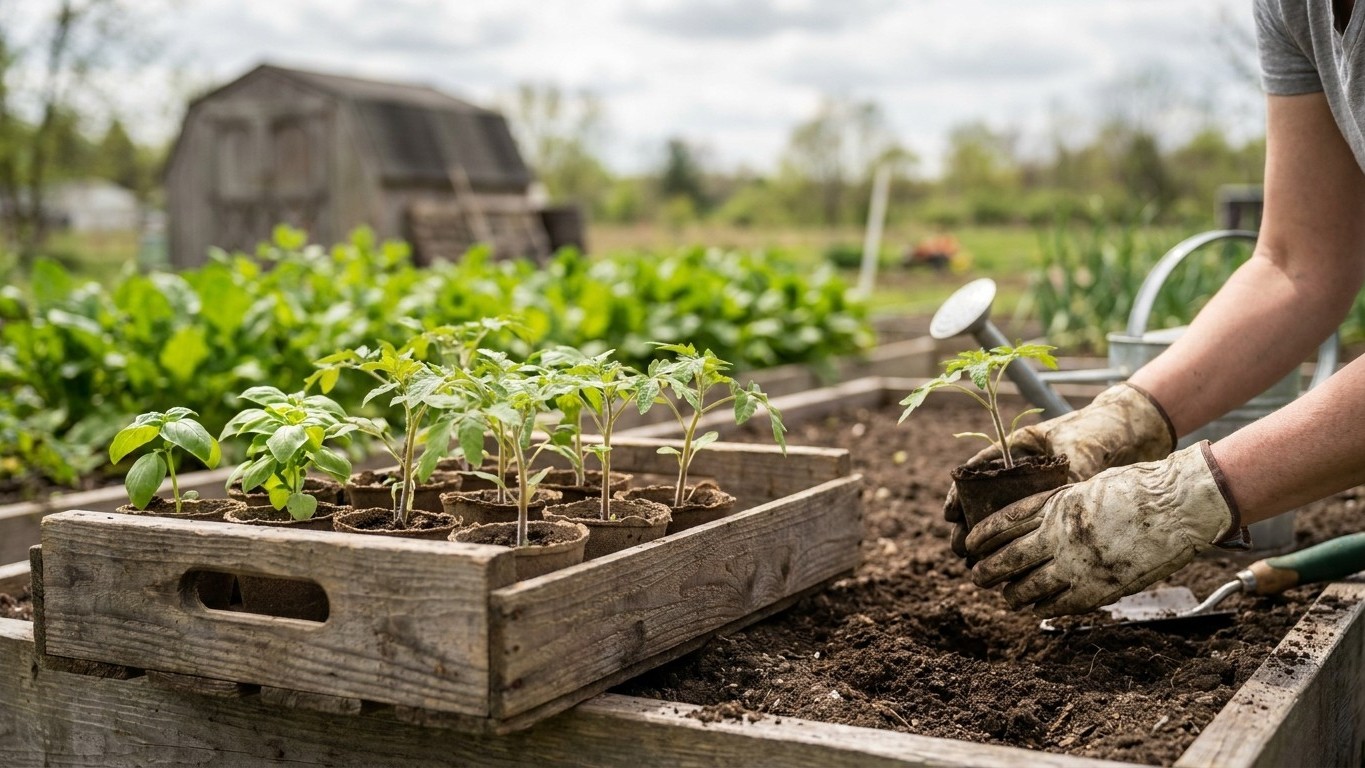

May in Yukon means cold soil and lingering frost risk, so the safe list stays short: peas, spinach, hardy greens, and onion sets, once the ground actually thaws and dries enough to work. Tender crops wait. Bare-root perennials and cold frames do the heavy lifting this month, with the real planting rush arriving once the frost risk genuinely eases in June.
What goes in the ground in May
The decision here isn’t the calendar, it’s soil temperature and how far the month sits from the frost window. Environment and Climate Change Canada’s climate normals put the average last spring frost at Whitehorse A at June 5, which means May sits entirely ahead of that mean date. That’s a mean, not a safe date: in roughly half of years, frost arrives even later than June 5, so treat every week of May as still inside the danger zone rather than counting down to a fixed deadline.
That rules out anything tender. No tomatoes, peppers, squash, or cucumbers go into open ground this month, no matter how mild a stretch feels. What does work is the short list of crops that shrug off a light frost: peas, spinach, radish, lettuce, and onion sets or shallots, once the soil has thawed and dried enough that it crumbles rather than smears when you squeeze it. Hardy brassica transplants like kale and chard can follow once they’ve been hardened off outdoors for a few days.
Cold frames and low tunnels earn their keep here, letting you push these hardy sowings a week or two earlier than open ground would allow, and giving new transplants some cover against the frost that’s still statistically likely. Bare-root fruit trees, berry canes, rhubarb crowns, and asparagus crowns also belong on May’s list, since they’re planted while still dormant, before the ground has fully woken up. Do the work in the order the ground allows it, not the order a seed packet suggests.
Whitehorse’s frost-free season, June 5 to the average first fall frost of August 25, runs about 81 days. That’s a tight window by any US gardener’s standard, and it’s the reason May’s job is preparation and hardy crops rather than a full planting spree.
What to start under cover
Count backward from that same June 5 mean, and remember it’s a midpoint, not a promise. Tomatoes and peppers, which typically need six to eight weeks indoors before transplanting, should already be growing by May if they’re going to make a short northern season; if you haven’t started them, lean toward the fastest-maturing varieties available rather than the ones bred for a longer summer further south.
Faster warm-season crops give more flexibility. Cucumbers, summer squash, and warm annual flowers usually need only three to four weeks under cover before transplant, which makes May the right month to sow them indoors for setting out in early-to-mid June, still under a cloche or row cover at first since frost can outlast the mean date. A second round of brassica starts, broccoli and cabbage for a later transplant, also belongs on May’s indoor tray.
Two mistakes undo all of this. Start too early and tomatoes and peppers sit rootbound and leggy for weeks waiting for soil that’s still too cold to receive them. Start too late, especially with anything slow-maturing, and the plant runs out of season before the average first fall frost of August 25 shuts things down. With only about 81 days between the mean frost dates, that margin for error is thinner here than in almost any other region, so the arithmetic matters more than the habit of just sowing everything at once.
What is ready to pick
Not much comes out of an outdoor Yukon bed in May, and there’s no point pretending otherwise. The soil is barely workable, frost is still statistically likely, and anything planted this month is weeks from producing.
What does feed the table is what survived the ground over winter or waited indoors. Rhubarb, a hardy perennial even in a zone this cold, sends up its first stalks now; harvest lightly once stalks are a reasonable length, but leave a new planting untouched its first year so it can establish. Chives and other early perennial herbs push up alongside it. Indoors, sprouts and microgreens fill the gap for anyone wanting fresh greens before the garden can provide them.
The other job this month is going through what’s left in storage. Potatoes, carrots, onions, and winter squash held over from the previous harvest start showing their age as the season turns: check potatoes for sprouting eyes and rub them off if you’re not planting them, look winter squash over for soft spots or dark patches on the rind, and pull any onions that have gone soft to use first before they spoil the rest of the batch.
The jobs that matter this month
May’s real value in a Yukon garden is preparation, and there’s plenty of it. As the last snow clears and the ground firms up enough to walk on without sinking, soil prep becomes the first priority: clear winter debris, work in compost where the bed is workable, and test soil once it’s dry enough to sample properly rather than guessing at what winter did to it.
Cold frames and low tunnels need setting up now if they’re going to earn their keep on this month’s hardy sowings. Tools deserve attention too, sharpened and cleaned before the season’s rush arrives, and raised bed frames or fencing should get a walk-around check for frost heave damage that shows up every spring in a climate this cold.
Seed ordering has a real deadline here that it doesn’t have further south. Zone 1b narrows the list of varieties that can realistically finish in an 81-day frost-free window, and the fast-maturing options that work in Yukon tend to sell out of local and mail-order suppliers early. If you haven’t ordered, May is late already.
Succession sowing planning matters more than usual too, since the window between the mean last and first frost leaves little room for a slow second round of anything. Map out what follows the peas and spinach once they’re harvested, rather than leaving that decision for June. And any transplants started indoors need regular hardening off on the milder days this month provides, a few hours outside at a time, building toward full days before they ever go into open ground.
What not to do in May
The classic mistake is trusting the air rather than the soil. A warm afternoon doesn’t mean the ground has caught up, and it doesn’t change the fact that the mean last frost sits at June 5 with roughly half of years running later still. Put tomatoes, peppers, squash, or cucumbers outside because a warm stretch felt like summer, and a single cold night can wipe out the head start entirely.
Uncovering too early is the same mistake from a different angle. Strip mulch or row cover off perennial beds and cold frames after a mild week, and a late-May cold snap, which is common here, can hit new growth that had just started hardening, undoing weeks of protection in one night.
Feeding is the third trap. Nitrogen-heavy fertilizer applied to seedlings this early pushes soft, leggy growth that neither direct sun nor any lingering frost forgives once the plant goes outside. Hold off until seedlings are hardened and the frost risk has genuinely passed, then feed lightly.
Direct-sowing warm-season seed, beans, squash, or corn, straight into May’s cold soil wastes both the seed and the time. It doesn’t wait patiently for warmth; it simply rots before it germinates.
Checking this against your own county
A territory-wide frost date is a starting point, not an instruction. The figures here come from the Whitehorse A station, and Yukon’s geography, river valleys, elevation, and the real distance between Whitehorse, Dawson, and Watson Lake, can shift these windows by weeks in either direction. A community at higher elevation or further from a moderating river will run later than Whitehorse’s own average, not earlier.
For a planting calendar tuned to your own district, check with Agriculture and Agri-Food Canada before locking in a date based on a single station’s average.
Common questions
Can I plant tomatoes outside in Yukon in May?
No. The mean last frost at Whitehorse A is June 5, and that’s a midpoint, meaning frost lands later than that in roughly half of all years. Tomatoes stay under cover through May regardless of how the weather feels.
What vegetables can actually handle Yukon’s growing season?
Fast-maturing, cold-tolerant crops do best given the roughly 81-day gap between the mean last frost (June 5) and mean first fall frost (August 25): peas, spinach, radish, lettuce, hardy brassicas, and quick-maturing root vegetables.
When does frost typically end in Yukon?
Environment and Climate Change Canada’s climate normals for Whitehorse A put the average last spring frost at June 5, based on the 1981-2010 period. It’s a mean date, not a guaranteed safe one, so treat it as the center of a range rather than a fixed line.
Is Yukon’s plant hardiness zone the same as a USDA zone?
No. Whitehorse sits in Canadian hardiness zone 1b, a figure from Natural Resources Canada built on seven climate variables rather than the single variable USDA zones use. The two systems don’t convert directly, and NRCan’s own comparisons show a single Canadian zone can overlap several different USDA zones, so this number shouldn’t be read against US zone maps.